Escape Religious Cage • Jan 10, 2026

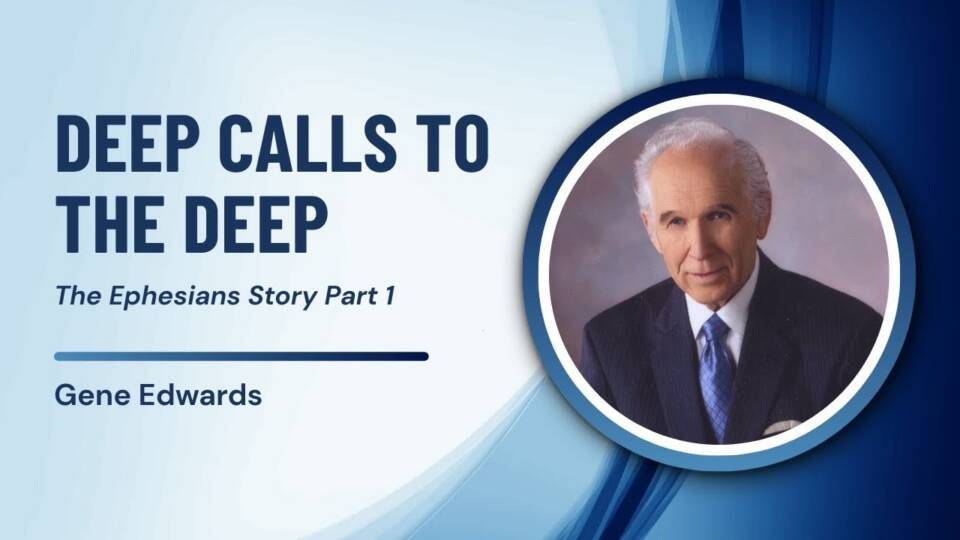
Deep Calls to Deep • Aug 15th 1993
What if our understanding of time limits our grasp of God’s eternal truth? Journey with us into the heart of first-century faith and discover a profound reality that reshapes everything. Gene Edwards invites us to revisit the foundational principles of the early church, exemplified by figures like Priscilla and Aquila and Paul’s unshakeable dedication, revealing a people willing to move and sacrifice for the Lord. This message culminates in a breathtaking exploration of God’s “eternal now”, where past, present, and future converge in Christ. We are called to see ourselves not as confined by earthly time, but eternally “in the deepest recesses of His Son”, a truth that promises liberation and a deeper union with Jesus. Prepare to have your perception of faith, church, and your place in God’s story expanded in ways you might never have imagined.
It’s the 15th day of August 1993, the year of our Lord, in a basement somewhere near Warrenton, VA. Nobody knows exactly where. There is a group of about 15 or 20 people here. Last night there were 45, and when the meeting was over, there were three. I never had such an exodus in my life. I was bruised in my pride forever and forever. (laughter) I’m going to try not to look up and find out who said that.
This story probably begins in Rome, and I believe it was Claudius who told all the Jews to leave Rome, and Priscilla and Aquila were Jews, and they were probably Christians there in Rome, but the church ended, and they moved to Corinth, and on Paul’s second journey, church planting trip, he stops in Corinth, the fourth of the four churches he plants, and he meets them, and there grows up between them a relationship that is really precious. If we did not have Priscillas and Aquilas, we wouldn’t have a church. These are two really magnificent people. You don’t know anything about them. I don’t know anything about them. They gave their lives to a brother who’d given his life to the Lord, and they worked with him.
And he asks them to go to Ephesus while he goes home to Antioch. And they move to Ephesus and open up a tent-repairing shop and infiltrate the synagogue. Now, that’s exactly what they did. They got in there and met all the Jews, who were really good Jews in the synagogue, and got to know all the people who were probably seekers. Probably these people were sheep stealers, in other words. Invited folks to their home and handed out a book entitled “How to Meet Under the Headship of Jesus Christ.” They talked about their experiences in Corinth and all of those things.
Paul went home, rested a bit, and actually went down to Jerusalem and visited it. And the sentence is always overlooked. It’s a trip he made to Jerusalem that you can’t even notice; the word ‘Jerusalem’ isn’t there. The only way you can know it is Jerusalem is that it says he went and he went up and greeted the brothers and then came down to Antioch. And the only way you know is because up always meant Jerusalem. Go up and go to Jerusalem. Came back home to Antioch. Stayed there a while and then made two separate plans at the same time. He planned his third trip and his fourth trip simultaneously. He made that fourth trip, but not the way he planned it.
He probably wrote two letters to all the churches. One letter said, “Send me Titus and Timothy and send me Gaius and Aristarchus and Secundus.” Those were brothers from different churches, and have them go with me to Ephesus.
So, he made a lot of preparations on his third trip that he did not make on his first and second. They were very spontaneous. And here’s the other thing he did. He wrote those eight little gentile churches and asked them, “Is there anyone there who would volunteer to move to Rome?” And he got the jump on the Jews because the Jews couldn’t go back to Rome, but a Gentile could. And he asked them if they would consider going to Rome and beginning the church all over. It would have been a Paulinian church, uncircumcised Gentiles instead of Jews this time. He had a good reason for that. Let me just pause here and tell you something. By the time Paul died, he probably had around 15 or 20 churches planted, maybe 25 between himself and those young men. Maybe they had gotten it all the way up to 30, but they were in the major cities and on the major arteries of the Roman Empire. And here is something you’ll find in your Bible, but you find it in 1st and 2nd Peter. You just don’t know it.
Those 15, 20, 25 churches changed the course of history, because in 70 AD, when Titus, the son of the emperor, leveled Jerusalem and began slaughtering people out in the villages and towns around, those people fled out of Judea, and every time they hit a big city, they had to go join a gentile church started by Paul of Tarsus. And that actually saved the gospel. They had to go join those uncircumcised people. And that’s a commendation to both of them, that the Gentiles had something going, and the Jews were finally willing to sit down with someone that unclean.
If you’ll read 1st and 2nd Peter really carefully, especially 2nd Peter, you’ll understand that those were two letters written by Peter, dictated probably to Mark, sent out to all those Christians and all those churches. Read it from that viewpoint; it’ll be very interesting. Paul won. He was dead, but he won. Had his head cut off, but he won anyway. He didn’t know he was going to win. And getting the church in Rome built by Gentiles, getting there ahead of the Jews, was one of those turning points.
So, he asks some young men who are going to become young church planters, and he asks some brave, wonderful Christians in these Gentile churches to pick up and move to the very unhappy city of Rome…unless they were rich. Now, he gets with these young men, and he starts toward Ephesus, and Priscilla and Aquila are there waiting. Everything is exciting, and something very unusual occurs. Before they even get into the city, there are a bunch of John the Baptist disciples. Does anybody remember how many there were? I think it gives the number; 12 or 13 of them. He preached the gospel to them. They were all baptized with the Holy Spirit and spoke in tongues. These people are obviously not Baptists, even if they are followers of the Baptist. Baptists don’t do these things. Anyway, they’re the first converts.
Now, two of those might have begun to be Tychicus and Trophimus. I don’t think so because it’s Greek names, but it could have been. Anyway, soon after their arrival, perhaps led to Christ by Priscilla and Aquila, are Tychicus and Trophimus. All this has to do with the book of Ephesians, by the way. He stays two years and raises up the church there, and then he begins to go around. I think he makes a trip to Corinth, goes back to Ephesus, and goes back into the environ there and takes these young men out into the towns and villages, and they probably plant the church of Philadelphia and two or three other nearby churches mentioned in Revelation that are very near the city of Ephesus.
And sometimes while he is there, the new emperor, I don’t know which one it is. The new emperor lets the Jews come back in, and this is just about the time all those Gentiles are headed for Rome. And Paul says to Priscilla and Aquila, “Drop everything. You’re going to move again. Take off for Rome. Get you a big house and let the church meet in Rome in your home.”
Escape Religious Cage • Jan 10, 2026
Break the Dead Chains • Jan 10, 2026
Revelation over Religion • Jan 10, 2026