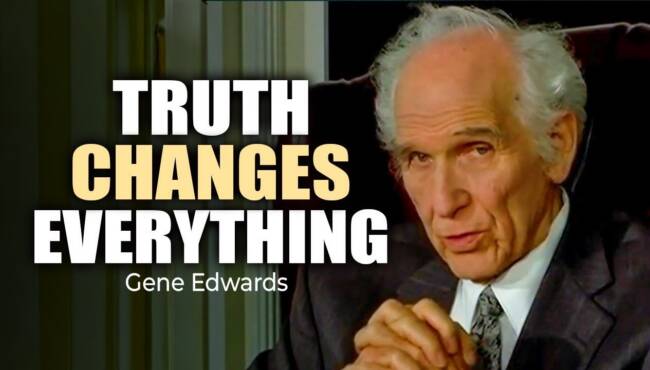
Truth Changes Everything • Jan 01, 2014


You Need to Start Over • Jun 01st 2012
What does a biblical home church really look like? In Part 4 of How to Have a Home Church, Gene Edwards challenges Christians to reconsider institutional Christianity and rediscover a Christ-centered expression of church life rooted in the New Testament.
Throughout this message, Gene repeatedly returns to a provocative conviction: “We’ve got to stop meeting this way.”
His concern is not simply where Christians meet. Moving a traditional Sunday service from a church building into a living room does not necessarily recover New Testament church life. Instead, Gene calls believers toward something deeper—a church centered on Jesus Christ, spiritual fellowship, participation by God’s people, genuine community, and a living experience of Christ.
Gene challenges the familiar distinction between clergy and congregation and argues that the songs, prayers, ministry, and spiritual life of the church belong to the people of God. He also urges Christians to read the New Testament as a continuing first-century story rather than merely as isolated chapters, verses, doctrines, and sermon outlines.
A major theme of this message is knowing and fellowshipping with Jesus Christ. Gene argues that Christian spirituality involves far more than simply praying to Christ: the indwelling Lord is to be known, experienced, touched, and fellowshipped with.
The message also becomes intensely practical as Gene discusses:
• Healing and caring for one another within the church
• Praying specifically for those who are sick
• Evangelism and personally leading people to Christ
• Welcoming visitors and new believers
• Enthusiasm in Christian gatherings
• Respecting personal boundaries
• Helping people facing serious marriage difficulties
• Creating a church atmosphere where weaknesses can be faced honestly
• The danger of judgment and self-righteousness
Ultimately, this teaching presents a challenging vision of biblical church life—a community where Jesus Christ is central and God’s people are active participants rather than spectators.
If you are exploring home church, house church, organic church, New Testament church life, Christian fellowship, discipleship, or a deeper relationship with Jesus Christ, this message offers important questions worth considering.
Right now, who am I speaking to? I’m speaking to people who write letters and say, “Help us have a church, have a house church. Would you come and speak to our house church?” And others who might write and say, “There are four of us in a town of 500. Would you come and raise up a church here? Because we really miss all the glory you’re having somewhere else?” But, you know, there’s also this. I think I’m talking to some seminary students, too, or Bible students. So a little of it for you, particularly, and all the rest of you listening.
We’ve got to stop meeting this way. We’ve got to stop experiencing Christianity the way it is. We’ve got to stop being evangelical Christians the way we practice. To all of you: seminaries should never have existed, and a Bible school is nothing but an echo of a seminary. I know that you heard some great singing and some great preaching, but I’m still telling you there’s not one of them in the New Testament. As long as we have them, and that’s all we get, we’re going to keep going around like that squirrel in a cage. Maybe someday someone will build me this cage, and we’ll put an artificial…I don’t know. I want somebody to see the same classes I took 50 years ago; the same subjects are still being taught in my seminary right now, and they were 100 years ago, and 200 years ago, and 300 years ago. Most of it is very similar to what the Roman Catholic Church teaches. You can’t really tell much difference in the curriculum of my seminary and that of a Jesuit seminary of 500 years ago. So you’re not going to get liberated. You’re not going to see creativity burst out of you.
I recently spoke to the second-oldest Bible school in the world, Moody being first, and I’ve spoken there too. I met with Christian young people. Then, later, I was asked to speak to Youth With a Mission, and I was struck by the fact that they were thinking, talking, and acting exactly like I was when I was young. Everyone seeking to know the Lord better is going to the mission field. A mission field should not exist…and neither should Paul’s “third missionary” journey exist either. That puts Paul out on the mission field, and then where do we get what’s not…what’s local? Well, we have First Baptist Church. That’s local, and the missionaries are over there.
There’s no difference between what happened in Jerusalem and what happened in Asia Minor. Some of it was mission, and some of it wasn’t. It was the preaching and spread of the gospel. The church of Jesus Christ is becoming more and more irrelevant, and it’s always been shallow. Incredibly shallow. Awesomely shallow. But right now it’s going through a period of time when it is extremely wealthy and unbelievably setting new standards of shallowness.
We’ve got to stop being this kind of church. So if you write to me, or to those who will come after me, and say, “Come help us,” you’ve got to understand that we are trying to stop meeting this way. All evangelical Christianity is going to stop doing what it’s doing. As I said, it’s becoming more irrelevant, especially for parachurch organizations, which didn’t exist in the New Testament. I think we’ve reached the point where every new Christian who is baptized should be given a legally incorporated parachurch organization (sarcasm) so that he can go out and do something nobody’s ever done before. It’s getting further and further away from what Jesus Christ Himself fashioned the church to be.
I have said that the church is shallow, so we’ve got to stop being shallow this way. You will not have an effective faith church of any kind, especially in the home, if there is not a depth of Jesus Christ. I want to tell you something else, and that is I don’t care who you are listening to; from the man I sat under, who was brilliant and reputed to be one of the best Greek scholars who ever lived, I would like to address my doctor. He’s passed away. God bless him. I loved him very much, and we were friends long after the seminary. Doctor, you read Greek. You are a master of exegesis, and you do not know the New Testament.
“That’s outrageous, Gene.” No. If you’ll bear with me just a minute. Every professor I had in the seminary when we sat in those classes and sat under them—and to those of you who might be listening, listen very carefully: You’re being taught verses and chapters. You have never once been taught the continuing beginning and continuing end story. And the story trumps the verses and the chapters. None of us have ever been taught, not once; no one on this earth living in 1,800 years is familiar with the story. Now, when you get a hold of the story, then you will have to say, if you’re honest, that story of the first century does not match what we’re doing today. We have created a Christianity with verses and chapters, and we’ve got to stop reading the Bible that way. We’ve got to stop studying the New Testament that way.
I think more than anything else that we’ve got to stop being non-courageous this way. I’m not going to say anybody is fearful, and yet I have watched, in my own experience, when I stepped out of the institutional church, there were flashes of moments when I realized I really was all alone. Alone. Alone. Totally misunderstood. I have made it a point that if I meet a minister, He and I begin to somehow connect in any way, on any degree, on any level, I will say to him, “I’m a Christian outside the institutional church. I’m a dissenter.” You know, it’s amazing how few friends I have who are in the ministry. Just almost none at all, and the few I have look at me more like a monkey on a string than anything else.
If you’re going to break with the way we meet, the way we sing, the way we think, the way we pray, the way we fellowship with Christ, the way we preach, and the way we should stop preaching and even shut our mouths for the sake of God’s people, it’s going to take a very unusual, utterly unique man. We’ve got to stop meeting the way we do. We’ve got to stop the Sunday morning service, per se. The songs we sing belong to the church, not to a choir director. The prayers we pray belong to the church, not to a minister. The church belongs to God’s people, and God’s people, along with Jesus Christ, are the owners of the church. We are visitors.
I would say above and beyond all else, despite the way we know we only know the New Testament by verses and chapters and outlines and marvelous sermons that we hear preached, the spiritual is the most difficult of all. And sir, the only way you’re going to know anything about that is for someone else to give it to you. I walk through the Christian faith. I keep hearing people say, “Pray for me. When you pray, take this and pray over it.” I keep thinking, when was prayer the only way we had a relationship with Jesus Christ? No one has ever spoken to me about walking with the Lord, having fellowship with the Lord. It’s always “pray.” We’ve got a book on spirituality; it’s about prayer. We’ve got a book on how to know the Lord better; it’s about prayer. Any subject that has anything to do with spiritual things is about prayer.
A living creature dwells in us who is in you and dwells in me, and He is far above and beyond just being prayed to. He is to be known, touched, and fellowshipped, and it will be so difficult to turn from where we are to that place. And I will say it again: Somebody’s going to have to show you, because it does not exist in the evangelical faith. On the day I was being ordained by Southern Baptists, they asked me over and over questions to make sure they put their hands on the right man. Someone said to me, “What do you think about missions?” And I shot back, “It’s the lost doctrine of the church.”
Truth Changes Everything • Jan 01, 2014

Free to Fellowship with Christ • Dec 07, 2013

Sow to the Spirit • Nov 23, 2013