Stop Playing Church • Feb 18, 2026

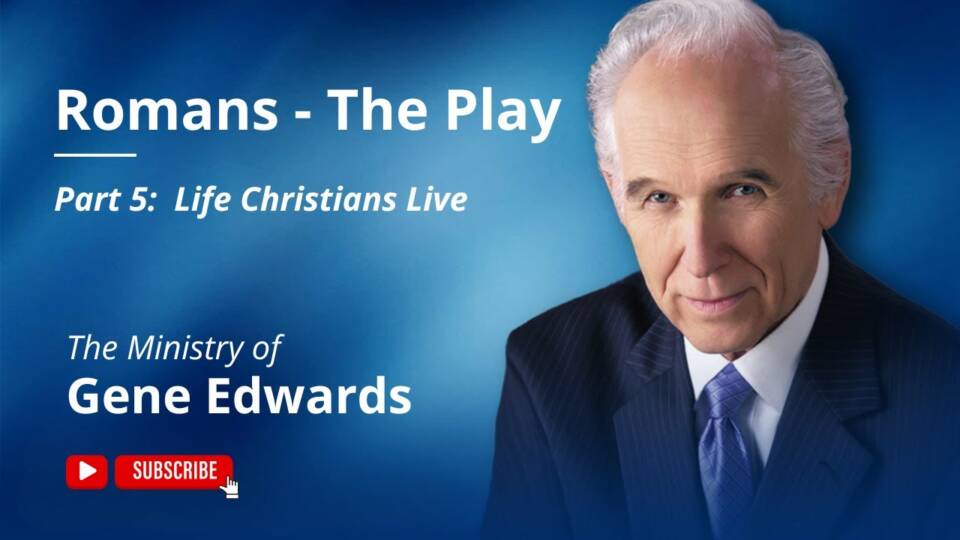
Life Christians Live • Nov 25th 1987
Discover how the Holy Spirit sets you free from the law of sin and death—not through your effort, but through His indwelling power. A bold message of inner transformation.
I’m going to tell you everything I know about Romans. This will probably take about four meetings. We’re going to go through Romans 8:1–17. Let’s take the first two or three verses really quickly, and then I will tell you what happens after the first two or three verses.
There is therefore now no condemnation to those who are in Christ because they have been made free from the law of sin, from the law of death. They have been made free from the law of Moses. And if you please, they have been made free from the good works of the heathen. Say something. Say Praise the Lord. All right, good. Thank you.
For the law of the Spirit of life has set you free in Christ Jesus from the law of sin and death. So, a greater law has come and set in and set you free from all of these things. Now, one of the most wonderful things in the world is that when the Lord begins to discuss with you the law of the Spirit… Do you have the feeling that—maybe you don’t—but as I look intently at this passage and watch it unfold, and I see these chains being taken off, I get the feeling He’s going to put them back on.
There’s the law of Moses—He got rid of that. There’s the law of sin—He got rid of that. There’s the law of death—and He got rid of that. He got that, and I see the law of the Spirit of life, and I think He’s going to demand something of me. Somewhere along here, He’s going to ask something of me. Something will be required of me. But when He comes to deal with the law of the Spirit of life, I can’t find any requirements. I will say, if there is any requirement here at all, it is a requirement that is no greater than the requirement that is made on society itself; I mean, the world’s society.
All right, here we go. We’ll come back later and learn about what the Spirit of life is. But what the law could not do… Now, what is it that the law could not do? Do you have any idea what the law could not do? Couldn’t bring us to God. Can you say it another way? Could not give life. All right, what else? It couldn’t what? It couldn’t sacrifice. Alright. Huh? It couldn’t justify us. It could not sanctify us and could not make us righteous, or… it could not save us.
Now, was the law at fault because it could not save us? Yes or no? No. What was at fault? Your flesh was the problem. The law could not save you because of your own inability to live by the law. The law was out there, prepared to save us all. Good. Very, very good. Ready to save every one of us. But there was not a one of us—because of our flesh. No, not our soul, not our spirit, but because of our mortal flesh. The law could not save us. Too much weakness here for salvation.
So, what the law could not do—say it—God did. Now what did God did? All right, let’s see what He did. You have two things here. You have the incarnation, and you have the crucifixion. You have the incarnation, and you have the crucifixion. You have the incarnation, and you have redemption. Alright. God did it. And how did He do it? He did it by sending His Son in the likeness of that flesh, but that flesh was without sin.
Now then—and He was offered up for our sins. Now then, He condemns sin in the flesh. Now, I find this a fascinating little verse. Maybe you’ve never looked at it. Maybe it’s not. First of all, who’s the “He”? That’s my first question. And the second one—He condemned sin in the flesh. And whose flesh was it that He condemned it in?
Alright, now, this is how God did it. We know what the law couldn’t do because of our flesh. God did. How did God do it? God did it this way. God did it by sending His Son—incarnation—in the likeness of human flesh. And then He took this sinless creature, this only begotten Son, the Son of God, and He turned the flesh of Jesus Christ into sin. He became sin. I don’t think we often get the full impact of that. In that last moment of Christ’s death upon the cross, you couldn’t find sin on this planet. And you say it was in Christ. That’s correct—but it was more than that. Christ had become the very embodiment of all sin.
Now, that’s not captured by time-space. Space-time is not involved here. It’s not just the sins that were on the earth at that time. It was all sin of all space and of all time. In other words, all sin that had ever been or ever will be committed in any place. Now, see, I might commit a sin today. There might have been a sin committed here in that same spot a thousand years ago by some Indian. That’s space. That’s space. But time, also, his sin a thousand years ago, my sin today, and someone else’s sin three thousand years ago in a different place. All space, all place, all time, all sin—placed in Him to the point that He was sin. And when sin was in Him, then God came out condemning. And He condemned. He didn’t condemn His Son. And He didn’t condemn you. He damned sin. He condemned sin. He convicted it, sentenced it, and condemned it. He did not condemn His Son. He did not condemn you.
Now, if all your sin and all my sin and all of mankind’s sin is in Him, and all of that sin was condemned in a certain place at a certain time, there is therefore no condemnation to those who are in Christ—because your sin was put somewhere else, outside of you, and condemned. Praise the name of the Lord. That’s how God did it. What the law could not do, God did, by gathering up all sin of all space-time, putting it on Jesus Christ, and condemning that sin there. And that’s the only place that’s ever been condemned. Isn’t it wonderful?
Stop Playing Church • Feb 18, 2026
Escape Religious Cage • Jan 10, 2026

Break the Dead Chains • Jan 10, 2026