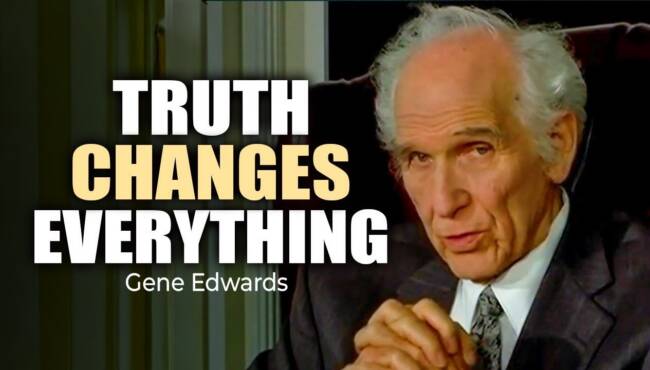
Truth Changes Everything • Jan 01, 2014


Life Christians Live • Nov 25th 1987
Romans 8 stands as one of the most powerful chapters in the New Testament, revealing the believer’s freedom from condemnation and the transforming work of the Holy Spirit. In this message, Gene Edwards walks verse by verse through Romans 8:1–17, unpacking Paul’s declaration that there is now no condemnation for those who are in Christ Jesus.
This teaching explores how Christ fulfilled what the Law could never accomplish. Through His incarnation, crucifixion, and redemption, Jesus bore the full weight of humanity’s sin, and God condemned sin in Christ rather than condemning those who belong to Him. The result is a life of freedom, not performance-based religion.
Gene highlights the contrast between living according to the flesh and living according to the Spirit. Rather than presenting Christianity as a system of obligations and religious effort, Romans 8 reveals a deeper reality: believers have been placed into the realm of the Spirit because the Spirit of God dwells within them. This truth changes everything about identity, assurance, and daily living.
The message also introduces four major ministries of the Holy Spirit found in Romans 8:
Throughout the teaching, Gene emphasizes the believer’s union with Christ, the completed work of redemption, and the assurance that God’s Spirit is actively at work within every follower of Jesus. The Christian life is not rooted in striving to earn acceptance but in resting in what Christ has already accomplished.
If you have ever wrestled with guilt, performance-based Christianity, or questions about what it truly means to live in the Spirit, this study of Romans 8 offers a refreshing and liberating perspective grounded in Scripture.
Watch this message to gain a deeper understanding of your identity in Christ, the ministry of the Holy Spirit, and the incredible freedom found in the gospel.
Hey, listen, come on. Look alive here. I want you to do your hand like this, will you? Everybody kind of lift it like this. Everybody, all over here. Would you? Come do it. Praise the Lord. Praise the Lord. Okay, you people over here, come on. Praise the Lord. Well, come on. Praise the Lord. Now, let’s all of us do it. Praise the Lord! Amen. The Lord is worthy of that, is He not? Amen, brother. That’s how God did it.
Now then, this next verse again fascinates me. “In order that the requirement of the law might be fulfilled in us,” and I can’t believe that brothers, having read all this far, would say, “Now, that means so that the requirements of the law might be fulfilled in you. That means that now that you are in the Spirit, under the law, the Spirit of life in Christ, you will, and you must, and you now do obey the law.” No, brother, I do not believe that’s what this is saying. No, sister—in order that the requirements of the law might be fulfilled in us—they are fulfilled in you because there is no sin there, and the flesh has been condemned, and the sin has been condemned, and death has been condemned.
Alright, if anybody comes to tell me to live a good life and to do this and to do that, they might as well go out to the graveyard and preach. They will not get a receptive ear from me. I, Gene Edwards, am clear on several things. And one of them is that I am not a Jew, that I cannot fulfill the law. If Paul couldn’t, I can’t. And I have another point to tell you. I’m not a very good Christian either. If I don’t do very good with the law, I don’t do very good with the Christian life. And don’t come, don’t come, putting long dresses on me, a somber look. Don’t come telling me that I have to pray and read my Bible and all these things. I’m fascinated by the fact that some Christians simply cannot bear hearing those kinds of words said. They just get upset. “Gene, you’ll give people too much liberty.” “Gene, come on, you’ll just end up with a…”
Listen, I’ve got to start somewhere. And I’m starting with freedom and working from there. And if I stand here to a group of new Christians and a new church and tell you, “You need to pray and read the Bible,” you’ll have, and all these other things, you’ll always have it in your mind that you’re under obligation. You’re not under obligation to anything. You are not under obligation to anything. There is a working of Christ in you that will work Himself and itself out, but you are not under obligation to perform; you are not in a situation where performance is an issue.
I want to hear you say it. Performance is no longer an issue. Say it. Performance is no longer an issue. All right. Say it. Performance is no longer an issue. Say it. Performance is no longer an issue. The law has been fulfilled in you. You walk along and say, “I am the fulfillment of the law. All my sin, all my sin, and the weakness of my flesh, which could not perform, was condemned in Christ Jesus. And therefore—and I have died with Him—and the law cannot find me.” It found Him and found itself fulfilled in Him, and I am in Him. Therefore, the law is fulfilled in Him, and because I am in Him, the law is fulfilled in me. Praise the Lord.
And as Paul said in Galatians, don’t let anybody ever tell you any differently—under any conditions.
Now, saints, that brings us to a new place in the book of Romans. We can go at this two ways, but I’m going to keep on going verse by verse. As I said, later, I’m not exactly sure when, we’ll come back, and we will take the whole chapter, and we will look at it from a totally different angle. But right now, we’re going to take it verse by verse from this point on through verse—let’s see—through verse… from verse 5 through 25. Yes, that’s it. Make it 26; shoot, make it 27. Now that’s good enough. Yeah, verse 27.
We have here a discussion of the work of the Holy Spirit. And one of the reasons I want to do this tonight is because you hear so much about the Holy Spirit. And it’s kind of like the weather—everybody’s talking about it, nobody can do anything about it. You hear this about the Spirit, and that about the Spirit, and this about the Spirit, and that about the Spirit. The Spirit is virtually – it’s mentioned, I think, two or three times in Romans up until right now—almost as an aside. And now, suddenly, beginning in Romans 8, you find the word “Spirit” in here constantly. And it brings you to ask yourself: What is the situation in Romans concerning the Spirit?
I want you to know something else, and that is that this passage of Scripture is very introductory, so that I would assume that anything that’s important about the Holy Spirit—I mean, paramountly important about the Spirit—is mentioned right here, because this is like a letter to new Christians. And I am fascinated about what’s not here. I am fascinated that power is not here. And I am fascinated that tongues is not here. I am fascinated that miracles are not here. All of these things that we usually—and success, one of the latter-day attributes of the Holy Spirit—success is not here.
There are four things here about the Spirit:
We’re going to go over those again:
And those are the first four things we ever learn about the Holy Spirit. And that really makes me very comfortable. I really appreciate knowing that this is the work of the Holy Spirit. This is the ministry; I’m going to tell you about the ministry of the Holy Spirit.
Alright, let’s start with verse 4. For those who walk according to the flesh set their minds upon the flesh, but those who are according to—or walk according to—the Spirit, they set their minds on the things of the Spirit. For the mind set on the flesh is death, but the mind set on the Spirit is life and peace.
Alright, you have here two patterns and two kinds of conduct, and two engines of conduct. There is the conduct of the flesh. If the mind is set on the flesh, the mind will conduct itself according to the flesh. The mind—and I’ll just say for right now—the person who sets his mind upon the Spirit will follow in the conduct of the Spirit.
Truth Changes Everything • Jan 01, 2014

Free to Fellowship with Christ • Dec 07, 2013

Sow to the Spirit • Nov 23, 2013