Christ Made You Holy • Mar 05, 2026

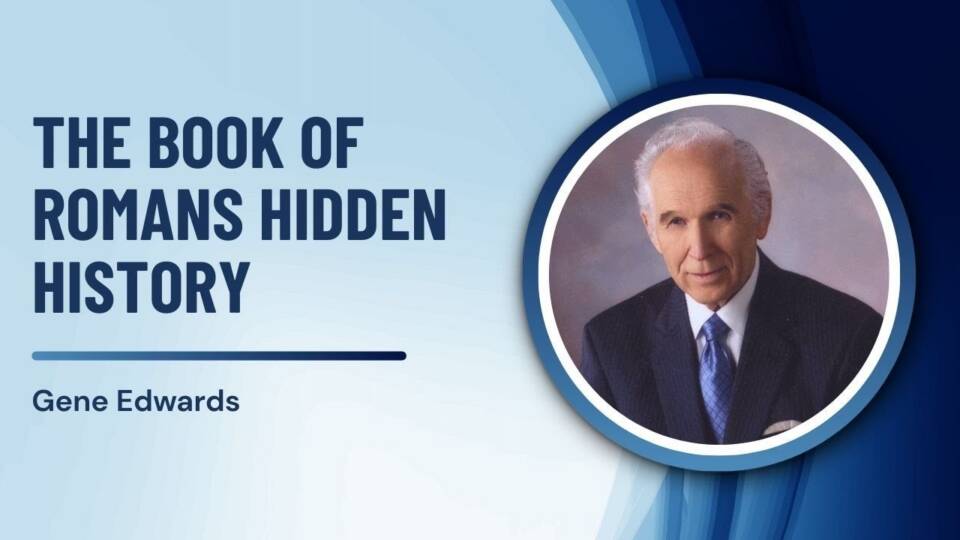
Ecclesia: More Important Than Evangelism • Mar 18th 2000
Have we lost the true essence of early Christian practice? In this compelling message, Gene Edwards invites us to journey back to 56 AD Rome to explore the lost practices and genuine heart of the early Christian faith. He challenges us to set aside modern assumptions and discover how believers truly functioned, not as a sit-and-listen proposition, but as a living, breathing body dependent on Christ’s headship alone. This isn’t about mere history; it’s a call to deeply appreciate the organic, often leaderless, and self-sustaining nature of the ecclesia—the gathering of God’s people. Prepare to have your perspective broadened and your heart stirred to what the church was truly meant to be.
The first thing you have is two church planters. They’re not pastors. They’re not prophets. We’re not looking at evangelists. We’re not looking at song leaders or ministers of education or worship leaders. We’re looking at men who plant churches. They have vanished from the face of the earth. We don’t even think in these terms anymore today. But they were center stage in the first century. You did not see a pastor center stage in the first century. In the twentieth and twenty-first centuries, you find the pastor center stage. In that day, it was the church planter. Two men went out to plant churches, and what they did was so exciting—and I lay it before you. They raised up four churches in two years. That means they spent approximately five months with each church. Now, you’re going to tell me the names of those four churches. Four churches—four months. We have a saying down in Texas: “One riot, one ranger.” Four churches—four months for each one of them.
Okay, what are the names of these churches? Don’t be timid. You’ll make a mistake, that’s all right. I’ll tell you you’re stupid and dumb. I’ll give you two ladies another chance. You don’t know? Okay. Antioch Pisidia. The Antioch of the Pisidians. We just left Antioch of the Syrians, and now we’re at Antioch of the Pisidians. What’s another one? These are all located in Galatia. Derbe – the last of the four. Lystra – the third of the four. So, you’ve got the second one. What’s the third one? We’ve got Iconium. Okay, so we have another Antioch, the Pisidian Antioch, Iconium, Lystra, and Derbe. And I think what’s exciting about Derbe is that it was not much more than a village, and I thank God for that. That means a lot to me. Alright, we’ve got two church planters. Now, if you are a people right here, and you’re all heathen, and you’ve been saved by the power of the gospel through the Holy Spirit—two men as the instruments, Barnabas and Paul—and they’ve preached to you for four months, can you understand that they’re the only two Christians you’ve ever seen? They can sit around and tell you all about the church in Jerusalem, the church in Antioch, and all the wonderful things—but all you’ve ever seen are these two men. And you love them. You never heard of Abraham, Isaac, or Jacob. You never heard of Moses. You don’t understand the law—trust me, you do not understand the law. At the end of four months, these two men—hundreds of miles away from the nearest church, with no sister church—get up and walk out and leave you.
The thing I want you to understand—and if somebody could just catch this, please Lord, let somebody catch this. Left you without a leader. And that isn’t all. Except for coming to visit you again for a couple of weeks—around two years from now—you won’t see them again for about four years. You are this group of people who’ve had four months, and the only two Christians in this world have run off and left you. You’ve got no leaders. Now that’s really what happened with the seventy in Galilee—their leader ran off and left them, and when Saul persecuted the church, and the church had to break up and people fled everywhere, they were cut off from their leaders, and they functioned without them. Now it’s happening in Galatia. There’s a trend here. The trend is not a trend—it’s the testimony of the church that Jesus Christ is the head of the church.
Now, if we have any task today in this century, it’s not to have a headless church with no leaders. You missed the point completely. We need to be raised up in such a way that we can function. Now, we need some young men to learn how to do that, brother. You understand? You don’t quit, Stanley. No, you don’t quit, and you don’t just preach folks to death; you show them how to function with you being absent. That’s your business—to raise the church up. And that takes preaching. Don’t misunderstand me—it takes beaucoup, beaucoup, beaucoup preaching and teaching. It takes a long time, and in our day, it’s going to take longer than it did then, but there must come a day when God’s people can have a meeting without me present, without anybody present that’s got any kind of position of leadership. That’s the goal we should establish.
Now, let me tell you why I’m riding this horse, because when we get to Rome, this gets really exciting. I’m telling you folks, this, to me, is so exciting. Also, notice there are no Bible schools. Alright, we’re back here to this little town. No Bible school, no seminary, no Christian college, not even Bibles. What Bible? First of all, you’re all illiterate—except this Jewish girl here, who knows how to read Hebrew. That’s going to help you a whole lot, isn’t it? And this Jewish merchant has one portion of a scroll his great-grandfather gave him, and he can quote the Psalms. He’s really religious—watch this guy. We have a Greek merchant here who can read Greek. And we have one Latin soldier among us who can read Latin. That’s really going to help the rest of you, isn’t it? Well, this brother right here, who can read Greek, says, “Well, you know, everybody ought to love one another. Bless our hearts, let’s love everybody.” And he says, “I can read Greek in the synagogue downtown—they’ve got the Old Testament Scriptures in Greek as well as Hebrew. I’ll just go down there and ask them if I can borrow their sacred Scripture.” And I’ll tell you for sure—that doesn’t work very well, does it? So that doesn’t work. You’ve got no Scripture, no Bible, no seminary, no Bible school, no Christian university, no apostles, no elders, no deacons, no gifted ones. And you’ve had four months of hearing the gospel.
And you’re so stupid that when those two church planters leave, you think it’s exciting! No Gentile workers. Are you clear with me? No Gentile workers, and you’re in a mess. Except for a two or three-week visit a little later on—praise the Lord, you’re on your own. You know what’s going to see you through? An indwelling Lord and the body. Boy, you’re going to close ranks. You’re going to help one another, love one another, and care for one another. Some of you are going to learn how to talk and share because you’re dependent on it. This brother, who’s memorized the whole book of Psalms—we’re going to lean on him. Every meeting we have, we’ll say, “Quote us one of those Psalms.” “Which one?” “It doesn’t matter which one—just quote it.” And we’re really going to lean on this brother. And this brother’s going to go over to the synagogue, and he’s going to listen to the Jews reading the Scripture. He’s going to come back and say, “Last Saturday I heard them read out of a book called Ezea…or Azur…or Ezra…or something like that, and it said in there such and such and such and such.” Of course, he misquotes it, but he gets the general idea. And you take that for a few weeks, and it becomes what you fellowship with the Lord.
And that’s not all. You know how to pray. You know how to get in with the Lord Jesus and have some fellowship with the Lord. And when you come together, you have something to share with one another. You build up one another in love. You build up one another. The building is now in your hands. The spiritual building is in your hands. And those two good-for-nothing apostles, they just walked off and left you. They don’t seem to care. They honestly believe that Jesus Christ can take care of you.
Alright, so we have a new way of churches being raised up. I guess I have to admit, this is where my favorite way of seeing the church raised up starts. You all get anything out of it? Alright, I’ll take that. How does it work? Two church planters who don’t have good sense walk into a town, stay for a while, and leave. Boy, that’s hard to do in America. You know why it’s hard to do in America? Ask me why it’s hard to do in America. Because of two or three reasons. One of them is, everybody immediately wants to know what their gift is. “What’s my gift? I’ve got such and such gift.” “You’d better listen to me because I’ve got a gift.” And the other one is, doggone it, you’re too democratic. “We don’t want any leaders. We’re not about to be special. We’re all equal. All the same. All of us are the same. Many leaders! Who’s Paul? Who’s Barnabas? Who’s this guy who raised us up anyway? What do we need him for? He can just stay away. We don’t need him. All we need is the Holy Ghost.” Anarchy. That may be great for the American government, but it doesn’t work that way, saints. We are not equal. Tell me that a thumb is equal to an eye. Fine, then let me yank out your eye, and you keep your thumb. How do you feel about that? I will give up a thumb to keep an eye on any day. Will you? Because my eye has a greater function than my thumb. It’s more important to my survival. It’s not a democracy, and it’s not even a theocracy. God appointed church planters to raise up people. If they’ve got any good sense, they’ll get out of there. Otherwise, they’ll become local pastors, which, as the old saying goes, that and a dime will get you a ten-cent candy bar. That’s just pastors. That’s modern-day stuff. He should eventually leave, and I mean really leave. Well, we don’t have any of these things today, and I’m not even suggesting that we try. I’m going to come a little bit later to tell you what we ought to do. These are not the places where we cure the problem.
I think I’d like to stop here and tell you something. This group of people defines all “Edwardian theory.” Do you know what I mean by that? “Edwardian” -Edward – Edward – you, and I know you’ve heard of this, but you remind me of the bumblebee. The bumblebee has been scientifically studied—and it cannot fly. Its fuselage is too long, and it’s too wide. It cannot, aerodynamically, get off the ground. It weighs too much. Its wings are too small, and its wing muscles are too weak. It cannot fly, but because nobody has ever been able to tell the bumblebee that, it flies anyway. That, to me, is this fellowship of believers right here. If you understood that you could not exist, but you do. This is one of those precious, rare things, and those of you who have heard me tell my story know that I’ve always included the story of a Japanese church in a town called Toyama, Japan. I’ve seen something that few men have ever seen. I’ve seen three or four organic expressions of the church survive. Survive.
Now, saints, there are thousands of groups of Christians that organically touch church life, but they die in weeks. Some die in days, some in weeks, some in months. Probably you’ve had that experience. I had it in college with a group of college students. We touched the life of the body of Christ. We had it for three, four, five months, and it died. The Baptists killed it. Dead. They didn’t know what the thing was, so they shot it.
I saw a Black community of believers in Watts, California, that, for a short time, was an expression of the body of Christ. Organic. But it lacked a vision of the body of Christ. It just had it but didn’t know what it had. They didn’t realize that that was more precious than anything else on earth they could do. So, they got off track.
In Sherbrooke, Quebec, Canada, I saw a French-Quebec expression of the church. It was there for only a few months. The leader decided to go to Africa as a missionary, and the thing died within days. There are more Christians in any one country in Africa than there are in all of Quebec, Canada, but he felt like he had to go preach the gospel to “other lands.” And it died; sank like a rock.
Christ Made You Holy • Mar 05, 2026
Stop Playing Church • Feb 18, 2026

Escape Religious Cage • Jan 10, 2026