Brotherhood Before Authority • Apr 18, 2026

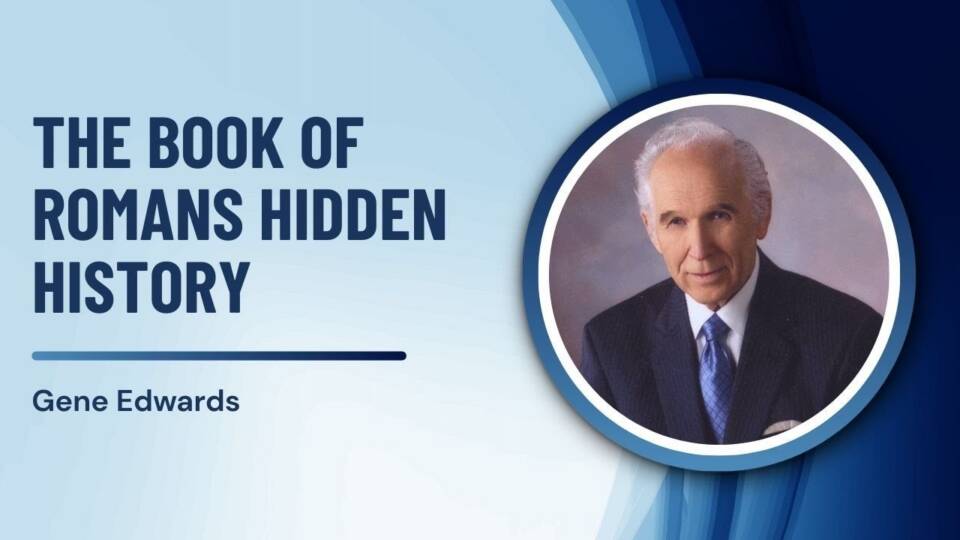
Ecclesia: More Important Than Evangelism • Mar 18th 2000
Have we lost the true essence of early Christian practice? In this compelling message, Gene Edwards invites us to journey back to 56 AD Rome to explore the lost practices and genuine heart of the early Christian faith. He challenges us to set aside modern assumptions and discover how believers truly functioned, not as a sit-and-listen proposition, but as a living, breathing body dependent on Christ’s headship alone. This isn’t about mere history; it’s a call to deeply appreciate the organic, often leaderless, and self-sustaining nature of the ecclesia—the gathering of God’s people. Prepare to have your perspective broadened and your heart stirred to what the church was truly meant to be.
So, Paul and Silas are on the second trip now. Now, why isn’t Barnabas there? I’m going to tell you why. Because two men of equal stature can’t work together very long, and that’s just the way it is—and that’s the way it’s going to be—and that’s the way it ought to be. The only time there was ever an exception to that was in Jerusalem, and that was because those men lived with the Lord Jesus. Barnabas and Paul had a falling out, and Barnabas went back to Cyprus to try to make those Jewish churches there into Gentile churches, or at least free churches. Paul went on with his commission to preach to places he had never been.
He raises up three churches on this trip, doesn’t he? What’s the first one? What’s the first church that is raised up after he visits you folks again? He’s now in Greek territory. He’s left the Gauls. By the way, I am a Gaul. Being French, I am Gaul. What? No. Second trip, not third. Second trip. Huh? No. First one? Oh, there are four churches. I’m sorry, I forgot one. Four churches. Is it Philippi? I thought it was Thessalonica. I think it’s Thessalonica, Berea, Philippi, and then Corinth. Are you with me? Because now the plot thickens. He raises up the church in Thessalonica, Berea with Silas, and then Philippi. He’s only there for less than a month. That’s really a short time, and that turns out to be one of the most precious churches of all the first-century era. Now, what year does he go out on his second trip? Let’s do that again. In 44, he leaves. Gone for two years. That’s 46. Comes home and gets back in 48. He stays a little time in Thessalonica, a little time in Berea, a little time in Philippi, and he hits Corinth in 50 AD.
Now I want you to watch the man who’s coming into Corinth. Our story really begins here. He’s Jewish. He is committed to the Gentile world and to a Gentile church that is not bound up in legalism. Isn’t that wonderful? He has raised up churches; he has raised up seven churches plus Antioch, and now he’s going into Corinth. He’s going to stay there for two years, but there is a city he wants so much to raise a church in; he can taste it, a very interesting city. He wants to get there before the Jews get there. He wants this thing to be a 100% Gentile church.
Now, Paul at this time is going to come up with two of the greatest strokes of genius that I know of that have ever taken place in the Christian faith, and he seems to come up with both of them at the same time. The question has always been: who raised up the church in Rome? And the answer has always been, well, there were some people who just went up there, got transferred there, moved there, preached the gospel to other people, and a little church was started. I don’t question that, but I can tell you this: whoever they were, they were Jews, because Paul has got seven Gentile churches in the whole world, two of them had just been born in the last few weeks, and the other four are you Galatians who are living in an obscure part of the world. You’re all poor. You’re illiterate. You’re not the kind of people who would travel five miles, much less go to Rome. The travelers of that day were the merchants. Who’s that? The Jews. We’re talking about Christians—the Jews. If there are any Christians in the capital of the world, if there are any at all, and I figure there are a handful, they’re Jews.
Paul does not like this. A church is being born in Rome, Italy, and it is going to be Jewish, and that means it is going to be culturally locked in. It is going to be ritualistic. It is going to be dead. It is going to be confined to about 50,000 people in a city of a million, because that’s how many Jews are there. And by the way, that’s a pretty accurate figure. They took a lot of censuses in those days, and some of them still exist. The figures still exist. Can you imagine how excited Paul got when he got to Corinth, and he’s going there to preach the gospel, and he meets a couple of Jews, and they are Christians. We don’t know where they came from, but they are Jews. They are two Jewish businessmen and businesswomen who happened to have gone to Rome and who have been there with the believers there. Paul says, “Well, hi, Priscilla. How are you doing? Aquila, how are y’all? How are things in Rome?” And they say, “Oh, haven’t you heard? Claudius has ruled that all Jews must leave Rome.” Paul says, Hot Diggity! “Are you following me? That makes Rome virgin territory for the gospel.”
And now, here is the stroke of genius. Now only you and I know this. Give me a minute before I tell you what the stroke of genius is. He has two strokes of genius. We’ve got the Lord in Galilee raising up men and workers. We’ve got a Jerusalem church raised up by twelve men over a long period of time: foundational work. We have the dispersion of the church, little Jerusalems going out and being transplanted. We have a church raised up by workers who are Jewish, and the people are Gentiles, but they are not apostles who raise up the church. We have two men going out in twos in the way the Lord had shown the apostles. Two men go out; they raise up four churches and leave them headless—human headless. Those churches develop an organic relationship with the Lord and one another. The men come back and ordain elders to take care of the piddly stuff that nobody really wants to mess with anyway. The churches go on functioning as they did when they had no leaders.
Now, that to me is the best way, but there are two more ways of raising up the church, about to be any minute now, and they are even better. The only thing is you can’t have those in the beginning. The two best ways have to come later; you can’t have them in the beginning or the middle. They have to be later. Trust me, it’s true. It’ll get clear in a minute. Paul comes into Corinth. I don’t know why he stays so long. He stays 18 months; that’s in the book of Acts. I don’t know why he stays so long, but the reason has got to be one of two reasons: either he thinks they are a wonderful bunch of people and he really wants to invest time in them, or they are the absolutely dumbest human beings that ever lived, and it takes him longer there than it does anywhere else. I tend to believe it’s the second one. He was there for 18 months.
Paul has another city on his heart, but he’s got something else on his heart besides cities. He’s got a dream. And I’ve got a dream. If you want to know what winds me up and makes me go, I will tell you now what winds me up and makes me go: I have a dream. I may not live long enough to experience it, but I’m going to get caught trying. When I saw this as a young man, it was a vision, and it will live with me till the day I die. It’s my hope. It’s my prayer. It’s the reason I get up in the morning. It’s the reason I go to bed at night. It’s the reason I live and breathe. I want to do what Paul of Tarsus did. I’m going to tell you what he did: he had another city on his heart, and that city was Ephesus. He wanted to preach the gospel there, and he wanted a church raised up there, but he wanted something else: he wanted workers who were Gentiles, not Jewish workers.
Do you notice that until now, all workers have been Jews? And that’s dangerous because they’ve all got a legalistic heritage. Now, you folks over here in Iconium don’t have a legalistic heritage. You’re a bunch of heathens. That’s what you are: converted heathen. The brothers and sisters in Antioch are Gentiles. Wonderful. They all have a rich heritage of the church without any great leaders over them. Here’s the church in Pisidia, Antioch…Antioch of Pisidia, if not Antioch, Syria. You have a wonderful, rich heritage of freedom and joy. You’ve gotten past the Jews and circumcision, and your experience is unique because you had a certain persecution. You almost didn’t make it, but you did, and you got a real-knit body. You’ve got a wonderful testimony. Here’s the church in Iconium. You’ve got a unique history. You’ve gotten past the Jewish thing and religion, and you are beginning to develop leaders. And you are Lystra, and you’ve got a brother who, from the day he got saved, was just a firebrand, preaching the gospel almost from day one. His name is Timothy. You’ve got a rich heritage that’s uniquely yours, and so does Derbe. That’s four churches, right?
Well, hold steady. Actually, it’s five, because Antioch. Alright, then there it is. Now the church in Thessalonica: new church, but it’s coming along really well, and the church in Berea is really unique and wonderful; brand new and wonderful.
(Continued in Part 2)
Brotherhood Before Authority • Apr 18, 2026
Return to the Beginning • Apr 13, 2026
Stop Playing Church • Feb 18, 2026