
Truth Changes Everything • Jan 01, 2014

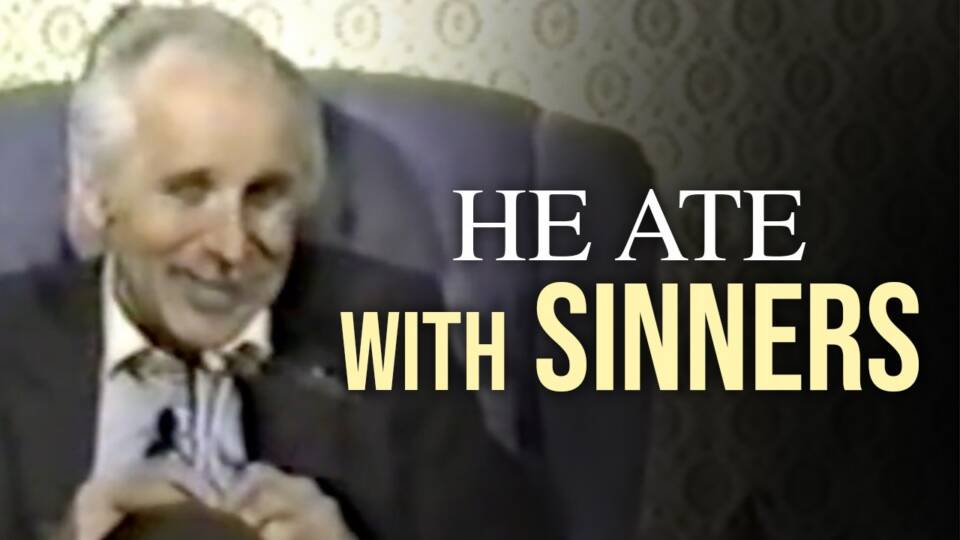
He Ate with Sinners • Jul 01st 1985
Why did Jesus feel so comfortable with sinners, tax collectors, and outcasts—and why were the religious leaders so uncomfortable with Him?
In this powerful teaching from Gene Edwards’s Life of Christ series, discover a striking picture of Jesus Christ among ordinary people. At Matthew’s banquet, Jesus is surrounded by tax collectors and people considered sinful and unclean by the religious establishment. Yet rather than withdrawing from them, Jesus is at home among them.
The Pharisees cannot understand it.
Their objection leads to one of Jesus’ memorable declarations: the healthy do not need a physician—the sick do. He then points them toward a deeper revelation of God’s heart: “I desire mercy, not sacrifice.”
Gene Edwards explores what this scene reveals about the character of Jesus, the Father who dwells within Him, and the Christian life itself. What if following Christ is not primarily about religious appearances, rituals, or continually trying to prove ourselves to God? What if God desires genuine fellowship with His people?
This message also explores Jesus’ teaching about fasting, the Bridegroom, new wine and old wineskins, and the danger of trying to force God’s new work into old religious forms.
You’ll discover themes including:
• Why Jesus ate with sinners and tax collectors
• Jesus’ confrontation with the Pharisees
• “I desire mercy, not sacrifice”
• Fellowship with Jesus Christ
• Prayer, fasting, and the Bridegroom
• New wine and old wineskins
• Religious tradition versus spiritual life
• God’s mercy toward imperfect people
• Experiencing Christ in ordinary life
Gene Edwards invites us to reconsider not only how we see Jesus, but also how we understand the Christian life. The Jesus revealed in these Gospel scenes is accessible, merciful, deeply relational, and remarkably at home among people who know they need Him.
Sidney Powell once wrote a very excellent book entitled Where Are the People? As I recall, he opened the book with an interesting illustration. A church building caught fire in a certain eastern city. Inside it was, unknown to most of the community, one of the best statues of Jesus Christ ever made. When the building caught fire, it was put out but badly damaged, and to repair it, they had to take the statue out and put it on the street. Hundreds of people came, stood, and stared at the statue, showing their appreciation for it and their interest in its masterful artwork.
Someone said, “I can’t believe all the interest in this statue, people coming from everywhere. It’s just mind-boggling. Why are you people suddenly so interested in this statue? Of Jesus Christ.” And the answer someone gave them in the crowd was, “Well, it’s because it’s out here on the street, and it’s not hiding in a church building. So I can leave peripatetic ministry, and now I can attack church buildings. I think they are one of the worst possible inventions for spreading the gospel. It is an unnatural place to go. Out along the seashore is a natural place to be, and someone’s home is a natural place to be. But to go into a religious building, run by a bunch of Pharisees, who all think they’re better than everybody else.
Well, these people ran around in synagogues, and today we run around in church buildings. We cut ourselves off from the masses. Consequently, we cut our Lord off from the masses. Some people will never be religious, yet they would still make great Christians if they could find Him on not…I would not say on their level, but on an organic level, a natural level.
This is what this scene is, and that’s why we have the publicans there, and all the ill-reputed there, and they’re having a grand time with Jesus Christ, and there’s a lesson in it. Turn that around, it seems that the Son of God is quite comfortable with them, and this is where He is chosen to be out in the open, very accessible, and with ordinary people, street people, in ordinary situations. I don’t think anybody dressed up to come to this meeting, folks. I have challenged on several occasions: why do we dress up to go to church on Sunday morning? I always get this glib answer: well, I feel like we ought to dress up and look nice for the Lord. We’re going to His house to worship Him, and we should look nice for Him.
These people didn’t dress up for Him; I’m certain. The ill-reputed, the unclean, the unwashed – these are the ones who are there, and the Lord feels perfectly at home with them. The only people He doesn’t feel at home with in this story are two people: the Pharisees and the Scribes. It seems to me that every indication points to, and it becomes obvious in the next passage, that these people are having a rousing good time. Frankly, I think they are overeating. I think there’s a good chance they are overdrinking, and I am certain they’re making too much noise. They are just not being religious. They’re not being reverent. They’re in the presence of a prophet and his disciples, and there’s none of this “sit down and listen to me while I dispense these great truths, and you sit there, you peasant, in the presence of this great religious human being”; it’s not there.
They’re having a great time, and the Pharisees can’t handle it. I wish I could tell you I’ve never met men who were unhappy when people were happy, but I’ve met a lot of Christian leaders who can’t stand this much happiness, saying the Christian life is too serious to be happy. Well, it’s God who’s in the middle of this meeting, and God is having a great time. This tells me that my God likes to run around with sinners, and He likes to be normal, and He likes to be average, and He doesn’t like much pretension. He likes to be in an organic situation, and this is not only my Lord and my Savior Jesus Christ, but His Father, who indwells Him, is having a great time. They are having a great time. I mean, the disciples are having a great time, so much so that it’s going to cause a real stumbling block here to some really dear people.
Now, I cannot believe that the publicans and the ill repute and the sinners and the disciples are all having a wonderful time while the Lord’s sitting there with His arms crossed, looking very sour at these whole goings-on. I think that there is no possibility, but He’s right in the middle of them, having a great time with them. I think He’s laughing. I think He’s probably telling them funny stories. Some of His stories are very funny. It’s very possible. I think the first time that story about the camel going through the eye of a needle was ever told, I honestly believe it must have been the most hilarious thing in the world to hear. I can see the Lord telling that. It was a real belly laugh, I’m sure.
The Pharisees walk in with their long faces, and beside them are the walking commentaries, theologians and religious leaders – the scribes. The Pharisees, with all their righteousness, and the scribes, with all their rules, corner some of the disciples and say, “Why are you eating with that woman? She is a harlot. That man is a known thief. Those people are sinful. You’re eating with them. They are unclean, and not only are you eating with them, but…” And the word they are using is very significant. It’s like calling them a professor, leader, or guru. We need a strong word here. Your spiritual leader is eating with them, which is virtually a condemnation of Him, virtually saying He must be one of them, or saying, what crazy kind of religious leader is this that would do such a thing. Religious leaders don’t do that, and they’re right. Religious leaders don’t do that.
You know what I think happened? This is the first year of the Lord’s ministry, and you know what I think happened? I think the disciples argued with them. You know what else I think? Three years from now, they wouldn’t do that. I think they are still immature enough to try to reason it out with their Pharisees. You don’t reason things out with Pharisees. It just doesn’t work. Those men cannot be won over intellectually. By the way, that’s left-brain, isn’t it?
Well, along comes the Lord. The Lord picks up on this conversation across the room. I think He actually hears this audibly rather than in His spirit. He says a very simple thing. He says, “Doctors don’t go around to well people. Doctors go to sick people.” Profound statement. I am here to go to the sick, and I don’t need to go to the well. If you could realize that statement had never been made until He made it, how arresting it must have been to hear for the first time.
Who are the well people? This is so obvious. Who are the well people? They only think they are. They are the sickest of all the people present. They are, in fact, the simplest of all the people present. One of the first things I ever read as a young Christian was a message by an old radio preacher. I bought this little thing, and he was talking about a situation like this. And he said, “Sometimes we meet these really righteous people, and we wish they’d go out and get drunk. Then maybe they could get saved.” Because they don’t ever do anything wrong, they can’t get saved, but people who’ve done things wrong, they can get saved. Another message I remember: a good man lost, and a bad man saved. Only the bad, the evil, and the wicked get saved. Only the ill-repute get saved; truly, truly saved. The good go to hell. The well die of their illness. The sick are cured…because they know they are ill.
Now, I want you to look at an indwelling Lord for a moment. I want you to look at an eternal God because we’re going to see Him for several minutes here. Has your Lord ever met these Pharisees and scribes before? It may not be a good question; say something that doesn’t matter; just give me a springboard. I think He has met them over at least 500 years, but He’s never had a chance to say something to them face to face in bodily form. Would you look at it with me from that viewpoint? Because He has been an invisible God and has deliberately withheld Himself from the created world for most of the… He makes very few entrances; our God is very hidden—a God with no name for so many centuries.
Truth Changes Everything • Jan 01, 2014

Free to Fellowship with Christ • Dec 07, 2013

Sow to the Spirit • Nov 23, 2013