
When the World Calls You Evil for Loving Christ • Nov 22, 2025

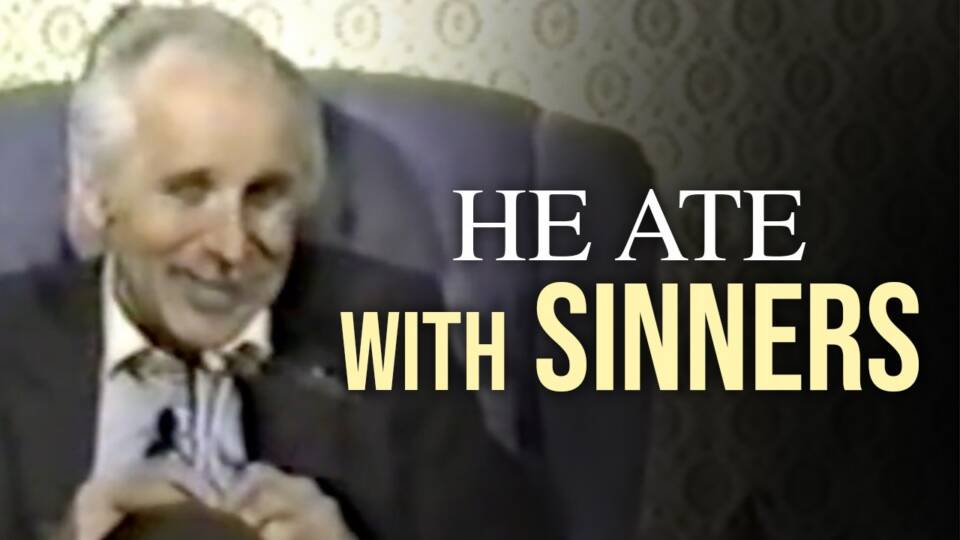
He Ate with Sinners • Jul 01st 1985
Why did Jesus feel so comfortable with sinners, tax collectors, and outcasts—and why were the religious leaders so uncomfortable with Him?
In this powerful teaching from Gene Edwards’s Life of Christ series, discover a striking picture of Jesus Christ among ordinary people. At Matthew’s banquet, Jesus is surrounded by tax collectors and people considered sinful and unclean by the religious establishment. Yet rather than withdrawing from them, Jesus is at home among them.
The Pharisees cannot understand it.
Their objection leads to one of Jesus’ memorable declarations: the healthy do not need a physician—the sick do. He then points them toward a deeper revelation of God’s heart: “I desire mercy, not sacrifice.”
Gene Edwards explores what this scene reveals about the character of Jesus, the Father who dwells within Him, and the Christian life itself. What if following Christ is not primarily about religious appearances, rituals, or continually trying to prove ourselves to God? What if God desires genuine fellowship with His people?
This message also explores Jesus’ teaching about fasting, the Bridegroom, new wine and old wineskins, and the danger of trying to force God’s new work into old religious forms.
You’ll discover themes including:
• Why Jesus ate with sinners and tax collectors
• Jesus’ confrontation with the Pharisees
• “I desire mercy, not sacrifice”
• Fellowship with Jesus Christ
• Prayer, fasting, and the Bridegroom
• New wine and old wineskins
• Religious tradition versus spiritual life
• God’s mercy toward imperfect people
• Experiencing Christ in ordinary life
Gene Edwards invites us to reconsider not only how we see Jesus, but also how we understand the Christian life. The Jesus revealed in these Gospel scenes is accessible, merciful, deeply relational, and remarkably at home among people who know they need Him.
The Lord says there’s the new and there’s the old, and the old has its way, and the new has its way. Then the Lord stands up for, takes the side of, and protects…the old. And I see in Him a real desire not to hurt…and to protect…past things. You might even say His past work; His own past work. When He starts the story, He tells those people that we must not destroy old things, because when we do, we destroy the new as well.
This is the story He told. Here is a piece of cloth and it’s got a hole in it, but obviously it’s got a lack. If you take a new patch and sew it on to it…and we immediately think we ought not to have anything to do with the old. The new…you can’t put something new on the old. Old and new don’t mix. Well, that’s a point too. But remember… He said what would happen to the old cloth. The new cloth would shrink, and it would rip the old cloth, and it would be torn. He didn’t want the old cloth to be torn; He didn’t want it damaged.
Now I know you have heard how wine works, but I’m going to tell it again in case there’s an Eskimo out there who may have never heard this. In the fermentation and making of wine, they didn’t have glass jars like us. They had skins, perhaps goat skins. They took a nice, new, fresh goat skin and they poured the wine in it. The wine would ferment, and it would expand the skin. The skin could stretch because it was fresh. The wine would swell and swell and swell, and the skin would swell and swell and swell. Then it would be stored, and it would become old wine – very tasty old wine.
Now, after you drank all the old wine, you could not take the new wine you had just brewed and put it into the old wine skin because, when it went to expand, the skin could no longer expand. It had already done that. It had stopped being new; it was no longer flexible. If you put new wine into it, the old skin, unable to swell with the wine, would rent open, and two disastrous things would happen. You would lose your precious skin and your valuable wine. There would be mutual destruction. But remember, the Lord was trying not to destroy, hurt, or damage the old.
I want to tell you something. Old wine tastes better than new wine. I could have told you that when I was nine years old. You see it happen every day. Have you ever tasted something, bought something, whether it be a car, a shirt, a revolutionary new way…let’s take the ballpoint pen when it came out. Now, you don’t remember when the ballpoint pen came out. I remember when the ballpoint pen came out. We’d been using ink, and ink was messy. We’d been using it for hundreds of years, and then something new came out. People said that they liked ink better. It feels funny. The old is better.
I remember when automatics came out. If I am so lazy I can’t stick a clutch in, I’ll stop driving. I like the clutch better than I do the automatic. You spend your whole life, and so do I, adapting to new things, and we never do like them. Now today we have several million young people who can’t drive a stick shift and can only drive an automatic. They don’t know how to handle the old. The Lord was saying to us, don’t destroy the old. It has a place and a right on this earth. Leave it alone. Do not destroy it by putting new things in it.
Now then, I find several things to say to all of you in this, but especially to those of you out there, because there’s hardly a week that goes by, but when I hear someone say, well, I’m going to stay in the denominations and try to change it. One thing is, you can’t do it. I’m going back to my little group and invest my life in them. I believe God wants to do something in Podunk. Or recently, someone said to me, well, this church is not what we want it to be, but we’re going to infiltrate it, and we’re going to get up into leadership positions, and we’re going to change it and turn it. It’s going to take a while, but we’re going to do it. It’s our hope. I said that it’s never been done in history, and you won’t do it. The old wine is better. It tastes better. It says so right there in the Scripture. The Lord’s own mouth said, ” The old wine is better. If you try to change the thing, you’re going to destroy the new, and you’re going to destroy the old. That’s unchristian.
You’ve got no business…to put this in the simplest words, you’ve got no business going back to Baptist churches and trying to bring them out of traditional ways and traditional values. I’m picking on the Baptists because I am one. You can’t do that. They can’t handle it, and it’s going to destroy them and you. Don’t damage God’s people that way. They have been drinking a certain wine throughout their lives and the lives of their fathers and their grandfathers, and they like it better.
You take those people out of Sunday morning’s church with dress-up, and you put them in a living room somewhere, sitting on the floor singing songs without a choir, somebody sharing who’s not dressed up well, who looks like maybe he was something the cat’s drug up the dog wouldn’t have, you’re going to disturb those people. You sit there for four hours in that meeting, and they’re used to going to sleep in their one-hour or their 45-minute meeting, and you expect them to come out of there saying, “This is better than what I have?”
No church building. Where’s the program for the children? All these people sitting around singing these songs I never heard. I like the songs of the faith – the grand old songs that Simon Peter and Paul used to sing. Amazing Grace and Shall We Gather at the River and Leaning on the Everlasting Arms and those other Old Testament Psalms. Those people don’t like the new, and they’ll get a bellyache trying to do the new. Leave them alone, or you will destroy the present faith that they’ve got. Their faith can handle what they have; don’t try to change it. You will hurt them, and God doesn’t want them hurt. They are His people.
True, you may feel the new wine tastes better. True, I may feel the new wine tastes better. But most of God’s people do now, always have, and always will believe the old wine is best. And they may be right, so leave them be, but don’t hurt them.
There are three destructions. You hurt the old. You hurt the new. You end the old and prevent the birth of the new. That’s cataclysmic. That’s terrible. That is nothing but tragedy. The new is never born, and the old is destroyed. You don’t want that.
When the World Calls You Evil for Loving Christ • Nov 22, 2025

This Is How You Must Honor The Son • Nov 22, 2025
Truth Changes Everything • Jan 01, 2014