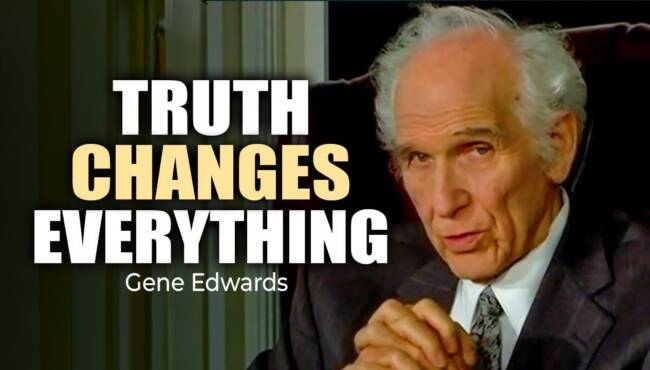
Truth Changes Everything • Jan 01, 2014


ARE YOU WILLING? • Nov 15th 1973
What does it really mean to imitate Paul as he imitated Christ? In this challenging Christian message, Gene Edwards examines the life of the Apostle Paul and the radical example he gave to the early church—an example of sacrifice, humility, work, generosity, and complete devotion to Jesus Christ.
Paul did more than preach the gospel. He lived in such a way that he could tell other believers, “Be imitators of me, just as I also am of Christ” (1 Corinthians 11:1).
Drawing from 1 Thessalonians 1, 2 Thessalonians 3, 1 Corinthians 4 and 11, Philippians 3, and Acts 20, Gene Edwards explores a dimension of Paul’s ministry that can easily be overlooked: Paul deliberately became an example for the churches.
He worked with his own hands. He gave rather than sought to receive. He poured himself out for the gospel and the church. And instead of merely asking Christians to admire his sacrifice, Paul called believers to follow his example.
This message asks a searching question for every follower of Jesus:
Are we willing to live the way Paul lived?
Gene challenges Christians to reconsider success, ministry, possessions, security, and our own interests in light of Paul’s example. The Christian life presented here is not centered on building a reputation or protecting ourselves. It is a life abandoned to Jesus Christ, His gospel, His church, and His eternal purpose.
The first-century believers who encountered Paul saw more than a gifted apostle. They saw a pattern of Christian living that could be followed.
For believers seeking deeper Christian discipleship, spiritual growth, first-century church life, and a more Christ-centered life, this message offers a challenging picture of what wholehearted devotion to Jesus can look like.
SCRIPTURES DISCUSSED:
1 Thessalonians 1:6
2 Thessalonians 3:7
1 Corinthians 4:16
1 Corinthians 11:1
Philippians 3:17
Acts 20:35
Then worked for a living. After working, sweating, and wasting his time, he took every penny he got and gave it to the Lord’s people, not keeping any for himself. Some of that very money was used against him. I want to illustrate that before we go into this. Brothers, men in this room can witness that, invariably, those who do not work full-time at jobs can be used as instruments…hear my words carefully… men can use them as the main instruments to bring disunity into the church.
Brothers in this room will witness that we have sat down in meetings to decide what to do about brothers who chronically would not work. And over and over and over we have paid their way, knowing I…may I use my own life…will you allow me? I have the right, knowing that I was going out the next day to work when I could have been out winning students to Christ. I was going out and paying that brother’s rent because, from the very outset, I’ve been one of the few brothers; there have not been many, and brothers have rarely made more than they spent.
There are brothers in this room who will witness that we continued paying those brothers’ salaries and their rent and their grocery bill and even the birth of their children when they were going door-to-door for the one stated intention of destroying my life. We never backed down from paying those brothers’ bills and rent, even during the darkest hour of their ugliest conduct; their conduct did not change our way. Paul did that. He went out, worked, and let everything God had called him to be lost, then let his own income be used against him, because Paul was dead set on establishing a testimony.
Now, brothers, I said to you one night: if you read history, church history, you will find this statement. Less is known about the church between 60 AD and 90 AD than at any other time in church history, and between 60 AD and 90 AD, all the great work of God was done. Who was doing it? Someday, when we get to the Ephesian line, you’ll understand why I have been talking about it for so long. Tonight, you’ll understand why I’ve always considered it so important.
Do you know who is doing the work? Do you know who was turning the world upside down? It was the churches that Paul gave his life for. A few men followed in his steps, and a new, higher standard than Jerusalem or Antioch had ever produced came out of Paul’s ministry and the ministries of those who followed him.
Paul spent his whole life establishing the testimony that was just so beautifully explained. That one, Paul of Tarsus, lived on this earth and could not have left all if he had received anything. But rather, in both outward zings and in his spirit, he suffered the loss of all things, gave it away without question, and didn’t even ask what would be done with it. He wasted his whole life to show brothers and sisters how to walk in the experience of having lost all interest in life on this earth.
Those of you who are sitting in this room tonight, here is the main point of the last seven meetings. A concept has been unknown among the Lord’s people for hundreds of years. Only monks who have taken vows of poverty know it. They gave up everything they had on this earth, were given a change of clothing, and throughout their lives, that was all they had. But those monks were in something formal, something dead, something religious, and they did not know life. Paul’s conduct has been lost, and in the hearts of everyone listening to this recording, and in the hearts of those of us in the room, we wait to see God bring back to earth a Paul who will stand before everyone as an example. One who received nothing but gave everything, worked with his hands to be that example, and that everyone sitting in the parking lot waiting for the bus would see a “Paul” on it, someone they could look at for a moment and say, “There was one who lived among us.”
But Paul would rise up and say, “I did not do it so that I could be some solo example to you; I did it so that you might all live the same way,” and let the brothers listening to the recording know… and let the brothers and sisters in this room right now know that if we are to be stewards of the mystery, that is the way to steward. I am asking you, are you willing to live the way Paul lived? Are you willing to live the way Paul lived?
I believe every one of you heard the verses of scripture that were read the other night. I’d like you to go back with me right now and look at a key word. 1 Thessalonians 1:6, “You also became imitators of us and of the Lord, having received the word in much tribulation with the joy of the Holy Spirit, so that you became an example to all in Macedonia and in Achaia.” Paul begins one of his earliest letters by telling people they should imitate him. Now we turn to the passage of Scripture where he speaks of his conduct and explains why he did what he did. It is 2 Thessalonians 3:7. This very passage was read last night. “For you yourselves know how you ought to follow our example.”
1 Corinthians 4:16, which was also read, speaks of this very thing. Paul says, “I exhort you, therefore, be imitators of me.” That was the chapter we read the night before last; now, we also read 1 Corinthians 11. I’d like for you to reread it. “Be imitators of me just as I am of Christ.” And that church (Philippi) which, more than any other that we know of, imitated him.” Philippians 3:17: “Brethren, join in my example and observe those who walk according to the pattern you have in us.” Brethren, join in following my example and look around for those in the church in Philippi who walk after the pattern you saw me walking when I was among you.”
We are all so familiar with the passage of Scripture that was read in Acts, but I’d like for us to go back and catch that verse again, which has lost its meaning because the word “example” has lost its meaning. Acts 20:35…by the way, most of the translations use the word example here. “In everything I showed you that by working hard,” he’s talking about using his own hands, “you yourselves know that these hands ministered to my own needs and to the men who are with me.” “In every way I showed you by working hard with my hands, you must help the weak. And remember the words of the Lord Jesus. It is more blessed to give than to receive.” And the words “to give is more blessed than to receive” have also been watered down to the point that they have lost their meaning.
In every passage I have read, the context concerns Paul’s testimony of working with his hands. Now, let us establish that again: here were workers not raised, nations not evangelized, churches not born, souls not saved, quality not made, Paul’s work not big and not great and not seen as all the other full-time religious workers in the world, and his very commission not carried out so that he might be an example for all those who did touch his life to follow it every way completely. His way was to go and work with his hands, come home, preach the gospel, pour his life out for others, never care one whit for himself, never be interested in his own life, never answer his critics, pour out his life in the gospel, pour out his life for the needs of the church, to never be resentful or hurt. Take the very money he earned while he wasted his life and give it to the church; never ask what they did with it; keep serving without looking back; be utterly abandoned to the Lord; and give them the example of what a “Paul” looks like.
Truth Changes Everything • Jan 01, 2014

Free to Fellowship with Christ • Dec 07, 2013

Sow to the Spirit • Nov 23, 2013