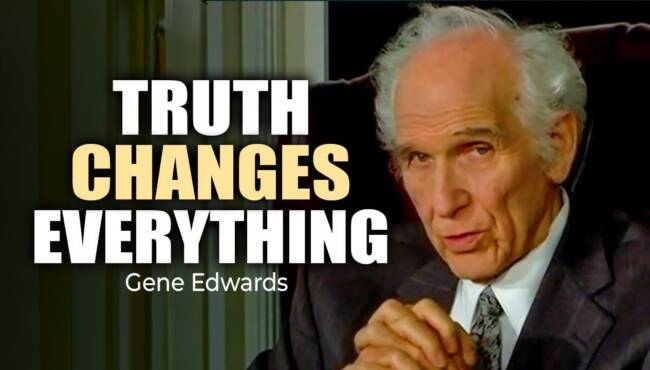
Truth Changes Everything • Jan 01, 2014


ARE YOU WILLING? • Nov 15th 1973
What does it really mean to imitate Paul as he imitated Christ? In this challenging Christian message, Gene Edwards examines the life of the Apostle Paul and the radical example he gave to the early church—an example of sacrifice, humility, work, generosity, and complete devotion to Jesus Christ.
Paul did more than preach the gospel. He lived in such a way that he could tell other believers, “Be imitators of me, just as I also am of Christ” (1 Corinthians 11:1).
Drawing from 1 Thessalonians 1, 2 Thessalonians 3, 1 Corinthians 4 and 11, Philippians 3, and Acts 20, Gene Edwards explores a dimension of Paul’s ministry that can easily be overlooked: Paul deliberately became an example for the churches.
He worked with his own hands. He gave rather than sought to receive. He poured himself out for the gospel and the church. And instead of merely asking Christians to admire his sacrifice, Paul called believers to follow his example.
This message asks a searching question for every follower of Jesus:
Are we willing to live the way Paul lived?
Gene challenges Christians to reconsider success, ministry, possessions, security, and our own interests in light of Paul’s example. The Christian life presented here is not centered on building a reputation or protecting ourselves. It is a life abandoned to Jesus Christ, His gospel, His church, and His eternal purpose.
The first-century believers who encountered Paul saw more than a gifted apostle. They saw a pattern of Christian living that could be followed.
For believers seeking deeper Christian discipleship, spiritual growth, first-century church life, and a more Christ-centered life, this message offers a challenging picture of what wholehearted devotion to Jesus can look like.
SCRIPTURES DISCUSSED:
1 Thessalonians 1:6
2 Thessalonians 3:7
1 Corinthians 4:16
1 Corinthians 11:1
Philippians 3:17
Acts 20:35
Okay, I’ll repeat it. It just automatically happens when we hear these things, and we say, “Well, we’re not going to do that then, are we?” No. That we immediately become proud and bitter. I am almost afraid for the next brother who drops through here who doesn’t meet with us; everybody’s going to be looking at him, trying to check him out. I’m going to ask you to do something in that respect. Will you be an imitator of me? You have no place to be self-righteous. You have no place to be bitter, because nobody’s hurt you. You have no place to be self-righteous because you have the same black heart. And you have no place to look down on someone else, because when you look down on someone else, you’re always underneath them.
I heard one of the sweetest statements of my life from a woman named Gertrude Behanna. She wrote a book entitled The Late Liz. She said, “I look down on people who look down on people.” Of course that’s not right either, but we ought to realize that there is no place, just because we don’t do something everybody else does, or if we do things no one else is doing that should be done…if we are getting proud, then the sectarian spirit will grow up in us, and the Lord is just through with us.
That’s the danger of dealing with a thing like this, but you answer this question to me. Which is more dangerous: dealing with it or not? They are both incredibly dangerous. I don’t know what to do, except through His mercy. That’s about all. I do want you to be aware. I didn’t realize this would take so long. Nonetheless, I felt it was in order to review the last message. I am not sure. I am not sure we’re all clear on what was said the other night.
May I review the points of the message the other night? Did Paul of Tarsus have a reason for working for a living? Paul worked for a living to be an example to the unemployed. He worked for a living to be an example to the entire church. He worked for a living even though he could have done more to save men from hell if he hadn’t. He worked for a living even though he could have raised up more workers if he hadn’t. He could have raised up more churches and gone to more nations if he had not chosen to earn his own living. And there was one other point: the Christians he saved and raised up would have been of higher quality if he had not earned his own living. He wasted most of his Christian life.
I also want to say, parenthetically, that no garage mechanic in the world today has an excuse for not turning the world upside down. You, my brother, have no excuse for not turning the world upside down. Even though you are a full-time employee, consider that. Consider that.
There’s one other thing I want to say and remind you of: Paul of Tarsus…several things…that though he did them, never seemed to catch on in people’s minds, and yet God honored them. Another thing is, he saw how valuable it was that no matter what criticism was launched against him, he had only one rejoinder. What was it? I work for a living. Would you take that testimony and throw it back into the battle? Could we begin to take that word and use it again? Would you? Could we? Let us do this thing. I work for a living. Oh, you really don’t agree with that, brother? No. Did you know that that brother’s a painter? What’s that got to do with it? He works for a living. What do you do? I want you to know all the other messages we bought here on what…I guess the subject is church finance…all of those things are hidden away in the deep, inner, closed, secret parts of men’s hearts, and they know why they are criticizing Paul of Tarsus. Do you know why they’re criticizing Paul of Tarsus? Because he is a threat to the structure that provides them with food and shelter, and they want what they have, and he threatens it.
It exposes the hearts of men that this testimony of Paul, dear precious brother Paul, has been lost. Brothers, I want to say one more thing: Paul of Tarsus stayed pure by owing no one anything and receiving nothing from anyone. He received nothing from anyone. Even in the letter to Philemon concerning Onesimus, if you read it carefully, Paul was never in debt to Onesimus. Paul pricked Philemon over and over, reminding him that only one person in this whole thing is in debt. Who is it? Philemon is in debt to Paul of Tarsus. You cannot imagine, unless you have gotten a feeling of it lately, the power there is in a man’s freedom from the influence of other men. I don’t mean you use it to blast people or split their skulls open, but simply being true to the Lord and your own heart’s motives can expose that.
Now my brother, now my sister. All of those things are standing there. Paul could have won more people, raised more churches, gone to more nations, had a higher quality of Christians, raised more workers, rested longer, lived longer, and led more people to the Lord if he hadn’t worked for a living. On top of all that, he, more than any other man, and Barnabas, both of whom worked for a living, had the entire gentile world as their personal responsibility. The blood was on their hands to win them to the Lord, and they were fiddling around mending tents.
Now tell me why Paul of Tarsus was willing to have a little church instead of a big one. Why was he willing to go to one city instead of 10 cities? Why was he willing to have only seven workers instead of dozens? Why did he let the whole Gentile world go to hell and save only a little bitty few? What was his main purpose? What was his testimony? Do you know? Can you say it? To be an example to the other believers…but what does that mean? Of money? By the way, his testimony broke that system. It broke it right down the middle. He took point-blank range and fired. That’s not it yet. He wanted to present the purity. It’s very possible he knew in his own heart that he was himself corrupt.
Alright, I don’t think there’s any question that it was the humility of the Lord coming through, but what would justify this conduct? How could it justify such an incredible law? Who is the one who is said to be an example to the flock? Brother, you know, you’ve answered, but that’s not good enough. That doesn’t get to the point. It doesn’t make the real point. My whole point in the last message was brought in the last 60 seconds, and I’m not sure that you were deeply impressed.
If he had received anything, he could not say he had given all. Our brother said, “to be an example,” but we get the impression he is being a wonderful example to everybody, and nobody’s being like him. You know, that’s what the very word “being an example” means. It bothers you a little bit; you look at it and say, “Yeah, wouldn’t that be neat if we were all like that?” Paul gave everything and took nothing. He lost it all. He gave all, and more than all, as an example that all those he led to the Lord, and all the churches that rose up, would do the same. That they would also have no excuse for gaining anything for themselves. That they would actually live as he lived. I told you that Paul of Tarsus not only worked and let the world go to hell, and no church or churches were raised up in certain places, and the Gentiles were lost, and workers were not raised up, and nations did not hear the gospel, even though he was under commission. He did all of that.
Truth Changes Everything • Jan 01, 2014

Free to Fellowship with Christ • Dec 07, 2013

Sow to the Spirit • Nov 23, 2013