Stop Playing Church • Feb 18, 2026

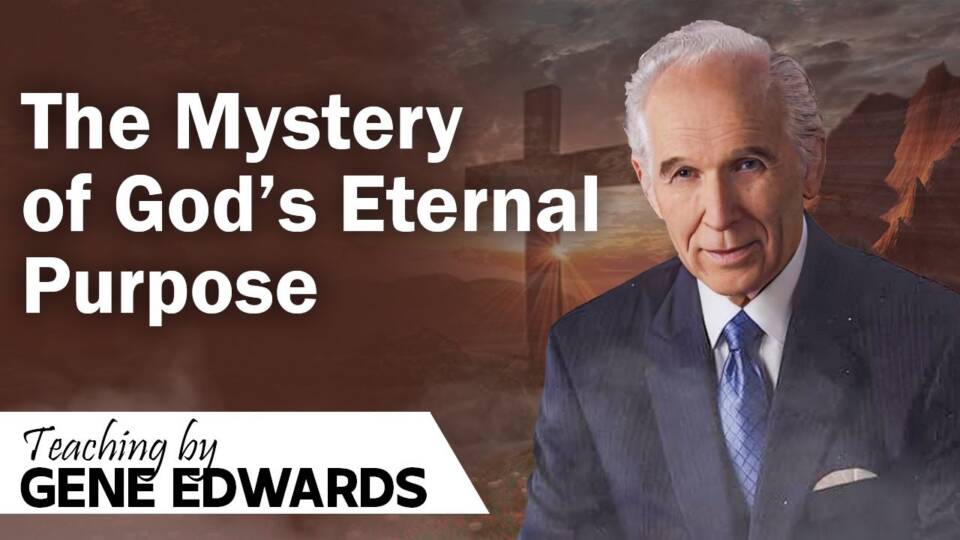
The Mystery of God's Eternal Purpose • Feb 01st 1994
In Debrecen #6, Gene Edwards leads listeners into one of the most sacred and rarely explored areas of Scripture: Genesis 1–2 as a glimpse into God’s eternal purpose. This message is not presented as information for discussion, but as a spiritual reference point—a “north star”—meant to orient ministry, revelation, and personal walk with Christ.
Rather than beginning with “In the beginning,” this teaching first returns to the eternal purpose of God, emphasizing that it cannot be fully defined, systematized, or exhausted. Like a great diamond or kaleidoscope, God’s purpose reveals new beauty with every turn, yet remains ultimately unfathomable. Any attempt to define it completely risks reducing something that must remain alive and dynamic.
Gene Edwards then makes a striking biblical observation: there are only four chapters in the entire Bible untouched by the fall—Genesis 1–2 and Revelation 21–22. These four chapters function as bookends to Scripture, revealing God’s heart before sin entered creation and after sin has been fully removed. Everything between them tells the story of fall and redemption, but these four chapters reveal what God wanted all along.
Genesis 1–2 is presented as a mirror—like the Sistine Chapel ceiling—offering glimpses of eternal realities without fully revealing them. Revelation 21–22, by contrast, unfolds those realities in fullness. A single, unbroken line runs from Genesis to Revelation, carrying themes such as light, life, seed, land, dwelling place, union, oneness, and God’s building. These themes are not isolated ideas but threads woven throughout Scripture.
The message then carefully traces major themes found in Genesis 1–2: God, beginning, heavens and earth, light and darkness, seed, life, multiplication, corporate man, image, rulership, land, tree of life, garden, habitation, river, precious materials, building, bride, union, and oneness. Each of these themes reappears—fulfilled and transformed—in Revelation 21–22.
A major emphasis is placed on light. “Let there be light” is shown to be the foundation of all progress—spiritually and corporately. Light precedes life, growth, and revelation. Darkness is not portrayed as Satan’s domain alone, but as an instrument still under God’s sovereignty. Even darkness, Scripture declares, is light to Him.
This teaching also confronts modern Christianity’s loss of church life as organic community. Drawing parallels with tribal life, Gene Edwards shows that God’s design for humanity is communal, relational, and lived—not institutional or organizational. As tribal life disappears from the earth, the church becomes the last living witness of God’s original design for humanity.
Throughout the message, listeners are reminded that Genesis does not explicitly name Christ—but it carries His fingerprints everywhere. These chapters contain echoes of a mystery hidden until Christ was revealed. Believers today are stewards of that mystery, called not merely to study it, but to live it.
The message closes with a simple but profound prayer that sums up the entire teaching: “Lord, let there be light.”
You might find something here in the word cultivation. I haven’t, but you might. Now, you find breath of life. You’re going to find the tree of life. This is the breath of life. We’ve already found the spirit of God. Now we find the breath of life. He gave him soul life. He breathed into him soul life. A garden. Now, here is the big one. Will you be able to find a garden in your looking? Only the wisest will find a garden. God made a garden.
Now, folks, we’ve got a home. I’m going to use the word home, but I want you to put out beside it habitat. A habitat for man, a place for man to live. This is extremely important. And now, gentlemen, not only a garden, and not only a place for man to live, a habitat, but we have the tree of life in the middle of the garden. So I’m going to give you a big hint for finding the garden. Look for a middle. Look for a middle. I’m going to skip the tree of the knowledge of good and evil.
Most people, most scholars, believe that somewhere in the first part of Genesis 2, there was the fall in heaven. And that’s why the tree of knowledge of good and evil comes. That fall did not take place on earth.
All right, gentlemen, a river. Capitalize the word river. Gold. Bdellium – pearl. Just a little mark. Bdellium could be a pearl. You may even look that up in your Roman dictionary, Romanian dictionary, and you’ll find it is either a kind of something that comes from a tree, or it is something that comes from the oyster shell. Anyway, we have a bdellium or a pearl. B-D-E-L-L-I-U-M. Bdellium and pearl, the words should go together. Stone. Put down there a stone. We haven’t had a stone up until now. Tree of the knowledge of good and evil – no, I did not put it down because you can’t find it in Revelation 21 and 22. It’s gone.
There is a flowing. And in verse 15, there is this reiteration of it being man’s home. The Garden of Eden is man’s home. Man does have a natural habitat. It is not the earth. It’s the garden.
Now then, you’ll not find this in your assignment, but you’ll find the opposite of it. Here is something not good. In verse 18, we come to a not good. We’ve had good, good, good, good, good, good, and suddenly we’ve got a not good. Now you’re going to find in your assignment a good. The word won’t be there, but just keep looking for good.
By the way, not good turns into good even here, in Genesis 2. And you’ll find that good. That was not good. In your assignment. Write down the word help meet. Put down the word woman. Well, you’ve already got the word woman. Let’s not do that. How about… I’m going to jump ahead of myself. Bride. And that we have a marriage. And put the word marriage down there. After all, that’s how this chapter ends.
Okay, put down there a female after his kind. Now this is not in Genesis 2 except for one little moment. And then it’s healed. A damaged side. Man has a damaged side for just a moment. What happens? God opens his side and brings forth a rib. And for a moment, there is a damaged side.
Boy, listen. Now, verse 22, this is terribly important. There is a building there. I don’t know if you have the New American, but in verse 22, this is so unique. God created some things. That means he created them out of nothing. He made some things. That was taking something and making them something else. But in this case, if you’ll look in your side reference, it says that God built the woman out of the man. There is a building. There is a process of building. The word only appears once in Genesis 1 and 2. And it’s here. That the woman was built out of man. And to me, in Genesis 22, you have a wedding ceremony. And God brought man, brought the girl to the man. And you hear John the Baptist saying, I’m not the groom. I’m the one who’s going to introduce the groom to the girl. And here God is introducing the girl to the man. So we have a wedding ceremony, or at least we’ve got a fiancé thing going on here.
You will not find bone of his bone. And I’ll tell you openly, you will not find spirit of his spirit. But you will find kind after his kind in your assignment.
Okay, the source of the woman. What is the source of the woman? The source of the woman is the man. All right. In verse 24, you have union, physical union. What happens after you get married? Physical union. And after physical union, or part of physical union, is oneness. And this is what always blows my mind, that in Genesis 2 is the word and the two flesh will become one flesh. I just, I’ll never get over that. Here it is in the unfallen section of the scripture, a reference to oneness. Look for oneness. All right. Were you able to keep up with that pretty well? Do you have your list? Well, let’s go back and find out where that fall took place. Was that in Revelation 19 or 20?
Chapter 20. Death and Hades were thrown into the lake of fire. That’s the second death. If anyone’s name was not found written in the book of life, he was thrown into the lake of fire. Chapter 21 and 22. By the way, I want to remind you that there is another line. Genesis 3 opens with it and it is the line of salvation and it is…I’m sorry okay there is another line but it is not in the unfallen chapters 1 and 2 it begins with chapter 3 and it’s the beginning of the fall and out of that fall comes salvation and here at the end of chapter 20 the fall and salvation are over There is no more fall and there is no more salvation. Listen to how Revelation 21 opens, “And I saw a new heaven and a new earth.” And if you don’t have enough sense, I’ll give you the answer to one of yours. Did you write down the word creation? Well, here’s a new one.
Stop Playing Church • Feb 18, 2026
Escape Religious Cage • Jan 10, 2026

Break the Dead Chains • Jan 10, 2026