
When the World Calls You Evil for Loving Christ • Nov 22, 2025

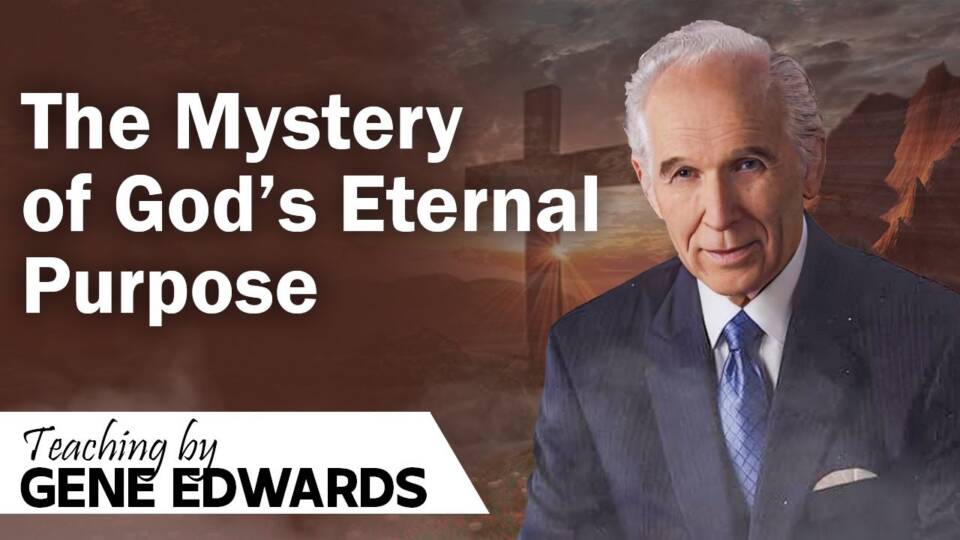
The Mystery of God's Eternal Purpose • Feb 01st 1994
In Debrecen #6, Gene Edwards leads listeners into one of the most sacred and rarely explored areas of Scripture: Genesis 1–2 as a glimpse into God’s eternal purpose. This message is not presented as information for discussion, but as a spiritual reference point—a “north star”—meant to orient ministry, revelation, and personal walk with Christ.
Rather than beginning with “In the beginning,” this teaching first returns to the eternal purpose of God, emphasizing that it cannot be fully defined, systematized, or exhausted. Like a great diamond or kaleidoscope, God’s purpose reveals new beauty with every turn, yet remains ultimately unfathomable. Any attempt to define it completely risks reducing something that must remain alive and dynamic.
Gene Edwards then makes a striking biblical observation: there are only four chapters in the entire Bible untouched by the fall—Genesis 1–2 and Revelation 21–22. These four chapters function as bookends to Scripture, revealing God’s heart before sin entered creation and after sin has been fully removed. Everything between them tells the story of fall and redemption, but these four chapters reveal what God wanted all along.
Genesis 1–2 is presented as a mirror—like the Sistine Chapel ceiling—offering glimpses of eternal realities without fully revealing them. Revelation 21–22, by contrast, unfolds those realities in fullness. A single, unbroken line runs from Genesis to Revelation, carrying themes such as light, life, seed, land, dwelling place, union, oneness, and God’s building. These themes are not isolated ideas but threads woven throughout Scripture.
The message then carefully traces major themes found in Genesis 1–2: God, beginning, heavens and earth, light and darkness, seed, life, multiplication, corporate man, image, rulership, land, tree of life, garden, habitation, river, precious materials, building, bride, union, and oneness. Each of these themes reappears—fulfilled and transformed—in Revelation 21–22.
A major emphasis is placed on light. “Let there be light” is shown to be the foundation of all progress—spiritually and corporately. Light precedes life, growth, and revelation. Darkness is not portrayed as Satan’s domain alone, but as an instrument still under God’s sovereignty. Even darkness, Scripture declares, is light to Him.
This teaching also confronts modern Christianity’s loss of church life as organic community. Drawing parallels with tribal life, Gene Edwards shows that God’s design for humanity is communal, relational, and lived—not institutional or organizational. As tribal life disappears from the earth, the church becomes the last living witness of God’s original design for humanity.
Throughout the message, listeners are reminded that Genesis does not explicitly name Christ—but it carries His fingerprints everywhere. These chapters contain echoes of a mystery hidden until Christ was revealed. Believers today are stewards of that mystery, called not merely to study it, but to live it.
The message closes with a simple but profound prayer that sums up the entire teaching: “Lord, let there be light.”
Now he comes straight to earth and then there is let. Let there be light and there was light.
And a long, long time ago, a gentleman by the name of McIntosh. You ever heard of this man? Let me tell you a little bit about him. He is called C.H.M. He was trying to be very modest. But he was C.H. McIntosh. And he wrote a book on Genesis, and he made the observation that for there to be any kind of progress, there has to be light. For there to be any growth, there has to be light. And even though he has created much, at least on earth, there is no life until there is light. Brothers, the subject of light begins. And you have to understand as you trace it through the Old Testament, and I’ll help you here. You’ll find the light growing in the creation account. You’ll find it again in the tabernacle. And in the temple. And then you’ll find the great and real light coming to earth, in Bethlehem and Nazareth. And the light continues to grow. And as long as the light is growing, there will be higher things happening.
And brothers, let me see, what can I say? I found out about salvation. But when I found out new things the Lord himself showed me, salvation became more real. And when I began to learn things about Christ from others, Then Christ gave me light that I did not have that no man gave me. And that was my engine. That was the unction. That was the driving power of my life and still is. Light that is my own. Given to me bursting forth within me as revelation. That’s got to happen to you to make the other things come alive. And that has to be married to, coupled with, it has to be joined to experience with Christ. Let there be light. It’s sort of a command of God in every generation. Let there be light.
Let there be more light on the church. Let there be more light on Christ. Let there be more light on my eternal purpose. Let light break through in this generation. He is a progressing God. There will be no progress until there is more light. May our Lord give you brothers in this room, especially you Albanians, and you Romanians, may you be driven by the light, by the revelation. And that’s what this whole thing is about here. A revealing of Christ. May the light burst in you. And you say, oh, wait a minute, I didn’t get this in Debrecen. Wow, Gene didn’t know this. Woo-hoo. Amen. Oh, this is great. This is wonderful. Let light burst forth in you.
In the beginning, God created the heavens and the earth, and the earth was without form and void, and the Lord said, Let there be light. Your prayer? Here’s a prayer. Lord, let there be light. And there will be light. Well, you know something? I want to read this. And God saw the light was good, and God separated the light from the darkness. And God called the light day, and the darkness he called night. And there was evening and morning, day one.
And so comes the first separation and it’s separating light from darkness. A lot of people have made a lot of a lot out of the fact that there’s darkness present here. I’m not going to touch that because I know something that perhaps they don’t know. The psalmist said, Does anybody know what I’m about to quote here? Who’s that? The psalmist. The one of the psalmists said concerning darkness, Lord, even darkness is light to you. All right. We even have a Psalm. Psalm 139. Lord, even darkness is light to you. And the darkness here
has light to it, in that it has revelation to it. The more there is light, the more you will see what is light and what is not light. And after all, darkness is nothing but the absence of light.
Let me take that definition and go a little further. Is there darkness in America? Yes. But actually, in my country, there’s simply the absence of light. Is Romania dark? Absolutely. You can feel the darkness when you go in. There are places in America I feel the darkness when I go in. You can almost cut it. I was very interested to note the first time I was ever in Rome, I felt an oppression of darkness. And you know, a lot has changed in Rome, Italy since then. The gospel has been preached. There are Christians everywhere in that country. Then, there were none at all. I didn’t have such a deep sense of darkness when I returned. I sensed a lot of darkness in certain places of the world. I don’t want to name any of them. But that darkness can be dispelled by light.
I’m here to give light to you through Christ. I hope some non-light has been removed. Darkness being the absence of light. I hope there will come a day when without any encouragement from anyone, you will be driven by Christ. You will know that it is Christ you are to preach. You will know that it is Christ to speak, Christ to pray, Christ to just about almost everything, with a little practical things of help thrown in here. And even that is the Lord. And that there will be a removal of that which is not light. Take light to your country.
So he called the darkness night and he called the light day. And don’t ever forget that there was night and an absence of darkness. Don’t throw away the word darkness quickly, would you? Take that word through the scripture. It is not always negative. Sometimes it can be very positive. And I’m going to just stop here for a minute. In fact, I’m going to show you how much I’m going to stop because I’m going to talk to you a minute. I want you to listen, if you will, because this is important.
Does darkness belong to Satan? Or does it belong to God? Does darkness belong to Satan, or does darkness belong to God? Anybody going to? Okay, even the darkness did not exist before God. Amen. There was only the Lord and He was light. I’m going to say to you that the darkness belongs to God. I hope you will never get too tied up with the devil.
I was in a country recently the name of which I will not give in which I was talking to an American missionary and he would tell me of all the wonderful things that had happened and I’d say well how’s that going now and he’d say oh the devil got into it and it’s gone now then he’d tell me something else wonderful and well what but and he said well the devil got into it it’s we’re not doing that anymore and something else what’s happening well the devil just couldn’t stand that and ended it. Well you know that’s really wonderful I would like to blame all my faults and all my failures and all my shortcomings and all my inabilities and all my sins and all my weaknesses on the devil, and it’s not good for me to blame anything on the devil. I got two people to blame and there are no others One, I’m going to say this in French, c’est moi. I think you can interpret that – me – and the other person to blame is God and keep it on those two. Keep it off of God’s people and keep it off the devil. But what if the devil does it, Gene wasn’t really you just know this is the devil can’t you just say the devil did that? No, because God is sovereign even over the devil. Darkness is in the hands of God.
When the World Calls You Evil for Loving Christ • Nov 22, 2025
This Is How You Must Honor The Son • Nov 22, 2025
Truth Changes Everything • Jan 01, 2014