Christ Made You Holy • Mar 05, 2026

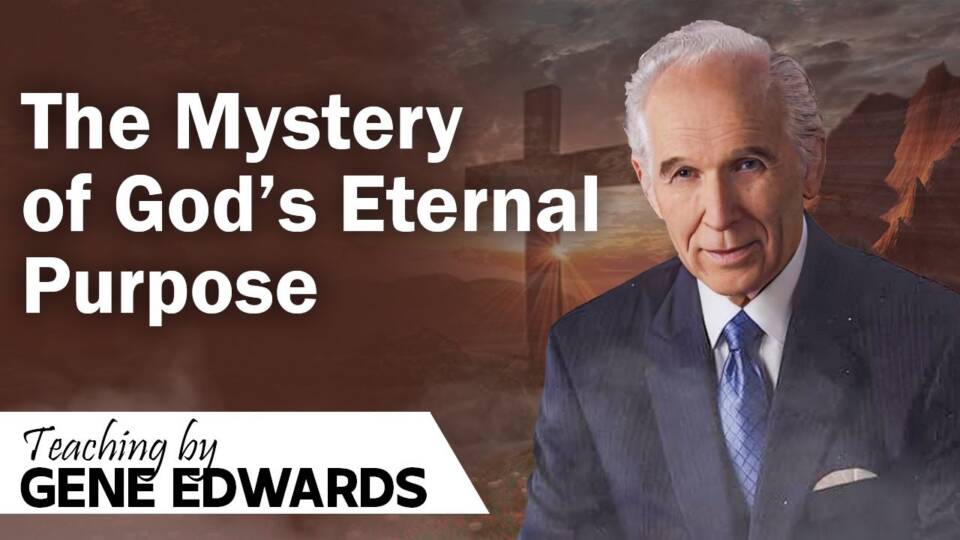
The Mystery of God's Eternal Purpose • Feb 01st 1994
In Debrecen #6, Gene Edwards leads listeners into one of the most sacred and rarely explored areas of Scripture: Genesis 1–2 as a glimpse into God’s eternal purpose. This message is not presented as information for discussion, but as a spiritual reference point—a “north star”—meant to orient ministry, revelation, and personal walk with Christ.
Rather than beginning with “In the beginning,” this teaching first returns to the eternal purpose of God, emphasizing that it cannot be fully defined, systematized, or exhausted. Like a great diamond or kaleidoscope, God’s purpose reveals new beauty with every turn, yet remains ultimately unfathomable. Any attempt to define it completely risks reducing something that must remain alive and dynamic.
Gene Edwards then makes a striking biblical observation: there are only four chapters in the entire Bible untouched by the fall—Genesis 1–2 and Revelation 21–22. These four chapters function as bookends to Scripture, revealing God’s heart before sin entered creation and after sin has been fully removed. Everything between them tells the story of fall and redemption, but these four chapters reveal what God wanted all along.
Genesis 1–2 is presented as a mirror—like the Sistine Chapel ceiling—offering glimpses of eternal realities without fully revealing them. Revelation 21–22, by contrast, unfolds those realities in fullness. A single, unbroken line runs from Genesis to Revelation, carrying themes such as light, life, seed, land, dwelling place, union, oneness, and God’s building. These themes are not isolated ideas but threads woven throughout Scripture.
The message then carefully traces major themes found in Genesis 1–2: God, beginning, heavens and earth, light and darkness, seed, life, multiplication, corporate man, image, rulership, land, tree of life, garden, habitation, river, precious materials, building, bride, union, and oneness. Each of these themes reappears—fulfilled and transformed—in Revelation 21–22.
A major emphasis is placed on light. “Let there be light” is shown to be the foundation of all progress—spiritually and corporately. Light precedes life, growth, and revelation. Darkness is not portrayed as Satan’s domain alone, but as an instrument still under God’s sovereignty. Even darkness, Scripture declares, is light to Him.
This teaching also confronts modern Christianity’s loss of church life as organic community. Drawing parallels with tribal life, Gene Edwards shows that God’s design for humanity is communal, relational, and lived—not institutional or organizational. As tribal life disappears from the earth, the church becomes the last living witness of God’s original design for humanity.
Throughout the message, listeners are reminded that Genesis does not explicitly name Christ—but it carries His fingerprints everywhere. These chapters contain echoes of a mystery hidden until Christ was revealed. Believers today are stewards of that mystery, called not merely to study it, but to live it.
The message closes with a simple but profound prayer that sums up the entire teaching: “Lord, let there be light.”
We have now come at last to Genesis 1:1. By the way, just those of you who are out there in tape land, you’d be interested to know that last night I delivered a very simple message on God’s eternal purpose, and the machine didn’t work. And you’ll never hear that message. And I don’t know what we’re going to do about it. We’ve got it on audio. But the video is dead. And I’m not surprised one bit. We’ll figure out something. Somewhere, somehow, someday. Now I’m going to say something that may surprise you a little bit. I’m going to ask you not to go home and talk about this message. I’m going to ask you to kind of keep this in your heart. I learned, and you know, did you know the, don’t ever talk about this one, would you? It’s possible that if you dug around in all the tapes I’ve made, you would find some reference to what I’m saying today. But this is not something that I talk about.
I keep this, and I’m sharing it with four Romanian brothers here in hopes that it will be a north star to your ministry. Do you understand the term north star? There is a star in the heavens that does not move, and everything else moves. The sailors use it to find out where they are. The North Star. A constant reference point. In fact, I would say that of all the messages I’ve brought so far, these were for you. They’re not for consumption. To help you find your Lord, to discover Him as the center of all things.
Now, you would think this morning the first thing I’m going to do, by the way, those of you who watch this on video, this may not be a video that gets made available very often, or very many people. You would think that I am about to tell you about Genesis
1:1 and in the beginning, God created the heavens and earth. No, that’s not where I’m going to start this time. I may do that tomorrow morning. I would like to remind you of the message yesterday. It was a message about God’s eternal purpose. And you remember when I closed, I said, I’m not going to give you a definition of the eternal purpose. You remember, we had a whole message, and yet I never came to a definition. I want to tell you that I hope you never define it. In fact, the moment you define the Lord’s eternal purpose, you have moved over into the camp of Aristotle. Aristotle said, always start with a definition. And I think we’ve got something here that’s indefinable, inexhaustible, unfathomable, and in some ways incomprehensible. In other words, we can’t really ever grasp it.
[I have been speaking on the Lord’s eternal purpose for longer than most of you have been alive. And I have never yet said, well, I may have in my young, brash days said, this is God’s eternal purpose. I have not grasped the length, the breadth, the height, the depth of his eternal purpose. All I can tell you is that I hope it rages within you and that you again and again present some part of that purpose to God’s people. It’s like that great diamond.
You turn it around and it just becomes many, many, many things. It changes in beauty and meaning. We talked about a kaleidoscope yesterday. The little thing you turn. And it’s always different. Always glorious. Always indescribable. Always beautiful. But never quite comprehensible.
Now we come to Genesis 1 and 2. And I’m going to tell you a story. Before I say anything about it. You’ve probably never been to Italy. To the Sistine Chapel. You ever hear of the Sistine Chapel in Roma Dele? It’s the place where Michelangelo, Michelangelo, something like that, Michelangelo, okay, you said it, did all the great work up on the ceiling. Well, this is a story. It turns out not to be true. It may have been true in centuries past. I’ve been in the Sistine Chapel twice, and it’s really true that you cannot take it all in. You’ll walk into the room and you’ll look up, you can see that, you can look over that way and see some more, and you’ll look this way and see some more. But there’s no way you can stand anywhere and see it all. So, I suppose perhaps a hundred years ago they had a vast mirror sitting on a huge table, and people could come in and look at the mirror and see the entire ceiling all at once. There’s a point here. Can you guess what the point is? Are we going to guess? That’s Genesis 1 and 2. It’s that mirror. That lets you glimpse. You can’t see the real thing or the whole thing, but the mirror helps you see some of it.
Now, it’s from this point on, I really don’t want you to do a whole lot of talking. I just want you to hold this in your heart. Keep it sacred. The scripture only gives us four chapters that allow us to glimpse his eternal purpose. There’s a little of it in Colossians, a little of it in Ephesians, a verse or two in Corinthians, but there are four whole uninterrupted chapters that will help us understand his eternal purpose. Now, anybody want to venture what those four chapters might be? And if you already knew before you walked in this room, you can’t say, I don’t want you to look good when you’re not. Anybody want to guess?
And that’s correct. I’ll repeat it. Listen very carefully, brothers. What I’m about to tell you is really important and to me is very sacred. There are four chapters in Scripture that have nothing to do with the fall. The fall begins in Genesis 3. The devil is thrown into the pit in 19 or 20. We’ll find out in a minute. It’s all over with around Revelation 19-20. And then you’ve got 21 and 22, there’s no sin. And the old creation has passed away. And Genesis 1 and 2 have no mention of the fall of creation or man. Now we have two chapters, let’s call them two pages from now on, of something totally untouched by the fall of man or Lucifer or sin or anything, and then at the very end we have two more chapters, two more pages beyond sin and Satan and those four chapters give you a glimpse of some of the things on the heart of God for man. And I’m going to tell you something. They’re inadequate. Genesis 1 and 2 is more inadequate than Revelation 21 and 22. Genesis 1 and 2 is really a hint. Revelation 21 and 22 are an unfolding.
Now, my brothers, here comes another very important sentence. There is a string. Do we still have our string here around here somewhere? There is a line. There is a connection that goes from Genesis 2 all the way to Revelation 21. There is a theme. We’ll begin in Genesis one or two or three, because salvation begins in three. There are themes in Genesis 1 and 2 and 3. And those themes continue throughout all the scripture unbroken. And they emerge again in Revelation 21 and 22. Filled. Fulfilled.
And this is what I would encourage you to do. To minister one of those lines. All the way from the beginning to the end. But not all of them. Ever. Keep that a secret. But. Abel. Jonathan. Daniel. Pilu. You have no business ministering any of this unless you can also bring brothers and sisters to a deeper walk with Jesus Christ. And that you cannot do at this moment. And because that is true and because we’re getting into things so holy that are in Scripture so clearly, we’re going to have to start giving some time to our mornings. We had one shot at that last week to just show you how bad off you are. Of course, last night, Brother Tim and Brother Timothy were highly engaged in profound spiritual things. They were out pursuing. What time did your brothers come home last night? A little after midnight. A little after midnight. Okay, I’m sure that this was very fruitful. Okay.
Christ Made You Holy • Mar 05, 2026
Stop Playing Church • Feb 18, 2026
Escape Religious Cage • Jan 10, 2026