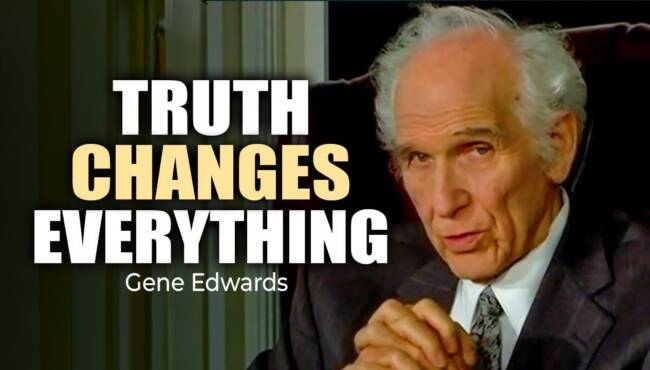
Truth Changes Everything • Jan 01, 2014


Why You're Not Growing Spiritually • Feb 01st 1999
Are you longing for a deeper Christian life—but feeling stuck in routine, religion, or spiritual frustration?
In this powerful and thought-provoking message, Gene Edwards challenges modern assumptions about Christianity, church life, and what it truly means to know Jesus Christ. This teaching confronts common patterns in today’s Christian experience and invites believers into something far deeper—an authentic, living relationship with Christ expressed through His body.
Many Christians pursue spiritual growth through Bible study, church attendance, or religious activity—yet still feel something is missing. Why? This message explores the idea that the Christian life was never meant to be lived alone, nor sustained through external systems. Instead, it reveals a biblical vision of life in Christ that is corporate, relational, and transformative.
You’ll discover:
• Why many believers struggle to experience lasting spiritual growth
• The difference between individual Christianity and life in the body of Christ
• Why much of modern church practice may fall short of New Testament reality
• How true freedom in Christ leads to deeper love, joy, and transformation
• A fresh perspective on Romans 6, 7, and 8 and their meaning for believers
This is not a comfortable message—but it is an honest one. If you’re hungry for more than routine Christianity… if you desire a real, living encounter with Jesus… this may challenge everything you thought you knew—and open the door to something far greater.
“The Christian life is not about trying harder—it’s about living in Christ together.”
Now I’m going to start the conference. I’d like you to listen real carefully next Sunday to anybody who’s ministering. It doesn’t matter who it is or what their background is; from the Quakers on up or down. The minister will open the Scripture and begin by saying, “Now we’re going to read Galatians 1 or Galatians 2.” Now, let us read this passage. Paul said this, and he meant this. Now, how can that become relevant to your life? You’re sitting there taking notes or thinking, ” This is really good. How can it become relevant to your life?’ My answer is: it cannot become relevant to your life. Nothing in Galatians will, in the long run, become relevant to your life.
Maybe today…maybe this week the pastor will say something that helps you feel good or helps you through a crisis, and you’ll thank God forever, and you’ll thank your pastor forever as well, as you should, but I’m speaking of the long haul. Nothing in Galatians applies to your life on the long haul. Now, Gene, why would you say that? The reason is simple. It wasn’t written to an individual. Nothing in Galatians is addressed to an individual. Everything in Galatians is written to a corporate body of people.
(speaking in a pastorate voice) Now you’ll hear a message on 1 Corinthians. I might as well do Thessalonians. I’ll do it in the proper order, not in the order it’s arranged in the New Testament. Somebody in a Bible class…I don’t want to pick on preachers or pastors. I want to pick on everybody. I want to pick on just about everybody breathing air on this planet who ministers in any way. Brother and sister, wake up; it wasn’t written to an individual, and this thought has not crossed our minds. In 1 Thessalonians, Paul says such and such and so and so and so. How can that be relevant to your life? It is not and cannot be, except on a short-term basis.
Are you following me all? Because there was a place called Thessalonica, in which a group of probably 30 to 75, maybe 100 Christians, more like 50 probably, were being persecuted in that town. They were all meeting together. They had no pastor. They met in a home, which is somewhat irrelevant, but let’s keep it informal. They were in a home. They had no leaders whatsoever other than the man who planted the church, and he left them. He left them for a long time. It was relevant. 1 Thessalonians and 2 Thessalonians are relevant…to a people…on the long haul. It is relevant to you only momentarily.
That’s 1 Thessalonians and 2 Thessalonians. So now we’ve come to 1 and 2 Corinthians. 1 Corinthians. Again. Such and such and so on and so on in this passage. How can that be relevant to your life? You came to church on Sunday morning because you wanted to hear what could help you. You have written a question: “Where do we begin to move…how do we move toward knowing the Lord?” And we go to church on Sunday morning to know that. Even the pastor does not understand a corporate endeavor with Christ. He leans over the pulpit and says to you, how can this be made relevant to your life? And the answer is, it cannot, except on a very temporary basis. It is relevant only in the long haul to a body of people, because 1 Corinthians and 2 Corinthians were not written to you or to me; they were written to a body of believers.
I want to go a little bit further, and I want to talk to you just for a second about you and your New Testament. Now then, I made a statement somewhere in Phoenix, Arizona, and some brother just really got upset. I mean, we’re not talking about upset here, folks. We’re talking really upset.
I’m going to confess to you my relationship to the New Testament. How’s that? Okay? I’m 17 years old. I have a New Testament that just came out. I can put it in my pocket. It’s called the Revised Standard Version. It was the first New Testament to come out in 400 years, except the King James, and I liked it. By the way, I’ve never studied the King James. I still don’t know how to speak King James English, and my prayers don’t do much for God because I’ve never prayed to God in it. I wish I still had it. I could pass it around to you. I underlined this, and I underlined that. I wrote little notes here and little notes there.
Let me tell you what I did. When I came to 1 Thessalonians, I read it; I didn’t have the foggiest idea of what that book was about, but I can tell you this. As I read it, a verse went “Whoopee” to me, and I underlined it. Right? Then I went a little bit further, and I underlined that. Then I went a little bit further, and I underlined that one. Then I had about six or eight or ten underlines in 1 Thessalonians, and then I read the whole New Testament. It was all marked up. About every fifth verse, something made me go, “Whoopee.” I had no idea what the other four verses were talking about.
Then I went to the seminary. It’s interesting that when I got into a New Testament class with a man who would read Greek backward, he basically taught and preached to us. He preached on those same verses…the “Whoopee” verses and skipped the boring verses that didn’t have any relevance to us whatsoever. So I came out of the seminary knowing the same thing I did when I went in at17 years old: look for the “Whoopee” verses and preach on them.
Are you following me? Can you understand? When you open the New Testament and read 1 Corinthians and 2 Corinthians, aren’t you kind of looking for the whoopee verses? The things that will bless you, comfort you, and help you. Sometimes you will read it, break down in tears, and the Lord will touch you. It is absolutely marvelous, but you’re still just going through, looking at that thing. It’s not much more, forgive me, but it’s not much more than a Ouija board to you. He’s looking for some guidance. It is as though the heavens are turned to brass, and one little thought can’t get through to earth: 1 Corinthians was written to a body of believers. 1 Corinthians is written to a functioning body of believers who had no one running the place. Paul was writing to them because they were so messed up. After all, Paul was not there.
He finally went there and helped them a little, and all that help started more problems, so he had to write 2 Corinthians. But isn’t it wonderful that Paul of Tarsus, who planted that church, could leave? Isn’t it wonderful that they had problems? Isn’t it wonderful that he could write them a letter? Isn’t it wonderful he could go back to them? Isn’t it wonderful that he left again, leaving those people to find their way together in Christ? Isn’t it wonderful that Apollos, a real dingbat, comes in with his oratory and really gets all the Greeks stirred up? Isn’t it wonderful that the church survived Apollos, the world’s first reverend?
Isn’t it wonderful that Peter, a Jew, came and preached there? And Peter…I just talked about the Greeks: Peter was a Jew, and there were Jews in Corinth. Isn’t it wonderful that Peter could come and preach? Isn’t it wonderful? All those Jews said, ” No, it’s miracles, it’s miracles, it’s miracles.” And the Greeks said, ” No, it’s knowledge, it’s knowledge, it’s knowledge.”
Truth Changes Everything • Jan 01, 2014

Free to Fellowship with Christ • Dec 07, 2013

Sow to the Spirit • Nov 23, 2013