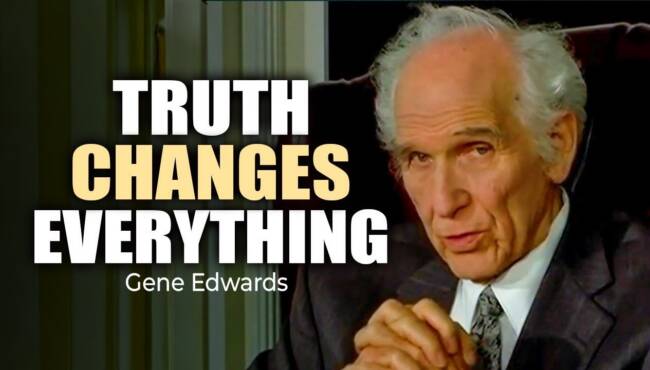
Truth Changes Everything • Jan 01, 2014


The Courage to Die • Nov 01st 2005
In Part 2 of The Present State of the Lord’s Testimony, Gene Edwards continues his deeply personal and historical examination of the modern church, focusing on Watchman Nee, the Little Flock movement, and the rise of spiritual authority structures in the mid-20th century.
Picking up from Hardoon Road in Shanghai, this message explores the powerful preaching and spiritual influence of Watchman Nee and T. Austin-Sparks. Edwards acknowledges the holiness, devotion, and sacrifice of those shaped by that ministry—many of whom endured imprisonment and persecution under Mao Zedong’s regime. The testimony of these believers was marked by sincerity, prayer, and a passion for the church.
Yet the message does not stop at admiration.
Edwards asks a sobering question: Can the highest preaching in the world truly transform a people if practical church life is absent? He reflects on how powerful ministry can produce gentle, devout believers—yet leave untouched deeper issues of authority, control, and spiritual life.
Through firsthand accounts from Taiwan, the Philippines, Hong Kong, and the United States, Edwards recounts his early involvement with leaders connected to the Little Flock movement. He describes the intense structure surrounding locality doctrine (one church per city), visible conformity, centralized leadership, and an emerging culture of unquestioned authority.
This message moves from historical narrative into personal testimony.
Edwards shares his own spiritual crisis after returning from Asia—losing any felt sense of God’s presence for years, enduring illness, poverty, and misunderstanding. He describes the pain of watching splits, accusations, and rigid control develop within movements that once carried a vision of restoring New Testament church life.
At the heart of this teaching is a critical distinction:
The recovery of doctrine is not the same as the recovery of life.
Preaching about the church does not equal living as the church.
Teaching unity does not guarantee humility.
Part 2 closes in 1969, just before the beginnings of what would later unfold in Isla Vista and the organic church movement. The pages beyond that year remain unwritten—just as in Part 1.
This is not a message of bitterness. It is a historical reckoning. It is a call to spiritual honesty. It is an invitation to examine the difference between authority and life, between structure and Christ Himself.
For those serious about church history, organic church life, Watchman Nee’s legacy, and the cost of spiritual testimony, this message is essential listening.
So, I got on the plane and flew home, my dear wife and two children… I’ll tell you that my wife had packed everything at home, given up our apartment, and was about to be flown to the Philippines, when I sent that telegram to her saying I was too sick to continue everything, and I was too. I was one distraught human being. They had had fights; they had splits, and I think I was beginning to understand then that all the great preaching in the world, if you don’t have a life in some way dealt with by means other than preaching, you don’t have anything at all.
I got to the meeting, and I was sought out. In fact, I just got home. I was sought out, and a brother said to me, “Gene, our brother, the leader, has asked you not to report back to your trip to the Far East.” I am not a fool. He said, “Wait until you get back to report. All of them get back.” Well, I knew that writing was like this. It said, “Gene Edwards, you’re a persona non grata. You’re in; this is where you get off.” And I had a crisis that Sunday. That was one of the hardest fault battles of my life. I knew that that movement was about to spread, and I knew that it was about to destroy thousands of lives. I was as clear of that as I am of my own name. I went to the meeting that morning, even though I was forbidden to speak or report, and this word had gotten back to me. Gene didn’t say anything about the Far East except for people’s love for one another. I was wrong about that part.
Now y’all going to have to forgive me, but I’ve been…you don’t understand…I’ve been sitting on this since 1965. I was torn and ripped to shreds that morning, and I found out that the church there, a place called Elden Hall, was on the verge of a split because of the way the people had taken over. While I was in the Far East, the others were in the Far East; these men, these white men, these protégés had just been treating everybody horribly. There had been so many people who came in there, idealistically and alive and gung-ho, and they were shocked. One of them came to see me before Sunday, and his name was Paul. Paul and I had gone straight to the bowels of hell together.
So, Paul came over, and he talked to me, and I was just a young man torn to shreds. I went there to become part of the Lord’s testimony, and that’s all I wanted. I never had any ambitions to be a leader, and I had already heard many times that Gene is the “heir apparent”. Well, there was every reason to believe that, because he hardly ever brought a message to even talk about me. Now, I don’t know where he got that idea; I don’t understand it, but I had no ambitions that way, and my dreams were crushed. I was talking to Paul just a few days ago; I talk to him about once every five years. He said, “Gene, you remember that day?” I said, ‘Yeah, I remember that day really well.” I’d come home from the meeting. I had slipped to the edge of my chair once or twice. I came that close to standing up and saying something, but thank God I didn’t, you’d have never met me if I had.
My apartment was upstairs, on the top floor. I was down like this, my head in my face. Paul came in, and he sat down at the bottom of the stairs. He was amazed that I was just ripped to shreds about what I saw and what was going on over there. So, he came over and sat down at the bottom of the staircase, and I was up there at the top, and I said, “Paul, I have absolutely nothing to live for.” He said, “It’s worse than that, Gene. You and I are in trouble with an apostle. And when you’re in trouble with an apostle, you’re in trouble.” I remembered that, but I didn’t remember what I said to him after. He laughed, and he said, “Gene, do you know what you said after that?” I said, “No.” He said, “Gene, this is what you said to me.” And this is me speaking. I said, “Yeah, we’re in trouble, man. When you’re out of Schlitz, you’re out of beer.” (laughter) That’s kind of the way it was with me. I was out. I did something that maybe has separated me from everybody else. Men were leaving by the droves; I didn’t leave. I said, “Lord, I’m going to stay here. This is where I was when I last saw you. I’m not moving until I see you.” That saved my life. For the next three to four years, I lived in a living hell. I lost the sense of salvation. Some of you have read that in a book, but you’ve never heard when; I had absolutely no sense of an indwelling Lord, and you’ve never had that experience that very few people have, and you don’t ever want to have it.
I remember one day Paul was in my home, spent the night, and the next day he got up, went into the bathroom to shave, and was singing, and it dawned on me that I had not sung a single word in a year. It was there that I learned one thing I could do: listen to Christian music. There have been many pilgrims who were just at the bottom of it all and could not find their way, and I have said to them, “Go get some Christian music, and just sit there and cry and listen.” We had two or three records. Helen and I were poor as a turkey. All my clothes wore out, and I had some good-looking clothes because I had been an evangelist and a preacher. Our undergarments wore out. Our shoes wore out, and I would like to thank General Motors for having made something called a Chevy 2. We did not have a penny in the world to repair that car. Everything on that car was broken, and we couldn’t put a penny in it, but doggone, that thing started and moved a little bit every day, and that was the mercy of God.
Now I’m off the subject. No sense of God. I got to back up a little bit. I guarantee you that what I’m about to tell you, there’s nobody in the world who knows this story. In those few days that I was there, I’ll tell you how I got out. That was the mercy of God. All these men started coming to me, telling me what they’d been through, and it was all horror stories; stories that would continue to be horror stories for the next 40 years. They said to me, “Gene, you’ve got to stop this man, and you’ve got to stop this work.” And that church was split right down the middle because of the conduct of what has been going on. You know what I did? I went to every person in that church by name I knew, and I sat down with them, and I said, “It ends here. You get back into that building, sit under that man, and don’t move. It’s where you belong, and don’t you dare split that church, and don’t you dare try to stop this work.” And somebody was being warned those days, and you know what reward I got for that? I was charged with trying to split the church.
Well, I finally got a job in Altadena. There was another little group meeting. There were several meetings, sort of as satellites to that, and they were just like us. They thought it was the grandest thing in the world. And without my knowledge, they said, “We’re in Altadena, and Gene works in Altadena. He’s a schoolteacher in a ghetto.” I was ill, I’d come home from work, and Helen would drive up to the car and open the door and literally pull me to the bed. I got in that bed, and I stayed there until it was time to go to work the next day. I did not move. I was swollen. I shuffled when I walked. I was in excruciating pain, and my Lord had left me; at least that’s the way it felt. And you know what I learned? I learned a lesson: you walk by faith, not by any feelings on this earth. You walk by faith, and that’s all I have. By the way, I will say this. I learned that from reading something by Jeanne Guyon. I’m going to tell you something now, and I’ll say it again in a minute. Those of you who have trouble with the church, who have problems at home and life like that, we walk by faith. We don’t walk by circumstances, nor by how good we feel.
Anyway, this little group of people just did it by the book. They wrote a letter to Elden Hall, and they said, “He lives in this town, and he works in this town, and we want him to meet with us.” Boy, if God ever was merciful, I don’t know if I’d have been excommunicated or what would have happened to me, but that just pleased everybody. And for the next two years, I met with that group of Christians. At one time, we went to a meal after two years. I took a deep breath, and I walked into Elden Hall, and I was in a meeting, and people stared at me like I was a devil, and I don’t think I was fully aware of just how black my name had gotten, but it was par for the course. Mike, it was par for the course; they did this with everybody. Anyway, I picked up a sheet of paper on the table as I walked out. I don’t know why I picked that thing up, but I lived to regret it. I had no idea what it was. I don’t think I ever looked at it. I want you to understand that I’m trying to explain the current status of God’s work on this earth. To this day, you will be told that I am a thief and that I stole from the church because I picked up that sheet of paper.
Back at Elden Hall, you know, one of the things I noticed in the Far East is that when they had elders, you kept them forever. And boy, those men were elders when they weren’t elders. A man will become an elder if you give him that title. I don’t care if he becomes the devil himself; that man will continue being an elder. Now you know why we don’t have elders. That name has been too perverted ever to be able to function in its proper way.
I do not know how to express to you the next few minutes. I was watching a man who had gained absolute control over people’s lives at any cost. I was watching men, either in their soul or their flesh, I have no idea, but not in their spirit, ruthlessly throwing people out, taking over other people’s works, and fighting to maintain their ministry. I lived in a place called Home Park, and the phone rang, and it was a guy named Petri. I remember his first name. He said, “Gene, have you heard that Campus Crusade has split? John led it, and they all want the church, and they want you to get out to Kansas immediately and speak to them as their apostle.” Now you all don’t know what that means. I’ll tell you exactly what it means. It means absolutely nothing. It was just the way they were.
So, I drove over to San Bernardino. We had two or three cars, and we were going to rendezvous in Missouri. Two men were sitting in the back. You’ve heard this story before. One of them was named Hal Lindsay, and the other was Gene Edwards, and we drove for three days and nights fighting over eschatology. Well, we didn’t fight. We enjoyed it, and you know, we are still friends. I got there, and I can tell you that that was nothing. It was just foolishness. I got back, and it was late 68. I got a phone call, and it was those men, and they were holding a conference at UCLA, and it was the night before New Year’s, and they asked me if I’d like to come over. They’re the kind of guys who stay up all night talking, and so I will leave you at UCLA. I didn’t know it was going to take this long. I am on my way to UCLA, and it was the day that changed our lives. So, you know what we’re going to do? I don’t know what we’re going to do. That’s the end of that. The status of the testimony of the Lord’s work, up until 1969.
Truth Changes Everything • Jan 01, 2014

Free to Fellowship with Christ • Dec 07, 2013

Sow to the Spirit • Nov 23, 2013