Escape Religious Cage • Jan 10, 2026

Paul's Deepest Battle • Aug 29th 2025
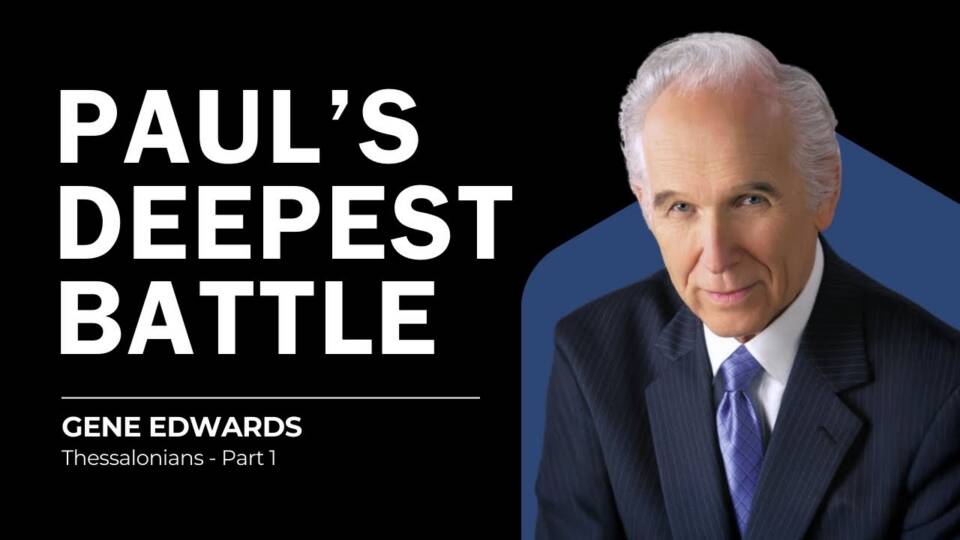
Step into the very atmosphere of the first-century church, beyond casual reading, to truly ‘smell’ what early ‘ecclesia’ meant. This message unveils the profound sacrifices and radical faith that shaped the nascent Christian movement, particularly through the lens of Paul’s second journey. We explore the informal, unpaid ministry model of the early house churches and the intense spiritual battles Paul faced, from defending the gospel against false teachers to enduring severe beatings and imprisonment in Philippi. At the heart of it all is Paul’s radical commitment to serving Christ as a layman, working with his hands and often without financial support, a principle that challenged and continues to challenge conventional ministry models. Join us to grasp these essential truths and experience a deeper appreciation for the gospel’s enduring power in your own life.
But before we do, I’d like to review with you the purpose of looking at Thessalonians. We are not going to be looking at it strictly to study the Bible or to master a book in the New Testament. Our purpose is a lot deeper than this and a lot more important. When you plunge into any book in the New Testament, often it’s just with the idea of what I can learn about the Scripture that benefits me. But in so doing, we suffer a great deal in our loss of not getting the spirit of what really took place in the first century. So, I’m not going to begin by opening the Scripture and speaking to you about what verse 1 in Thessalonians is about.
Before I do that, I want to build with you a complete matrix of everything that was going on that provoked that letter, what really caused it to come into existence, what was happening to the major players, and what was the sociological, cultural background. Now, all of that is for a very definite purpose. It is so that you can understand the atmosphere of what was going on among first-century Christians.
I don’t go to church on Sunday morning. That is, I don’t sit in a pew and listen to someone speaking behind a pulpit. I meet with a group of Christians in a living room. Very informal. We have no paid clergy. The ecclesia, the church itself, carries its meetings each week. Now, that’s not just because of some personal preference on our part. This was also the atmosphere of the first-century church, and to rebuild that atmosphere is perhaps the main purpose of these messages.
I want you to know what it was that took place in the city of Thessalonica among the believers in the first century, that you might be able to better appreciate what the gospel is to be for your own life. I would like for you to know the full spirit, to be able to literally smell what ecclesia meant and what the expression of the church meant in the first century.
Now, before we can go looking at Thessalonians, we have to finish our story about the churches in Galatia. And we have to finish the story of Paul’s epistle, his letter to the Galatians. In order to do that, let’s do a little reviewing.
We go back to Paul, Barnabas. They’re the first people who come up on the center of our stage. They have been to a place called Galatia, and they have raised up four Gentile churches in the lands far from any of the Hebrews and Jews. Now, they got in trouble doing that. And here’s what happened. They came home to their home church in Antioch, and some of the devout Hebrews, Jews, came to Antioch and told the people that they had to be circumcised, and there were many, many, many laws they had to live by. Paul and Barnabas did not appreciate this. And they demanded that some decision about this be made. So they went down to Jerusalem, Paul, Barnabas, and Titus, and met with the apostles in Jerusalem. And they had the greatest meeting of the first century as far as the luminaries were concerned. They got together and the question was, ‘Do those heathen up there in Galatia and up in Syria have to be circumcised and do they have to obey the law in order to be believers in Christ?’ And after a very heated debate, the apostles decided, No, Gentiles do not have to be circumcised nor obey the letter of the rituals of the Mosaic tradition.
Well, Paul and Barnabas are about to go home to Antioch and tell their story to the people there. And they also know that they need to get back into the four churches in Galatia because those are the four churches that have really been hurt. The reason they were hurt so desperately is because one of the men who was at the council in Jerusalem went all the way up into the hill country of Galatia and began telling those people that Paul and Barnabas were not truth-speakers, and that those people in Galatia had to be circumcised and obey the law. Now, that man’s name is not given in the New Testament, so I gave him the name Blastinius, Drachma Blastinius. And he did much damage to those four churches.
So, Paul and Barnabas have a profound sense of it’s time to go home to Antioch and announce that this debate is over, no circumcision for Gentiles, and then to go back to Galatia. Now, as they were packing to leave, someone very, very wisely said, you know you may be accused of lying, that you just made this up, so we here in Jerusalem are going to draw up a letter signed by the leaders of the church that this matter is settled, and then you pick two men from our fellowship who are well known and reputed men of integrity and take them with you back to Antioch, and they will bear witness that the letter is authentic.
And so, the letter is drawn up. Paul and Barnabas row it up in a nice scroll. And two men go with them, men of rural stature. One is named Judas called Barsabbas, and the other is named Silas. Judas called Barsabbas was a gentleman who almost became one of the twelve apostles. And Silas is also a well-known Jewish believer, very faithful. And they go back now to Antioch.
And when they get there, they read their letter. And Judas called Barsabbas says the letter is valid, and it’s true, and I have drawn it up. And Silas does the whole story of what happened in Jerusalem. Everybody rejoices that the Gentiles do not have to be circumcised. And then Paul and Barnabas sit down to the business of making their plans to go back to Lystra, Derbe, Antioch, Pisidia, and Iconium, to read the letter to the four churches so damaged by Blastinius.
And Barnabas says to Paul, Paul, we want to take John Mark with us again. Paul said that the little kid will run out on us the first time we have a hard time. And Barnabas says, Oh no, my cousin John Mark is a very fine young man, and he’s learned his lessons, and he’ll be very faithful. And after all, Paul, we did have a hard time. Paul said, No, absolutely not. And Barnabas says, absolutely yes. And they have an extremely serious conflict between them.
Escape Religious Cage • Jan 10, 2026
Break the Dead Chains • Jan 10, 2026
Revelation over Religion • Jan 10, 2026