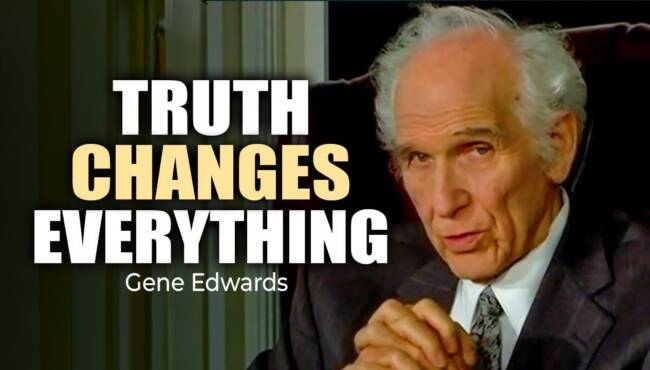
Truth Changes Everything • Jan 01, 2014


ABIDE IN CHRIST - THE SECRET OF JOHN 15 • Sep 13th 1973
What does it really mean to abide in Christ? In this powerful John 15 Bible teaching, Gene Edwards explores the secret of abiding in Jesus, living in complete dependence upon God, and experiencing the deeper Christian life through union with Christ.
Drawing from John 5:19, John 15:1–5, and Galatians 2:20, Gene Edwards reveals a profound spiritual truth: Before Jesus Christ called His disciples to abide in Him as branches in the true vine, He Himself had lived in complete dependence upon His Father.
Jesus declared that He could do nothing of Himself, but only what He saw the Father doing. His life demonstrated perfect fellowship, surrender, obedience, and dependence upon God.
In this Christian Bible teaching, discover:
Gene Edwards challenges believers to look beyond religious formulas and spiritual techniques. Instead of simply asking how to abide in Christ, he invites us to behold how Jesus Himself abided in the Father.
The Christian life is not merely an effort to imitate Jesus through human strength. It is an invitation to participate in His life, depend upon Him, and allow His life to be expressed through us.
Whether you are studying the Gospel of John, seeking a deeper relationship with Jesus Christ, or longing for greater spiritual maturity, this message offers a Christ-centered perspective on abiding, surrender, and Christian discipleship.
Scripture References:
John 5:19–20 | John 15:1–5 | Galatians 2:20
So, brothers, in John 5, we see a Christian life being lived out by the only Christian. That was the Father’s life. Now, the unique experience of one man, the Son of God, having that same experience. Now, suddenly, in John 15, this beautiful history of life, this glorious experience, this magnificent relationship, this unutterable, incomparable experience known by no one but God and Christ, suddenly, historically, gloriously shifts. And the invitation is given to others to join this two-person experience.
That experience can’t be compromised. That experience can’t be cheated. It can’t be watered down. And somebody has got to stand in the third place. In fact, it is only second place, because even the Father had never had this experience. So, it was the Father and the Son having the experience. Now then, it is a third person, and who has the experience? Who? Us, with the Son, in the Father. Us, with the Father, in the Son. So there are two experiences: the Son experiencing this relationship with the Father and the Father experiencing this relationship with the Son.
Now there is the disciple, you, experiencing the same experience with this duality. The Father and the Son now experience with you what the Son once experienced with the Father. I tell you the Father gets joy out of re-experiencing His experience with the Son. All He needs is somebody who will hold their nose and jump. It’ll take a long time for us to understand that experience.
Alright, let us listen to a disciple who one day decided he would, in fact, walk this way.
Galatians 2:20. You’ve read it a thousand times or at least a dozen. I have been crucified with Christ, and it is no longer I who live, but Christ lives in me. And the life which I now live in the flesh, I live by faith in the Son of God. I believe you’re all aware that it should read, “I live by the faith of the Son of God,” and I don’t know why the New American doesn’t translate it that way. It doesn’t give it a little note in the margin, either. I live by the faith of the Son of God. He loved me, and He delivered Himself up for me. It’s the last part that I want you to look at. He delivered Himself up for me.
He delivered Himself up for me. Those last six words, what is the deep meaning of that? What is the deep meaning of that? It was the deepest meaning I know…the deepest meaning I know was delivered to you on the night we talked about the Lord dying, but give it to me in a whole, complete statement that we can all understand.
He allowed Himself to die. Now, this is closer, much, much closer. All right, I’ll help you. Christ had to do something even the Father could not do. This, I believe, is what made Him redeemer, but it was a legitimate question; this, I believe, was the last moment in yielding Himself to death that He had to do alone. This is where He really earned His saviorhood that no one else can have.
Now, listen. The word “Himself” is the key here. He delivered “self” up for me. He took the nature, “self,” and put that self on the cross to death. What self did he deliver up? His self-life was delivered up. Until then, Jesus said, “Apart from the Father, I can do nothing.” There was “I” in there, but in the last moment on the cross, He delivered the “I” up. Now the “I” is put to death. He took not only the self, but He also took…He really took the self, the only real self there was. If you please, the only unfallen self there ever was, and He allowed something unfallen to go to the cross and die. He took the self-nature and put it to death.
Now, brothers, praise the Lord that never happened; not even to the Lord. The Lord Jesus could not say, “It is no longer I that lives but the Father.” He never made that statement. He never said, “No longer I, but the Father.” He said, “I put Myself in subjection at all times to the Father.” He could not say “I no longer exist,” but in the last moment on the cross He took His self-nature and put it to death.
John 15. Now please tell me what I’m about to say. Audience: He became one with the Father.
Alright. Wonderful. Audience: The vine became the branch.
The branch became the vine. But now, look at Galatians 2. Alright, I’ve changed the subject. I’m now in Galatians. Do the same thing in Galatians as we did in John. He Lost The “I.” There was no longer a Christ; He was put away. The “I” was dead and killed. Now, He’s no longer the branch; He’s the vine. Whatever has happened to Him has happened to me.
Truth Changes Everything • Jan 01, 2014

Free to Fellowship with Christ • Dec 07, 2013

Sow to the Spirit • Nov 23, 2013