Escape Religious Cage • Jan 10, 2026

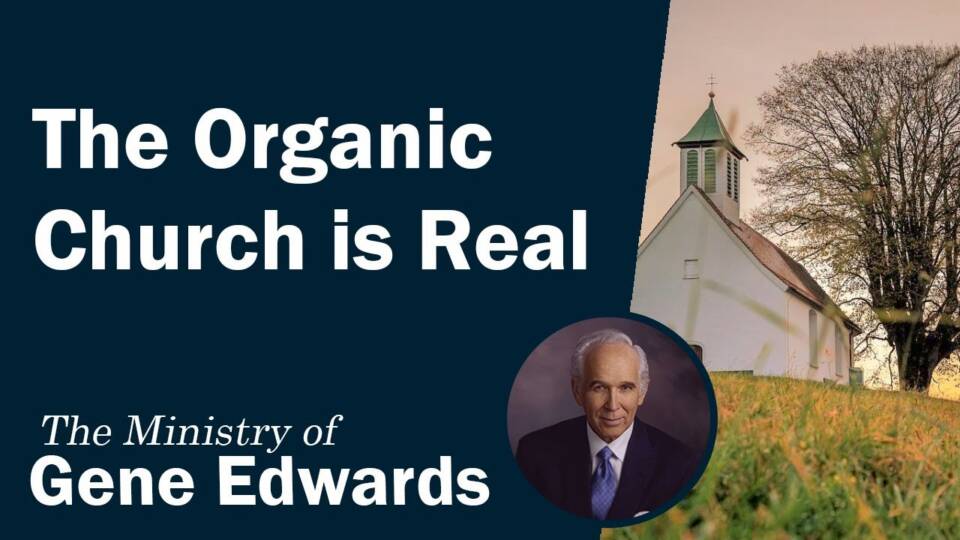
The Organic Church 2007 • Aug 15th 2025
What if your understanding of the ‘New Testament Church’ is missing a crucial, living dimension? Gene Edwards humbly invites us to reconsider the profound reality of the early church: an “organic” expression of Christ that flourished long before the New Testament was compiled. He challenges the idea of the church as a “machine” built from verses, revealing it instead as a spiritual, living creature, sustained by the indwelling Spirit and mutual care. This compelling message calls us to look beyond rigid structures to discover the vibrant, native “DNA” of the Ecclesia, fostering a direct and intimate experience of Jesus Himself. Join us as we explore a fresh, heartfelt perspective on what it truly means to be the Body of Christ. (correction in video – Galatians was written in 50, not 30, and the two Thessalonian letters were written in 51 and 52)
This is Gene Edwards, and this is the Organic Church, and I’m hoping that this recording will be listened to twice. First, by whoever has this CD, and the other, by whoever you might gather around it. I’m faced with a rather difficult challenge here, and that’s to convince you that the organic church is more New Testament than the New Testament church; that the organic church is what really did happen in the first century and should be happening today. For instance, maybe we can begin there.
At the time the very concept of the organic church was taking place, there was no such thing as a single passage of NT Scripture in existence. Paul set the pattern on his first journey and on his second journey, and yes, even on his third journey, of how a church is to be raised up. And yet the very first book he ever penned was Galatians, which was after the first four churches he raised up. Then he didn’t come in there with a New Testament, putting this verse and that verse together. So that’s my first point, and here’s the second one.
I don’t know how familiar you are with the history of the first century, but the manuscripts, another word for that was the Codex, they didn’t just suddenly come into existence – 27 books, all sewn together, and everyone standing around reading them. It was a very slow process; in fact, it was a process so slow that sometimes it’s frightening to even tell people what it was. So, I will gamble just a little bit and say that it was probably not until the 400s, in fact, at least 397, when the entire concept of a bound New Testament began to emerge. Certainly, there was nothing in the very first century that would even come close to being called a New Testament as we know it. It was still being written, still being considered, still being appreciated, but it took until after the destruction of Jerusalem and the temple in August of the year 70 A.D. before the Church of God really woke up to the fact that we should probably start gathering together the writings of the apostles. And again, without any thought of this being how we’re going to produce the next church.
Now I’m going to talk to you a little bit about just what did happen on Paul’s first journey and his second journey, and yes, on his third journey, so that you can get the organic nature of the church. Actually, this comes down to a very simple question: Is the church a machine? We put the parts together and turn it on, and it suddenly works. Is it a “put this and this and this and this and this together, and this and this and this and make it work?” And that makes a church, and that makes a New Testament church? You know, we don’t even need God to pull off something like that. The nature of the church is spiritual. The nature of the church is Christ. The nature of the church is a living creature. And yet somehow, we have the idea of: we’ll search the verses in the New Testament, put them all in their proper order, then go and put all of these elements together, and—voila—there’s a church. It doesn’t…and didn’t… happen that way. I want you to join with me here for just a moment in looking at that very, very first piece of Christian literature. Now, whoever penned it, try to remember this was the summer of 50 A.D.: we are at least five years away from the first gospel being written – Mark. Maybe two, three, four, five years after that, before Matthew was written. And then about 62–63 A.D., when Luke was written, and possibly as late as 80 A.D., before John was written.
We’ve got a book here called Galatians, written in 50 A.D. And it’s written to Gentiles. Now, if you walk up to a Gentile in Galatia and start talking to him about Abraham or David or Adam or Moses, he’d look completely blank at you. So, I want you to remember that this was not a piece of literature that got passed around in Israel, and it did not get passed around in Jerusalem or in Judea. It’s being passed around in a very obscure part of the Roman Empire, rather untamed, extraordinarily poor, and ignorant. And let’s look at it and see what we find.
In one of the first chapters, Paul is trying to clarify and answer some lies that have been told about him by some Jewish people. Ah, wait a minute. This is a letter he wrote to them…. two years after he met them. On the day he met them, they’d never heard of David, or Jesus, or Moses, or Adam, or Abraham. So, let’s hope and pray he was a storyteller. And he was. And he had told them the story of Abraham. But that beautiful passage where he said, “I’m so shocked that you have been among you who have seen Jesus Christ graphically, publicly, graphically, as in a drama, crucified.” So, he has told them the story of the crucifixion. Be sure, dear child of God, he didn’t just tell them about His dying on the cross. All evidence in that book points to the fact that he also told them what happened on that cross—that you will not find in Matthew, Mark, Luke, and John—but which was part of the gospel. And that is: that the world was crucified, and the world system was crucified on that cross. And so was the old man. And so was creation. And so were you. And so also me.
I was crucified upon that cross. And the law was crucified upon that. And Moses’ teachings and the observance of the many ordinances and the festivals and holy days—he makes it very clear then and also in Romans and in other of his writings that these were all put to death. And he graphically demonstrated this to these people, and yet later, when some Jews from Jerusalem came and visited them there way up in obscure Galatia, they believed those men. And Paul was really upset. You just keep reading Galatians, and what do you see? Over and over, Paul speaks of the Spirit. So, this we know: he told those Galatians something about Abraham, he told them something about Christ dying on the cross and ending everything, all of creation itself, and everything that was in it, including themselves and sin. These are the things they learned. There’s one other thing that they learned, and that is that there’s a Spirit—the Spirit who brought them Christ, the Spirit who worked mighty things among them, the Spirit now working in you, the Spirit that is crying out, “Abba, Father,” in you.
And now we are seeing things spiritual that are the foundation of those first four Galatian churches. Learning to hear a calling God who dwells in each one of them and dwells in them corporately. And upon this, those people were built as a body of believers. Paul talked to them about caring for one another. When he was gone, he talked to them about not becoming legalistic, about not listening to some of the gospel. Some of this he wrote in the letter, but some of this he said while he was with them. Stay with me for just a moment. Read Galatians. Look at it and ask yourself, ask yourself again and again, I’m a Gentile. I’m in a town. I‘ve never heard of Jesus. I don’t even know where Israel is. Man, I haven’t even heard of Israel. A man walks in, talks to me about salvation. I believe; something inside of me happens. That’s the Spirit. And Paul addresses them and says, That’s the Spirit. You’re feeling something. You’re sensing something. Something new is going on. That’s the very Spirit of Jesus Christ working in you.
And he tells them stories. Tells them that they have died in Christ. And they get so excited. And they hug one another, and they take care of one another. Now here’s the funny part. That first church was in Pisidia Antioch; he was there for about five months. The second church he went to was called Iconium, and he stayed there for about five months. We would have to figure in walking time for the apostles. After that, Lystra was not very long and was almost stoned to death. And then Derbe, he was either there six or seven months, or he was only there three or four weeks. It’s really hard to say. That’s it.
He then went back to Pisidian Antioch and ordained some elders, and then went to Iconium and ordained some elders, stayed a few days, strengthened each one of the churches, went back to Lystra—where he was an outlaw—and had to sneak into town. It’s not at all sure that he even got back to Derbe. But he bids them all goodwill and takes off. No New Testament. Gentiles who know nothing about Christ. There is no Bible. There is no church building. There is no pastor. There is no songbook. Five months – that’s from a dead start.
That was a New Testament church; what I boldly declare was organic. Now, what do I mean by that? I mean, it was natural. I mean, it’s organic—almost exactly like the instincts we’re born with. We’re told that two of our strongest instincts, even in the cradle, are fear of falling and fear of loud noises. And we’re born; every one of us is born that way. There is a church instinct. These people said goodbye to those two apostles, and they had the Spirit. And they had Abba Father. And they had one another. And they had meetings where they shared with one another and cared for one another, and out of that grew an organic expression of Christ that we now call the Ekklesia. And they didn’t hear from Paul again, until Paul heard that some Jews had come in and tried to change their gospel and to cut with a knife the male, telling them they could not be saved. And when Paul heard about this, he was mortified. Paul didn’t come back at first; he sent a letter first. And here are four churches, each that had been left alone in a heathen land, with nobody around them, no one to help them, and the pastor had not developed, because the development of the pastor didn’t come until the Reformation. Nobody’s sitting in pews listening to preachers. These are people—and that’s all they are—taking care of one another.
Escape Religious Cage • Jan 10, 2026

Break the Dead Chains • Jan 10, 2026
Revelation over Religion • Jan 10, 2026