
Stop Playing Church • Feb 18, 2026

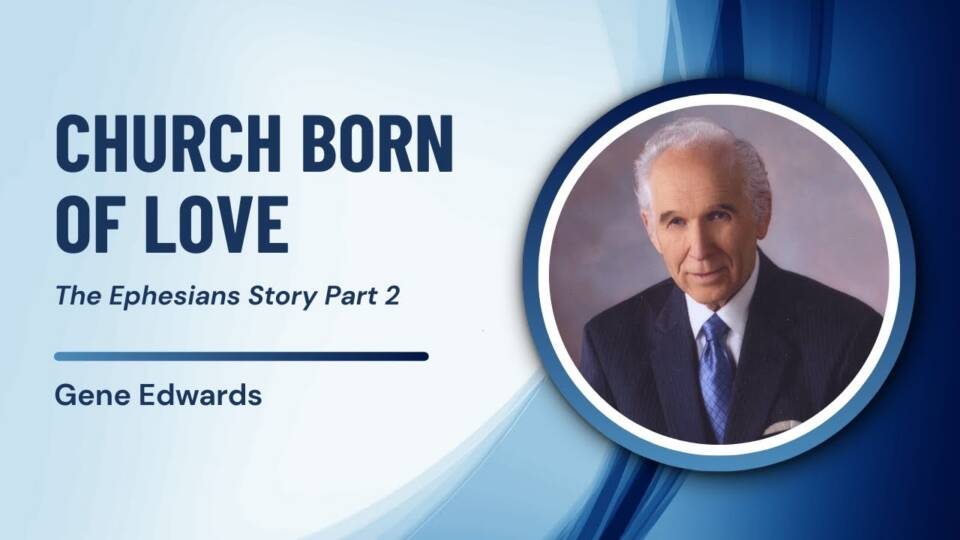
Church Born of Love • Aug 15th 1993
Imagine a faith so revolutionary it transformed a society steeped in misery and caste, without buildings, budgets, or formal leadership. Gene Edwards unveils the raw, unvarnished truth of the first-century Ekklesia – a gathering of people who, despite extreme poverty and hardship, discovered an electrifying, instinctive love for Christ and each other. This wasn’t built on programs or rituals, but on the profound, indwelling presence of Jesus and an organic unity that defied all social norms. This message invites us to look beyond institutional forms to rediscover the powerful, unhindered life of the Church as God intended, centered solely on Christ and a revolutionary love amongst its members. Tune in to be stirred by this ancient, yet ever-present, truth.
I don’t care if you did not understand me. It is not necessary that you understand me. Your spirit understands. And you really have enough information there, sister, to go do some of this stuff right now. I mean, tomorrow morning, when your hubby leaves you and you’re so tied up in things, go get lost. Praise the Lord. Go get more. And those are the deepest things that we can do today. If we don’t have a gospel at least this big to declare in these homes, we ought to really go back to the Baptist church, because it’s far safer. Otherwise, we’re going to hurt a lot of you.
Remember, you did not understand what I just told you. It is not important that you understand. Your spirits understand. Poke around and let your spirit show you that you are from eternity and will return. You’re very ancient and you’re very young and your antiquity is the future, not the past. Your antiquity is in the future as well as in the past.
Alright, we’re going to meet the city of Colossae, probably a town of no more than 5,000, which would actually be a large city at that time. Come with me to this town. First of all, I would like you to look at the economic conditions and understand that it is totally unlike anything we understand. We’ve seen too many movies about the first century, and we see everybody in their beautiful robes walking around, and everybody’s lovely and beautiful in the forums, and the streets are wide, and the chariots are passing by, and it looks really great. But here is the truth.
First of all, it’s very difficult to understand that people had never thought that the concept of freedom for the masses had never crossed anyone’s mind. The concept of democracy was unknown. People were resigned without question to their position in life. And it was a caste system. Here’s what’s so difficult to understand. If we were to try to make a chart, we’d have to draw a circle and right down the middle horizontally, we would say the bottom half of the people are slaves, close to 50%. The top half would have to say 48% of them are people whom we would probably refer to today as beggars if we saw them. They are not enslaved, nor owned, but they themselves own absolutely nothing. Do not look upon them as being people employed full-time. The concept of full employment, shucks, didn’t come until the late 1700s and the 1800s of human history. These people are simply seeking to do one thing, and that’s to keep from starving to death. The average age of these people: they’re dying at around 30 to 35. If you met a 30-year-old person in the city of Colosse on the streets, he would look like I do around 60 years old. Someone 40 would be considered old, about like we would look upon someone between 70 and 80. If you made it to 60, you were considered what we would consider someone today living up to 85, 90, or older.
Paul once called himself the ancient one, and he was about 60, and that’s about as old as people got to live in those days. Stature, because the food had so little nourishment to it, people were between about 4’8 and 5’4. Virtually no one was any taller than that, and if they were, they were considered giants. You look at someone who’s 6’6 and think he’s tall. They look at someone who was 5’10 as a giant.
I want you to see the streets. The streets are covered with filth. They’re about 5 ft. wide. There’s a little channel right down the middle of the street. You can’t walk on the street; you can only walk on the filth. Everything that is garbage, everything that is human waste or animal waste, is piled out in the middle of that street with hopes that someday it’ll rain and wash it out of the town. This is where a great deal of the disease spreads from. Probably a mother bearing children would see less than half of her newborns reach adulthood, and a lot of it was right there in the streets. The stink is beyond our comprehension. Flies are everywhere. A typical non-slave is living in a room, not a house. There’s a fire in the middle. There may be a mat of straw on the floor. There is a window, and it probably has nothing like what we would consider glass; they might stuff it full of something when it rained. There would be a door. This room is filled with soot because of cooking in it. The people slept on the floor, which was often dirt. Five, six, eight, ten people might live in one of those rooms, and that is the way the freemen, people who were not slaves, and they weren’t actually free; that was their home. The slaves lived in like quarters, and some of them had to sleep outside except in the coldest of weather. Their owners lived generally up in the hills around the town to stay away from the stink and villas, mostly small and nothing really you and I would call attractive, with a few really major beautiful buildings up around the hills of the truly, truly wealthy.
Now that’s 98% of the way people lived. As far as those who were not slaves, the men walked into the marketplace every day, hoping someone there, perhaps one of the wealthy of the city or a merchant, would need someone to help for half a day or a day to work in the fields or to do something, to haul something. And people lived day to day. They were not paid in money. Neither the slave nor the people who were not slaves. 98% of the population had no idea what money was. They didn’t hold it in their hands. They were paid in grain, or they were paid in fruit or vegetables, which in turn they would take to the marketplace and border and haggle back and forth with the people in the marketplace who had something to sell. Now that’s the way they lived, and those are the people to whom Paul of Tarsus is bringing Jesus Christ, and try to remember, he is bringing to them the ekklesia, which is the most electrifying thing that ever happened in the lives of people from the dawn of western civilization. The ekklesia, the most electrifying, magnetizing, awesome, mesmerizing thing that people in a town had ever, ever beheld.
Now, keep in mind that half of those people are slaves. They are under the domination of a wealthy family that may own many. Now, you think of the slave as working around the house. Not so, these slaves actually made a living for the wealthy. The owner of the slaves would send those people out into the fields that he owned. They owned nothing. It wasn’t even anything as high up as a sharecropper. Or he might send them into the marketplace with a skill. And there they would pit their low price of their skill against someone who was a tent maker, and the tent maker, any kind of repairman, a shoe cobbler, even someone with any kind of skill, a knife maker, anything that was out there, if the slave had a skill similar, he could always underbid the free man. The free man’s only hope of making a living was to do it a little better and hope that someone wanted quality. And that, by the way, you should keep in mind, is what Paul faced every day that he worked in the marketplace as a tent maker. He was constantly having to bid no lower than a slave who made no money whatsoever and took whatever it was that he had made back to his owner and laid it at his feet. Now that’s the economic conditions. That’s the sanitary conditions. Culturally, everybody had one name. There was no sense of family. If there was a guy whose name was Apollynus, his wife’s only name might be the wife of Apollynus. You might grow up your whole life being called nothing more than ‘son of Apollynus,’ even though Apollynus might have been dead for 15 years; that was your name.
And each stratum of people, the slaves, those who were not slaves, had certain names that fell within their category. Merchants had different kinds of names, and the wealthy had yet another kind of name, and the soldiers another. And the Romans and the wealthy sometimes even had two names. And nobody who became a Christian in those days ever called anyone by their last name, so that there would never be any knowledge of their social strata. The church of the Lord Jesus Christ was without social caste, but that’s getting ahead of our story, isn’t it?
Anyway, I want you to see people. I want you to look out here at this so-called congregation. They’re all sitting in a home. Let’s hope there’s one merchant who can read and who has a decent place to meet, and everybody’s in this room. There are torches on the wall to give some light if it’s at night. If it’s early morning and there are torches on the wall again, and everybody’s gathered in the morning, and Tychicus opens this letter. I look out at the faces of these people. There’s a 30-year-old man who has wrinkles deep in his face. There’s a 25-year-old woman out there who looks 50, and if you don’t think that’s possible, then you’ve never seen some of the jungle tribes who eat such meager and poor food. They’re dying of old age at 30 and 35, and that held true just about up until two centuries ago, when it had been pushed all the way up to maybe 40 or 45.
I want you to look at the old men when they’re not so old. I want you to see the tattoos around their mouth and on their bodies. I want you to see the scars. Everybody has sores on their skin. There are several people there with one eye. There are blind people there because of malnutrition. The eyelids have curled up underneath and scratched out their eyeballs. There’s no beauty in this room, and it stinks to high heaven because the concept of a bath has not yet taken over the world. You get a bath in Rome. You get a bath if you’re one of the well-to-do, and that’s an all-day experience for you where you sit around and bathe. These people don’t bathe.
Stop Playing Church • Feb 18, 2026

Escape Religious Cage • Jan 10, 2026

Break the Dead Chains • Jan 10, 2026