
Faith Without Answers • Apr 27, 2026

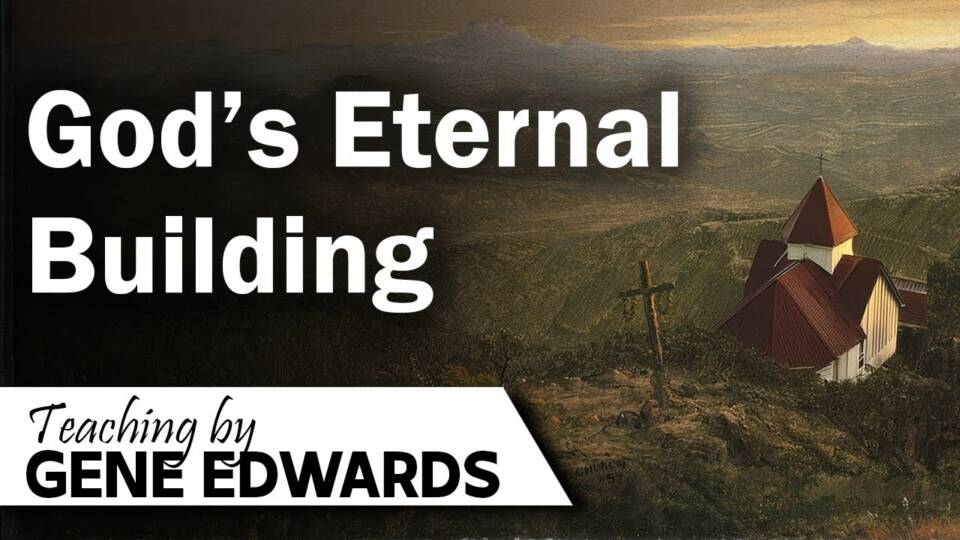
God's Eternal Building • Aug 30th 1969
Why did God bring Israel out of Egypt?
Not merely to rescue them — but to build.
In this message, Gene Edwards unfolds the spiritual meaning of the Tabernacle in the wilderness as a revelation of God’s eternal purpose: the building of a corporate man — the mingling of God and humanity.
From Genesis to Revelation, Scripture moves from raw materials (gold, pearl, precious stone) to a finished city. In between stands the tabernacle — the visible pattern of God’s building.
After leaving Egypt, Moses ascended the mountain and dwelt in the presence of God. There, he received the pattern. Throughout Scripture, whenever God’s people leave sin, religion, and the world, He reveals His building.
The tabernacle was unlike anything on earth. It was heaven’s pattern manifested in the wilderness.
But before entering the building, there are experiences we must pass through.
The first object encountered is the bronze altar. Bronze represents judgment. The altar was made from censers used in rebellion — melted down and transformed into an instrument of sacrifice.
Entry into God’s building begins with death.
The sacrifice was burned to ashes. The worshiper identified himself with the sacrifice. This speaks of dying to self, talent, ability, ambition, and natural strength.
You do not enter the church by prominence.
You enter by a funeral.
The laver was made from mirrors. It exposed. It washed.
Church life is a mirror.
In fellowship, believers are exposed — pride, ambition, impatience, hidden motives. This exposure is not condemnation; it is cleansing.
Paul speaks of washing by the Word. In church life, brothers and sisters become instruments of exposure and refinement.
The outer court wall was fine white linen — visible to the world. It was not moralism, but righteousness.
Judgment (bronze) separates the world from the building. Righteousness is what the world sees.
Before glory, there is judgment.
Before gold, there is bronze.
Only after altar and laver does one move toward the inner tabernacle.
This message also addresses offering. God asked Israel to bring gold, silver, and fine linen — not their leftovers, but their best. The Lord desires what we value most. When given for His building, it returns in transformed form within the church.
The tabernacle is not merely ancient architecture.
It is a living pattern of God’s building today.
God is not seeking individual spirituality.
He is building a corporate expression.
And the pathway begins with offering, judgment, exposure, and cleansing.
The first thing in the building that we see is the altar. And he gave the measurements of it. Two by one and a half by one. And he said, ‘You will take the altar, and you will build it of acacia wood, and you will overlay it with gold, and on it shall be the horn of the oil.’ So the first thing in moving toward the building is the altar. Now, brethren, the first thing God said when he spoke of the altar, He told him what to make it out of, and from this, we see what the altar is. He said, Make it out of the brass censers. You can read this in Numbers 11. The censer, the brass censer that the men used when they rebelled against Moses. ‘Melt it down and build an altar.’ This is a sign that the altar represents judgment.
And then after you have built the altar, offer a sacrifice, and burn it as soon as it’s built. It is made of wood and overlaid with bronze. Bronze is always a symbol of judgment. And then He said, ‘Take it and put a sacrifice in it and burn it. And don’t do anything with it. Only keep the ashes.’
Brothers, the first element in the building is the altar of judgment. As you come to go into the building of God, before you can get in, you have got to go through the altar of judgment. You come and lay up before the Lord a sacrifice, and the Jews would take their hand and they would lay their hand on the head of the sacrifice, and they would speak before it. They were imputing themselves into that sacrifice. And then the priest representing God took the sacrifice, and they burned it.
Brother, how do you get into the church? Praise the Lord. Brother Dave, do you know about this thing? Brother, we get there by means of a funeral. You are taken, buried, and die. All of you is taken and burned. It is buried. It is destroyed. It is taken away. Brothers, the key man on campus doesn’t go anymore. Or did you ever hear that term? Did Crusade give that up? When you get to the campus, find the key man on the campus and win him to the Lord. Brothers, the Lord doesn’t want good men. He doesn’t want outstanding men. He doesn’t look talented men; He wants dead men. You come into the church by means of a funeral. You come through the Red Sea. You come through the brazen altar. God has judged you. Now he has destroyed you, and the only thing he uses is the ash. That’s all that we use.
Brothers, we come through the altar. Brothers, in order to get into God’s building, come to the altar and present yourself as a sacrifice.
Brothers, we come into the church by being offered up and killed. We come into the church by death, by dying to all. Secondly, really quickly, after you go through the altar, brother, you’ve got to come to the altar, the dying, the dying to talents, to the abilities of self.
The second thing you do is you come to the laver. Now, what was the laver made of? Quickly. Mirrors of the women. Now then, do you know that in Titus 2 or around 5, I believe, Paul writes to Titus by the washing, by the washing of the water. The word there is by the laver. The word can as easily and it should be translated by the laver, by the laver. The laver was the place where the people came, and they were washed by being exposed. Jesus came to earth, and I’m one of the twelve, oh hallelujah, I’m going to live right here with the Lord, and I’m just going to go with Him, and He’s going to build his kingdom. Praise the Lord. By the way, Brother Mike, do you remember what someone asked me to do lately? Yesterday, he asked me to get some bread. Did you know he could have asked anyone else to get the bread? And did you notice that when we went to open the wine, I got to open the wine bottle? Brother, don’t you believe that when the Lord comes into his kingdom, I should sit at his right hand? And I noticed that you were able to go out yesterday and get some fish. He asked you to get the fish. I believe, brother, you should sit on the left, don’t you? Well, someone else heard about it just over here, and they got to pouting.
Now, who got exposed? Who got exposed? All three of them got exposed. Why would you pout if I said at the right hand of Christ, unless in your heart you want to sit there? They were all exposed, then, after having been so exposed, then they began to be built up. Brothers, I want you to just realize what it is when it happens. You have got to begin being linked. You’ve got to begin being synchronized. You’ve got to begin being built up. But with the building must come the death, and with the building must come the exposure. But then praise the Lord. Praise the Lord. All this is bronze. All this is bronze. This is judgment on us. Do you notice that we are not yet in the tabernacle? We are just getting into it.
One other thing I want you to see. The outer court. Just the wall. The wall, brethren, had two things about it. On the earth, separating the dirt from the tabernacle’s wall were two bronze sockets, and then hung as a wall around the tabernacle. Not the tabernacle, all of this is before you get to the tabernacle – the bronze socket, and the fine white linen. The outer walls were made of fine white linen. An unbeliever could not go into the tabernacle. All he could do was stand outside and look. What did he see? Praise the Lord, brother. He saw fine white men.
Praise the Lord. Brother, fine linen. The world won’t see much of the church. The unbeliever won’t see much of God’s children unless he comes through the altar of redemption. This is another sacrifice, of course. And if he comes in, he has got to be redeemed. Why? If he never comes in, what does he have to see if he never comes in? He’s got to see the fine white linen. Brethren, that fine white linen is not goodness and it is not morality, but it is something of the very righteousness of Christ himself. It is not false purity, but it is really the righteousness of Christ.
First, there is judgment, then there is the exposure, and then there is the fine white linen that the world can see if it can see nothing else. In you, it sees the purity and the righteousness, the fine white linen of the Lord. The world has to see this if we are to have a proper building. If there is going to be a wall that separates the world from the building, that wall has to be righteous and pure with sockets of brass. The judgment is the protection of us from the world. The fine white linen is the very protection. Brothers, the white linen, the court around the tabernacle, the laver, the altar: these must be our experiences before we come in.
Do you notice everything is bronze up now, brother? Everything is bronze. Everything is judgment. Everything is the Lord’s judgment upon us, taking us into death, exposing us, making us fine white linen. We are not yet in the tabernacle. We have got to go through these things, brethren, praise the Lord. There is no bronze in the tabernacle, but the tabernacle grows out of and comes out of the bronze, the judgment.
Faith Without Answers • Apr 27, 2026

The Mystery of God • Apr 21, 2026
Return to the Beginning • Apr 13, 2026