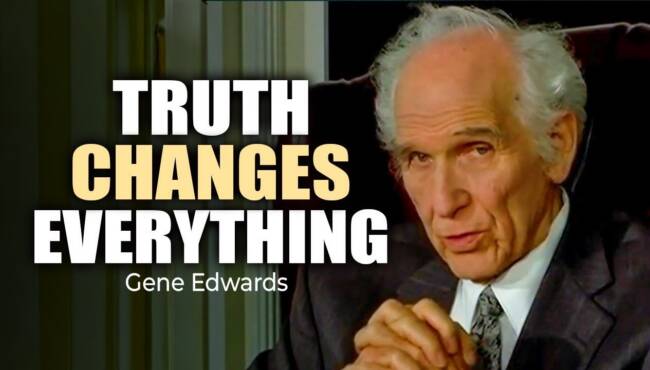
Truth Changes Everything • Jan 01, 2014


Victory is Finished • Jul 01st 1985
What does the centurion’s faith teach us about Jesus, spiritual authority, and the unseen realm? In this powerful study from the life of Jesus Christ, Gene Edwards explores the Roman centurion’s remarkable understanding of authority and why his faith caused Jesus to marvel.
Drawing from Matthew 8 and Luke 7, Gene looks beyond the outward events of the Gospel story to ask a deeper question: What was taking place within Jesus Himself?
The centurion understood authority. As a Roman officer, he could give an order without personally traveling to the place where that order would be carried out. When he heard about Jesus, he recognized something extraordinary: if Jesus truly possessed authority over sickness, He did not need to physically enter the centurion’s home in order to heal.
“Just say the word.”
Gene uses this encounter to explore the relationship between biblical faith, spiritual authority, and what he calls the unseen realm—the reality of God that is not limited by the physical world around us.
What does it mean to have faith? Rather than treating faith simply as something Christians must somehow produce, Gene points to the centurion as a man who recognized an unseen reality. His understanding of earthly authority helped him perceive something about the heavenly authority of Jesus Christ.
The message then turns to Jesus raising the widow’s son at Nain. Gene considers how this miracle helped spread Jesus’ reputation throughout the region and how the people responded with both fear and praise, recognizing that God had visited His people after generations of spiritual dryness.
This teaching challenges Christians to consider:
• Why did the centurion’s faith amaze Jesus?
• What did the centurion understand about spiritual authority?
• What does it mean to “see” what is unseen?
• How was Jesus’ life connected to both the earthly and heavenly realms?
• What can Christians learn from seasons of spiritual dryness?
• Why should we treasure genuine visitations of God?
Gene Edwards encourages believers not merely to study what Jesus did, but to enter more deeply into an understanding of the life He lived with His Father and His awareness of the heavenly realm.
We’re looking at the life of the Lord Jesus Christ, seeking to see what was going on inside Him, rather than what this story has to do with us, to understand the experience He had internally and with His Father. We’re using a book called The Life of Christ in Stereo, and we’re on page 50; this is in Matthew, chapter 8, and Luke, chapter 7. Now here’s the story. I want you to see a God who has His life in other realms. It doesn’t matter how much Jesus Christ was on this earth, how much He was human, or how much He knew us. The larger part of his memory, of His life, is lived in eternity. That’s where the larger part of his memory is. The larger part of my memory is in Texas. The larger part of His memory is in the heavens.
Now in the heavens, He has a throne, and that throne was His authority. He had at least 10,000 times 10,000 angels who obeyed Him. At this point, I have to say what I have said so many times: never before the New Testament, never after the New Testament, have there been so many people who had a sense of time and space and things other than time and space, and this incident in the Lord’s life is a perfect example of this. The Lord’s memories are of His own authority instructing angels, who are often depicted as military figures! Don’t know if you’ve ever thought about it, but there’s a sword, and there are fiery chariots, and there are battles, legions, angels. They all had names, at least some of them did. Yeah, all sorts of warlike elements here.
He gives orders, and they’re made more instantly than you and I can ever understand. Again, they are commands carried out outside of time and space. And sometimes ordered outside of time and space and carried out in time and space. The angels are very free from the thoughts of geography and temporal things. They can shoot about everywhere. They can be in eternity, where there is no dimension, where there is no time, no matter. They can burst into time, obey the Lord’s orders, do what He tells them to do, and step out again.
Now, this is what the Lord is so used to that it’s commonplace to Him. I want you to understand that. But He has come to earth, and He is in a temporal situation where everything is physical. Everything is seen. Everything is solid. Everything is hard. There are walls around, skies above, earth below, air around—everything you see is it. You can’t see yesterday, and you can’t see tomorrow. Yet, as he deals with authority, he remembers authority as something not confined to time and space.
I’ll go a little further and say, not only confined, not confined to it, but free from it. There is no past, there is no present, and there is no future in His experience with authority. There’s no such thing as measurable geography. To Him, there’s just no such thing. To us on the earth, there is. Therefore, as we think of time and space all around us, we think in terms of having to be bound by it and having to deal with our problems in relationship to geography—to that which is solid, and that which is walled, and floors and skies, and locations.
Now the Lord is coming into the town, Capernaum. At the same moment, there is a man who has a hundred soldiers under him. He’s a Roman. He’s a legionnaire. He has a boy who is a slave, whom he really loves. The child seems to have spinal meningitis or something like that. He’s having convulsions, and at the same time, he is paralyzed. He is obviously dying. This Legionnaire…this man in charge of a hundred soldiers doing a little police keeping. It’s a police action. He represents the role of making sure the zealots stay in their place—a little trouble down in Galilee.
He hears that the Lord is coming in, and for the first time, he starts drawing on some debts that are owed to him. This is a very religious man and has been deeply taken with the Jewish faith, so much so that he has donated the money that built the synagogue in Capernaum. He has protected the Jewish people. He has been a true friend to them. The elders of the city—probably if you ever give any money to anybody for anything, they’ll be back for more. And obviously, the Jewish leaders of the community have been to him for many, many favors, and now he’s out to collect. He goes to these men and implores them, “When you see this man, I have a slave who is desperately ill, would you plead with him to do something?
I’m fascinated that the Lord Jesus Christ is moved by class and political one-upmanship. He is arrested by the fact that the Jewish leaders have come to Him. Here is a man responding to class, to caste: he’ll help one person get well, but won’t help someone else because they’re in a high position, because they built the synagogue. This doesn’t seem like the Lord, does it? Does that strike you as the Lord? It doesn’t to me. I feel the Lord is impressed that this Gentile respects the Jewish faith. He is a seeking man. He is a man who protects God’s people, and I think that is what arrests the Lord.
Now, we don’t know whether Luke is correct or Matthew is correct, but in one of them it seems the centurion, the overlord of a hundred men, met him, and in the other it seems he did not. I’m going to tell it the way Luke told it. We have a most interesting experience here. I have a feeling this centurion is on the verge of a revelation at his house. He can see the Jews pleading with the Lord. He hears that the Lord is coming his way, and he begins to recognize that time and space are not a paramount issue. He gives orders to people he never sees. He knows they get carried out without ever finding out. He has soldiers under him, too. And those are his own words. “I also have soldiers under me.”
“I also, Lord, I’m like you. I have soldiers at my command, and I give orders, and I say go, and they go, and I say come, and they come, and I say to them get out of here, and they get out.” Away with you. He turns to someone in his household and says, “Go and deliver this message.” He must have repeated it clearly, because it is a very complex message. He said, “Now you make sure, you tell the Lord exactly what I said.” The servant goes to the Lord, and the servant says, “My master has sent me. Someone from the Centurion’s home. He comes to Jesus, and he says, “You don’t have to bother with coming to my master’s house. “My master says he’s not worthy of having you in his house.”
This opens a whole world here. I have authority on the earth. You have authority outside the earth. That makes you above me. People look at me and respect me because they see my authority. Your authority is high above mine because it deals with the unseen. This man has recognized that healing is not something that has to do with this realm. Breaking into the order of the universe and breaking the laws of this universe has to do with another universe. If this man can heal, he can heal anywhere because healing in itself is free of physical things. It is a divine thing. It is an out-of-this-world thing. It’s another realm thing.
Truth Changes Everything • Jan 01, 2014

Free to Fellowship with Christ • Dec 07, 2013

Sow to the Spirit • Nov 23, 2013