Christ Made You Holy • Mar 05, 2026

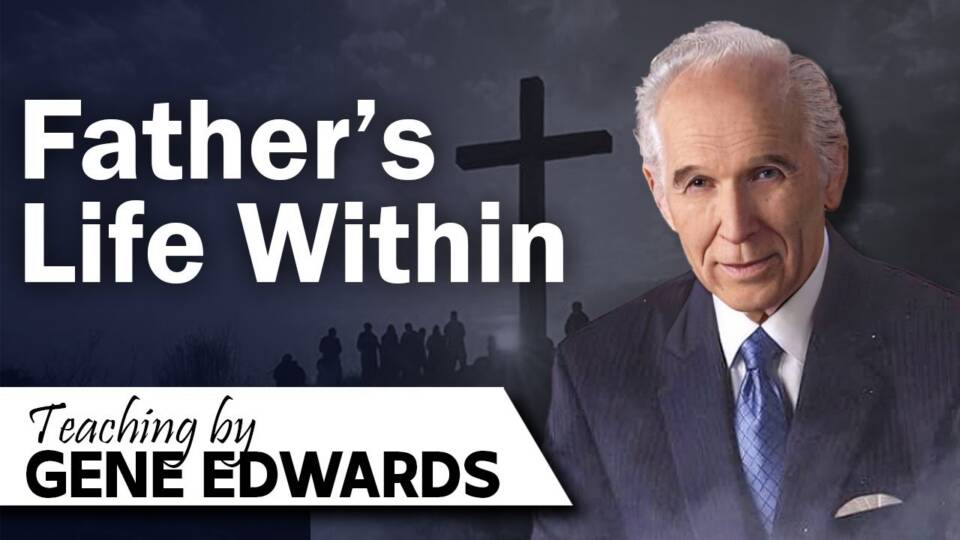
The Father's Life Within • Jun 01st 1986
What if everything you’ve been told about the Christian life has truly missed the main point? Gene Edwards humbly invites us to reconsider the true secret to a vibrant walk with Christ, moving beyond exhausting religious duties and guilt. This profound message challenges conventional wisdom, revealing that the very source of Christian vitality isn’t found in a list of ‘to-dos’ but in the eternal, intimate fellowship of the Father, Son, and Holy Spirit – a life lived by the Father, as Jesus himself demonstrated. Discover why traditional practices like prayer, Bible study, and church attendance are often the fruit of this life, not its root, and explore a historical perspective on how early believers truly lived. Join us to uncover a transformative understanding that could liberate your spirit and deepen your union with Jesus.
The first Gentile churches that ever existed on this earth were in the land of the Gauls, where the Gaul letter was written – the Galatian letter was written. There were more slaves and more slavery in that area than anywhere else. And by the way, if you’re wondering just how many slaves there were, in the time of Paul of Tarsus, in his actual lifetime, there was a census taken and then covered up because they didn’t want anyone to find out. It was shocking to everyone. Half the population of the city of Rome was slaves, and they were illiterate. Roman officials did not want people to know how many of those slaves there were; they were afraid of a revolt. They had no idea that half the population were in turn slaves. The rest of the people, with few exceptions, lived in abject poverty, did not go to school. School was something that cost money. Money was something they did not have. Bordering is how people lived. And even Rome had a higher literacy rate than the countryside did. But there were the merchants and the very wealthy. And some of them could read Latin. And some of them could read Greek. But those who could read were small in number.
Now, someone may say to you, Yes, there were the Scriptures in the synagogue, and you could go there and borrow them. Well, they were there, but I doubt that a Christian could get inside that synagogue to read them. They were not welcome there. And that’s not all. Even a synagogue would usually have the first five books of the Old Testament; they would have Isaiah and the Psalms. If they had anything more than that, they had more than what was typical. Those were the books that most of the synagogues outside of Jerusalem had, and the synagogue was equipped with.
It was a very long, arduous process to create Scripture. It was very, very bulky. And yet, I have the impression as I listen to men speak that in the first century all Christians could read, and every one of them was carrying around the Bible. If that had been true, then every one of them would have had a wheelbarrow filled with scrolls, carrying something they could not read. Certainly, a slave in Galatia could not read Hebrew, but the fact of the matter is, he could not read Greek either, or Latin. The largest publishing house in the world was in the city of Rome, and as I recall, it had slaves in it. And those slaves sat there all day long, seven days a week, copying books. And those books went out extremely expensive. Only a few people could buy them. Only a few people owned books. And those that did owned very, very few. And these were secular books, mostly the classics, the Greek classics and Roman philosophers and poets, the writings of these people.
To conceive of Christians being able to, at that time, fill up room after room after room after room after room, fervently writing down the Psalms in Latin or Greek. It’s simply not there; the people were illiterate. Now it is true that many, but not all, of the men who preached could read, but that number was not among the apostles. When the apostles were brought in before the Sanhedrin. The Sanhedrin said these men are, and the best way to translate that would be men who cannot tell you what a letter in the Hebrew alphabet means. They were men who could not recognize a letter in the Hebrew alphabet. They were illiterate, unlettered. They were men who could not read. And yet they are the men who preach the gospel because they preached a living relationship with Christ. Other men wrote down what they said, and it became Matthew, Mark, and Luke. And then, obviously, John either learned or did know how to write, or he dictated awfully beautifully. You could even be an articulate orator in that day and not know how to write, and probably not know how to read. Literacy was something confined to one or two percent of the population of the Western world in that time, and it got smaller than that during what is called the Middle Ages or the Dark Ages, when the ability to read and write, except among scholars and some priests, almost vanished from Europe.
Now here are the historical facts. Illiteracy was almost unanimous in the Western world of Europe during the Middle Medieval Ages until Gutenberg came along and invented the printing press, and the printing press spread, and the Reformation rode in on the fact that people were beginning to read, and it got outside the cloistered confines of the monasteries and the nunneries, and ordinary people on the streets began to read. And because German was phonetic, they picked it up very, very quickly. It was still among the well-to-do. It was not until the 1700s, which was just 300 years ago, that men and women began to read.
And in fact, during the American Civil War, they didn’t take a poll; they asked when men filled out the forms. Over 85% of the Southern soldiers had no idea how to read or write. It was slightly better among the people in the north. Northerners always had a better shot at it than us southerners. Today in America, literacy is something around 85-87%. This is a new phenomenon that began in the latter part of the century and spread during the century. We’re talking about something very, very modern when we talk about people’s ability to read.
Now, I’d like to go back to the first century, and I’d like to go back to Galatia, and I’d like to go back to the Gauls, into a place where literacy was virtually unknown except among some of the Romans and the Greeks, and the Jews within any city in that area, probably running less than1%. The Christians that Paul of Tarsus ministered to in Derbe, Lystra, Iconium, and Pisidia, Antioch, he was talking to a house full of illiterates, and yet we are envious of them because of the depth of their life and their walk with the Lord Jesus, their understanding and comprehension. In that day, illiteracy was not equated with ignorance. You could be a very smart person and not be able to read and write. And you could be very, very ignorant and still get to know the Lord Jesus Christ.
Now, I ask a question of all theological scholars, especially those who are demanding a total knowledge and a daily reading of the Scripture. How do you explain the depth of the Christians who lived in the first century, who were illiterate? And are you confining the victorious Christian life or the depths of the Christian life? Are you confining that only to men and women who can read? It is a good question to ask. It demands an answer.
Now, the Scripture means as much to me as any man living on the face of this earth. I am as committed to the Word of God as any man I know or have ever met. And I believe in its infallibility. I believe that it is inerrant, without error. Yes, I believe in the inspiration of the Scripture. Yes, I believe in the literal meaning of the… Somebody asked me this, so I’ll pass it on to you. The first 13 chapters of Genesis. Why stop at 13? Why not go through them all? Yes, I’m like the old fellow who said, I not only believe every word in it, but I even believe that it’s bound in genuine Morocco leather.
But I also am a student of history, and I know that, well, for instance, there is no known knowledge of anyone having a complete set of New Testament letters until the day of a gentleman named Origen, who lived in the second century. About 1000 AD, a man died. You know him by the name of Bernard of Clairvaux. I almost called him Saint Bernard. Bernard of Clairvaux. And he was sainted, and yes, he was called Saint Bernard until a dog came along, and then they called him Bernard of Clairvaux. And he died, leaving one of the largest private libraries in the Western world to the monastery. He owned those books himself. It was amazing. His entire library, donated to the monastery, and I can tell you exactly how many books there were in his library. He had 12 bound books, an almost unprecedented number for a man to own.
Last week, I read that the Sunday morning edition of the New York Times contains more information in it than a person living during the Revolutionary War would be exposed to in an entire lifetime. That was less than 300 years ago, not much more than 200 years ago. The question begs an answer. Are we saying the first-century Christians were what they were because every morning they got up, each individual, and poured over the New Testament when most of the New Testament was not even written?
Whatever the first-century church had on us, there’s one thing it did not have. It had no New Testament. It was not available to the believers. And the Hebrew Old Testament, as we refer to it, simply was not available to a poor, Greek, Latin slave who became a believer in the Lord Jesus Christ. There had to be something going on within him that was making him the Christian, often the awesome Christian that he was. Perhaps he had an edge on us in his walk with the Lord, even as an illiterate. Prayer, Bible study, and going to church. I’ll make short of that one. We don’t go to church. We are the church. And yes, we so desperately need the continuing fellowship of the body of Christ. There ought to be a group of people with whom we are living our lives out, not on Sunday morning, but every day of our lives. And that’s how those believers in the first century understood the ecclesia.
Christ Made You Holy • Mar 05, 2026

Stop Playing Church • Feb 18, 2026

Escape Religious Cage • Jan 10, 2026