
You Can't Do It Alone • Aug 18, 2026

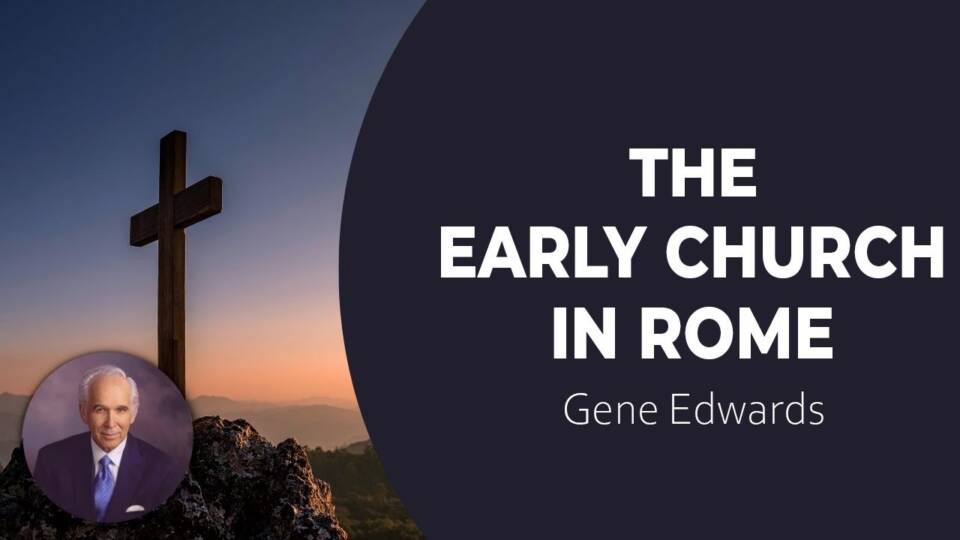
Escape Rome's Cult Mentality • Mar 18th 2000
In this message from the Romans series, Gene Edwards continues exploring the world of first-century Rome and the people who received Paul’s remarkable letter to the Romans. To truly understand the book of Romans, we must first understand the city, culture, and challenges faced by the believers living in the heart of the Roman Empire.
Rome was unlike any city in the ancient world. With a population approaching one million people, it stood as the political, economic, and cultural center of civilization. Citizens enjoyed unique privileges, military power protected its influence, and people from every nation brought their customs, religions, and traditions into the city. Yet beneath the grandeur of marble buildings, aqueducts, forums, and monuments existed crowded alleyways, poverty, slavery, and social division.
This teaching paints a vivid picture of daily life in ancient Rome. Viewers are introduced to the vast contrast between Rome’s wealthy elite and the ordinary people who lived in cramped apartments and struggled to survive. The lesson also explores the diversity of cultures, races, and backgrounds represented within the early Christian community.
Most importantly, this message helps us understand why Paul was so passionate about establishing a strong church in Rome. The gospel had the opportunity to reach every corner of the known world through this strategic city. Paul recognized that believers living together in Christian community would face real challenges, including cultural differences, personal conflicts, and spiritual immaturity.
As the study moves toward Romans chapters 12 through 15, Gene shows that Paul’s focus was not merely individual theology but learning how believers from radically different backgrounds could live together as one body in Christ.
Whether you are studying Romans, exploring the history of the early church, or seeking a deeper understanding of Christian community, this message provides valuable historical context that brings Paul’s letter to life and helps modern believers apply its truths today.
And there is, of course, Caesar himself, to whom anybody who is a Roman citizen—do you understand what that word “Roman” means now? —a citizen of the city of Rome—who can appeal to if he’s about to be sentenced to death. Can you see the city? Can you understand why Paul wants the gospel there? You can reach any race, and this is where the power is. This is New York, London, Moscow, and Hong Kong combined, though in Washington and Paris. It’s the city of the world. And beginning with right now, you live there. Okay? Beginning right this minute, you live there. How’d you get there? Boats, okay, and you walk. How did you get there? Paul sent you a letter and asked you to move there. Were you excited? Yeah, you were really excited. What about when you moved into that insula? How did you feel about that? Kind of wilted your tail feathers, didn’t it?
Okay, brothers and sisters, I’m going to tell you what we’re going to do this week. It’s really simple. Paul reaches back throughout his entire 18–20 years as an apostle and a church planter, and he tells them all about the riches of the gospel, until he gets to chapters 12, 13, 14, and 15. Not chapter 16; 12, 13, 14, and 15. There, he addresses living together in community. That’s what he does, and we’re going to find out what your problems are in Rome, at least. Some of you are really characters, a few of you are really, really troublemakers, some of you are neat people, but I don’t sometimes wonder why Paul asks some of you people to go to Rome, because you really are turkeys. We’re going to find out what the little community of believers in Rome, Italy, faced, and you’re going to be really surprised, I think, to discover how closely related the church in Rome among the Italians in 56 A.D.—how much they look like the brothers and sisters who gather on Claiborne Street in the gigantic city of Chicago, Illinois.
We’re going to see if we can get a little help from the great church planter Paul of Tarsus in our daily problems, in our lives, in our psychological hang-ups, and in our trying to get along with one another, and can’t. I’m going to ask you to read 12, 13, 14, and 15 if you possibly can tomorrow. I know that’s almost impossible, but we’re going to take Tuesday off. Try to come in here by Wednesday, having read it. I’m going to seek, as I have just now, to put you into the spirit of the city of Rome in the meantime, and I will close with this, and we will let the people with the TV set go.
I’m going to tell you folks who are watching on television what we’re about to do. We’re going to take names right now of these folks. Not all of us will be able to do it, but I’m going to give some of you some names so that we can talk to you about some of the problems you’re creating in the church. And the rest of you can take names if you want to. Your new converts will have… if you don’t get one of the names, would you like to take a name? Invent one—like Plinicus, and Gripicus, and Pouticus, and Guticus, and Pesiacundus—and if you can think of something that might some way match you, maybe you want to take the name Dictatoricus. I want to hear that one. What was it—Kamikas? Maybe I should ask Brother Alex to help me name some of these people, or maybe I will ask the fellowship here to name you, but we’re all going to get a name. Everybody who’s willing will get a name. All right, those of you on the television screen, I just want to say to you before we leave you that the letter to the Romans was not written to you—it was written to a church, and there’s not a promise in it that’s for an individual. It’s for the body of Christ. These people did not come to church on Sunday morning at 11 a.m. They had piled in with one another, and they were living with one another 365 days a year in a strange and foreign land, and they had added to their numbers all sorts of weird people called Italians.
And if there’s an Italian in this room—okay, there is an Italian in this room, okay—I will refrain from calling you by your…what do we call that…your ethnic, the ethnic slur that they put on Italians. By the way, they do that with everybody. I don’t know what they are, but I know what Frenchmen are called. Do you know what Frenchmen are called? Frogs. You didn’t know that? Because they roll their words, and every time they come to an “r,” and they speak down here. And so, the Englishmen always call them frogs. So, we all have ugly names. But anyway, these Greeks and these Jews and these Galatians have poured in here, and now they’re having to put up with… I’ll use the word once—Dagos. Alright, I didn’t mean that in any unkind way. I’m trying to get you to understand. You’ve got a mixture of races and cultures here, and they are all trying to follow the Lord, and they’ve got problems, beaucoup. You’ve got problems with the brothers who are Greek and can’t get along with the Gauls. You’ve got the Jewish brothers and sisters having a real hard time running around with uncircumcised, heathen, unwashed, unclean, Gentiles. But it’s still the church. It’s still the church, and we’re going to have to learn how to live with one another, and that’s what Romans 12, 13, 14, and 15 are about. We bid you goodbye. Alright.
You Can't Do It Alone • Aug 18, 2026
Stop Playing Church • Feb 18, 2026

Escape Religious Cage • Jan 10, 2026