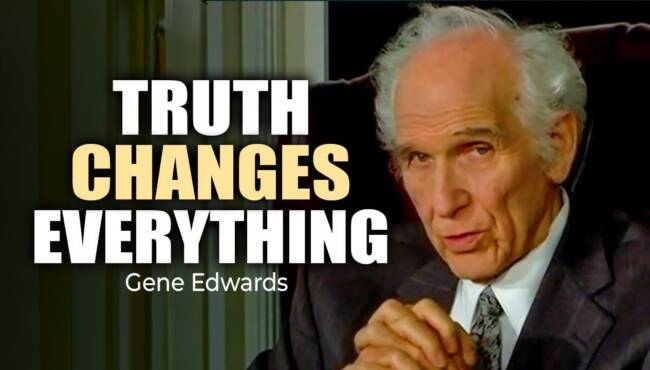
Truth Changes Everything • Jan 01, 2014


You Were Never Meant to be Alone • Feb 01st 1999
Romans 8 explained in a way most believers have never heard. This powerful teaching reveals the corporate reality of the Body of Christ—a truth largely overlooked in modern Christianity.
In this message, Gene Edwards explores Romans 6, 7, and 8 through a deeper lens, uncovering how the apostle Paul was not speaking primarily to individuals, but to a body of believers living as one in Christ. What does it mean for the church—not just the individual—to be dead to sin, free from the law, and raised with Christ?
This teaching challenges the foundation of individual Christianity and presents a radically different view of the Christian life—one rooted in shared life, corporate identity, and the living reality of the church as the Body of Christ.
You’ll discover:
Why Romans 8 is written in the plural (we, us) far more than you may realize
The difference between individual striving (Romans 7) and corporate life in the Spirit (Romans 8)
What it truly means to be dead to sin and alive in Christ—together
Why spiritual growth happens most powerfully within the Body of Christ
How this truth changes everything about Christian living, discipleship, and church life
This message will challenge assumptions, deepen your understanding of Scripture, and open your eyes to the strength, freedom, and life found in Christ’s body—not in isolation.
As shared in the teaching: when a people—not just a person—reckon themselves dead to sin and alive in Christ, something changes the entire landscape of the Christian life.
I spend quite a bit of time with pastors and ministers, and they’re always talking about how glorious things are. Everything’s bigger and better than anything I know, and God’s about to do something. For the last 44 or 45 years, every one of them has been saying, “God’s about to do something.” They’re living on “about.” Their entire life has been lived on “God’s about,” but I always look at them, and I think inside, “Brother, if you’d had all your people living within four blocks of one another, how high could the gospel reach?
Can it suffice when people live near one another? As long as you and I gather in a church on Sunday morning and hear a sermon, we will never test the gospel we’re hearing. When it gets down into the trenches, then that gospel is tested. I offer my opinion quickly: I don’t think the gospel being preached today reaches far enough to hold a group of people together who live near one another. It cannot do it.
One reason we live near one another is that the church, when there is no pastor, no minister, and no designated leaders, cannot survive on sermons. It has to survive on the community. You have to be in the thick of it. If you’re wondering whether they had this in the first century, you need to know that Jerusalem was one square mile and had a population of somewhere between 100,000 and 300,000 people. When the Romans built a city, they walled that thing in, and there would be about 5,000 to 10,000 people in it, 120 acres.
The cities that you read about in the New Testament, except the big ones…Dura-Europos has been completely dug up. About 15,000 people lived on 120 acres. It had five temples, a Jewish synagogue, and a Christian gathering. That town disappeared in 250 A.D., and it was dug up. They’ve been digging it up for the past century, and they’ve learned so much about it. People lived near one another; you have to realize there were no automobiles. Wherever you went, you walked. Therefore, everything was compact.
You don’t have to live in that community. Still, I don’t know anybody who’s ever been part of one of the churches I have anything to do with, and either wanted to or eventually moved there because that’s where everything is happening all the time. I have asked churches on occasion to stop meeting, and I’ve done that only when somebody was about to cause some real problems, and I didn’t want to see anyone hurt. So, I just said, “Stop meeting.”
The interesting thing about it is that nothing changes. You can’t tell whether the church is meeting or not; it just keeps on doing what it’s doing. An enormous amount of activity, and yet none of it is particularly planned, or very little of it is. It’s hard to describe, but the only way we can live all over a city and still come together over a long period of time is if we have sermons, and we don’t; not in this church life.
Community becomes a necessity for at least half the people. There always needs to be a core of people willing to move into an area, most of whom have never been there in their lives, relocate, find new jobs, and everything in the world against it. But God bless them; there are always people like that. Somebody’s going to have to be willing to, and if someone says, “Oh, we moved into the community; we’re only ten blocks away…we’re only two miles away.” Forget it.
My wife came up with a definition of how far away you should live. She said, “You shouldn’t be further than you can walk two minutes in the rain.” I’m telling you, the closer, the better. I’ve heard people say, “I live two blocks away, and I feel like I’m out of it.”
Let’s talk about Romans 6, 7, and 8 really quickly. In a minute, we’ll look at Romans 8 as we open our Bibles, but a question was asked just before we broke up. “I understand Romans 6 from an individual viewpoint, but what about a corporate one?” I don’t think you’ve ever heard — I don’t think modern Christianity has ever heard — what I’m about to say. When an entire body of people reckon themselves as dead to sin, free from the law and dead to the law, and an entire people reckon themselves as having been raised with Christ from the dead, and that the reckoning is not individual, but it is corporate. Brothers and sisters join hearts and hands together and say, “From this day forward, we’re dead to sin.” You have no idea what that means when it’s a people instead of a person. One of the most interesting things about church life is that there’s always somebody up, just as surely as there’s always somebody down.
The church we work with in Chicago is made up of people from the streets; a lot of them used to be drug addicts. I said to them, “Have you had problems of immorality in the church?” They answered, “A little bit.” I said, “But has the church ever been immoral?” You could see their faces light up. You see, we always are fearful that the individual is going to do something…but she doesn’t know to do this…she has died to sin. She is raised with Christ, and because you are part of her, and she is part of Christ, do you understand that? She’s the body; He’s the head. She’s the rib; He’s the rest. She is one with Him. She exists only because she came out of Him. Her DNA is identical to His DNA. She came out of His side.
She is dead to sin. She has risen from the dead. You put the church of Jesus Christ into the reality of her own experience, and you’ll watch her rise from the dead again and again and again. You’ll see resurrection. This gal is hard to put down. She doesn’t live in immorality. You’re part of her; sometimes there’ll be a bump in the road, and sometimes there’ll be a weakness. Sometimes somebody will slide, but the church doesn’t. She has risen from the dead in Jesus Christ. If you can’t fully understand that, I really wish you’d read The Divine Romance. This gal is absolutely gorgeous. She’s beautiful…and she’s your mother. She’s from above, and God doesn’t look at her, and Jesus Christ doesn’t look at her, in a way that we can comprehend.
Truth Changes Everything • Jan 01, 2014

Free to Fellowship with Christ • Dec 07, 2013

Sow to the Spirit • Nov 23, 2013