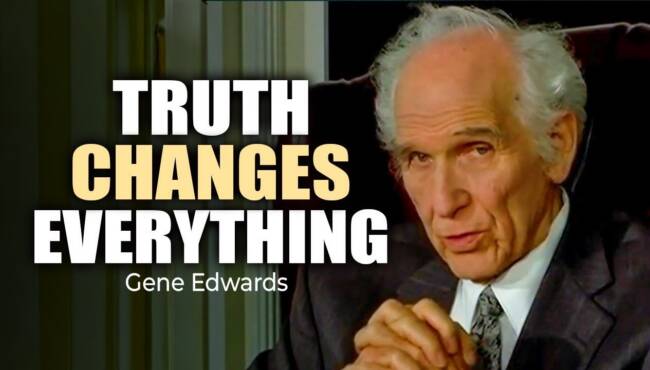
Truth Changes Everything • Jan 01, 2014


Oneness with Christ • Oct 21st 1987
One of the most profound truths in the Christian life is the believer’s union with Jesus Christ. In this powerful teaching from Romans 6, Gene Edwards explores what it truly means to be “in Christ” and why the gospel offers far more than forgiveness of sins.
Many believers struggle with guilt, condemnation, and an ongoing focus on personal failure. Yet Paul presents a radically different perspective. Instead of motivating Christians through fear, law, or self-effort, he points to a spiritual reality that occurred at conversion: believers were united with Christ in His death, burial, and resurrection.
Drawing directly from Romans 6, this message examines Paul’s startling response to the question, “If salvation is by grace, why not continue in sin?” His answer is not a list of rules or religious obligations. Instead, he reveals a deeper truth: those who belong to Christ have died to sin because they have been made one with Him.
Gene carefully explains the biblical concept of union with Christ, emphasizing that believers were immersed into Christ Himself. When Christ died, believers died with Him. When He rose from the dead, believers rose with Him. This new identity fundamentally changes a Christian’s relationship to sin, guilt, condemnation, and spiritual growth.
This teaching also addresses the difference between conviction and general guilt, helping believers understand the freedom that comes from living in Christ rather than under constant self-accusation. Through vivid illustrations and practical application, Gene shows how faith accepts spiritual realities that cannot be seen with natural eyes.
If you have ever wondered what it means to be dead to sin, alive to God, or truly free in Christ, this study offers a life-changing perspective on the believer’s identity and inheritance in Jesus Christ.
This session is part of the Romans series and provides foundational insight into grace, justification, Christian identity, and the believer’s union with Christ.
Now, I’m going to try to explain something to you that you already know. Before I was converted, I was not a big sinner. Drunkenness and lawlessness were not particularly mine. That’s no feather in my cap; I just was kind of shy. And a little scared – scared of God. And had been raised morally, more or less. But sin was out there, and there was no sense in me of some limitation in my relationship to sin. I don’t know how to say it any clearer than that. You’re going to have to follow me by instinct from here. There was some relationship that I had with sin, and with that which was improper and wrong, that had no restraint to it. I didn’t take the opportunities to their fullness. Nonetheless, on the day I was converted, my relationship to sin radically changed.
Someone has said, “Before I was converted, I sinned and enjoyed it. After I was converted, I sinned and despised it.” And that’s a pretty good relationship, but it doesn’t quite go far enough. There was simply a deep, inured sense that something between me and sin had radically changed.
Now, for those of you who might be questioning—no, I am not… I hate to even have to bring this up, but there’s always some Eskimo out there on the back row who heard someone preach once, and he said, “Oh, he’s preaching sinless perfection.” That is so ridiculous. I am simply presenting to you a difference in your relationship to sin. Big difference. Now, something awesome happened in death and in the grave. Something that radically changed Christ’s relationship to sin—and your relationship to sin. Totally changed it because you were so totally one with Him in His death. Amen?
Now then, something else happened. He came out of the grave. There’s no power – nothing -that could have kept you from coming out of that grave with Him. Why is that? Vicki, why is that? “I don’t know.” That’s right. I’m going to tell you:
Because you have been plunged into Christ. So totally that you can’t be un-plunged from Him. You were put inside of Christ. And when He went into the grave, you had to go there. When His relationship to sin changed, so did yours. And, sister, when He came up, there was no way to separate you from Him. You are that united with Him. One with Him. In union with Him. I don’t know what—people: united, all of these things, oneness—all of these words that are used. I don’t know which one is better.
EIS. Inside of. With. Totally one with Him.
When He came up out of that grave, there was nothing that could prevent you from coming with Him. He died to sin. You died to sin. He rose to life. You rose to life. And your relationship to sin has now been utterly, totally altered.
Now then, Paul said: Accept that. Consider it. Take it. Reckon it.
And we’ve gotten on this word “reckon.” Reckon yourself dead. Dead to sin and alive to God.
Reckon yourself. Reckon. We have to reckon ourselves. Reckon. I’m sitting on a reckoning. And I’m trying to believe that I’ve died to sin, and sin has died to me, and yet I know that I still sometimes sin. And so we have built these great doctrines to try to explain that. I am not going to explain that. Your old man has died to sin. Your old nature, your old self. And we get all of these definitions. I’d like to free you from that, and I’d like for you to just accept the empirical:
Something changed radically when you got converted.
Something changed radically when, by faith, you received His righteousness. Something changed. Accept that fact. It’s true. Accept it. Now then, I’ll go on and say to you that there are things that are happening to us that don’t happen to us in this realm. There are things that happen to you that don’t happen here. They happen somewhere else. There are things that happen to you that you cannot see.
Truth Changes Everything • Jan 01, 2014
Free to Fellowship with Christ • Dec 07, 2013
Sow to the Spirit • Nov 23, 2013