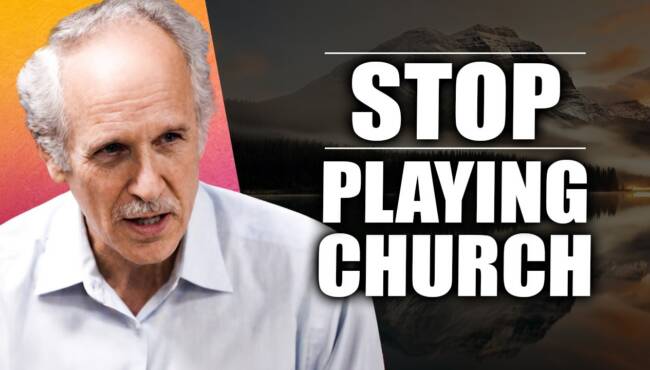
Stop Playing Church • Feb 18, 2026


Urgent Call for Restoration • Nov 01st 2011
Restoration is without question more difficult than even the beginnings and more difficult than the reformation itself. Yet, in a day not conducive to it, it remains the heart cry of every one of the faithful of God. In this profound message, Gene Edwards confronts the comfortable assumptions of modern Christianity, arguing that relying on method is but death without the living fellowship of Christ. He challenges us to look beyond the “forever up” of emotions and embrace the reality that we often learn more hanging from the cross than in revival. Gene Edwards reveals that true, functioning spiritual life, as found in the first century, is centered on a corporate pursuit of Christ, navigated by broken men who loved God’s people. Discover the urgent call to abandon the limitations of the institutional church and step onto the pilgrimage of restoration. Your faithfulness is required for the generation in which you live.
Next, I would like you to know who it is that walks through the door. Now, this is not a criticism of anyone. This is universal. It is ingrained in us, and we must recognize it. I put it this way. I know of no denomination, nor evangelical or otherwise mindset, but what we are essentially Methodists. That is, we are centered on method. The question is, “How do you do that?” As though the answer was found in changing practices. Without even thinking about it, the first questions are, how did you change that? What’s your practice? Who thought that one up? Well, that’s wonderful. I’ve always wondered how you could solve that problem. The answer is not there. God knows we need revolutionary practices, but oh, the fire that feeds the church is Christ. The water that we drink, the drop for our spirit, is found in touching the Lord Jesus Christ. It is praying and reading your Bible, nor is it pray, pray. It is a living, breathing fellowship of you with your Lord and you with your brothers and sisters. All methods without that are but death.
How much we have tried to recreate the first-century church by nothing more than method. Practical things where the flow of the waters of Life is not known. The story was told of someone from Asia who left a nation of persecution and visited the United States. When he returned, he was asked, “What did you learn?” His answer was, “It is amazing how much people can accomplish without the Life of Christ and the work of the Holy Spirit.” We are Methodists. Again, God knows we need some new methods, but we also need a revelation of Christ. With that, we have to have a heart to go through dry spells, for dry spells are of God. If you are here looking for a forever up, you have come to the wrong place, for there is much to be as much to be learned in the down as therein as in the up. And the living spirit which dwells within you cannot always be up. Oh, He can, but you can’t. We live in this limited earthly and, even, fallen fleshly body, and an addiction to the ever-up of emotions will rip you to shreds and leave you in a place where there’s nothing in this world that will stir your inward parts, or any story or any experience will cause you to believe in such things.
There is a valley of dry bones of those who attempt to live in the forever of emotions. Expect a miracle every day. Expect a miracle when you pray. By actual count, only five people in the Gospels and Acts are named as having performed miracles. In the epistles, even fewer. You have to ignore a large part of the New Testament in order to have a continual, forever victorious, never hindered by the world nor by the fables and follies of man; naked and in peril, owning nothing. I despaired of life, in danger of false brethren, in cold and in nakedness. Demetrius has done me great, great harm. It is a tried saying, but it’s nonetheless true. Only storms and perils of the sea make a great sailor. You and I will learn more hanging from the cross than we will ever learn in the midst of a revival. These things we must know and these things we must embrace and bring to our hearts and fold them into the very depths of our souls.
So, two things I would point out to you. One of them is to realize that when we ask how the first how should be, “How do we know the Lord,” and “How do we handle the cross?” Even the solving of solutions by means which others before us have discovered must never be the gods of our work for Christ, nor to be in the church. I would add those who were trying to live forever, faced with the harsh realities of life on this fallen planet; they fall farther and become more despondent, reaching emotional lows when they have craved highs. I turn to look at the past. 12 men in one center, Jerusalem. Those men went out into the highways and byways of the towns and villages of Judea, into the villages of Samaria, and into the many towns and villages of Galilee, always fed and always returning to that first center. Then came the Gentiles, and there the exquisitely beautiful church in Antioch, in one of the most heathen, godforsaken, worldly pleasure-filled, immoral, addicted cities of the world: the church, large, vibrant, overcoming and backing two men.
Then they went to a church, another, another, and another. They stayed about 5 months, came back to visit for a few days, and then left those churches for a year. Those were functioning bodies of people. Two or three things I learned from that, and one of them is that we need a center, very committed people, and broken men who live not for themselves nor for the glory they find in their imagination, where living in the drunken intoxication of that imagination sees and believes they can do anything. But always the one who lives within their imagination is the glory hog. Always in the middle of that imagination that sees it can do anything is you. The man on the stage, standing in awe of your great messages, is not the man who left Antioch and went out into Galatia. Those were broken men who loved God’s people; they abandoned their very beings for the care of God’s people. Men who knew their Christ and who knew the church and the life of that church and the cruelties that take place within the body of Christ, as well as the glories. Men who knew answers because they had been students of the church of the living God. No, they were not men addicted to sermons; they were there to depart and leave a functioning people of whom Christ was their center.
God save us from the young man who comes to the church to pick up all the practices he can. A man with no love in his heart or his soul. No willingness to be a follower. Always standing in judgment of those who would instruct him. Standing in judgment of the church of which he is a part. All of that so that he might equip himself with methods and messages that could cause him to go out and become the movie star of the pulpit. I would address that man and tell you, “Sir, you can do nothing, for you cannot love God’s people nor tolerate their eccentricities. And I’m telling you, their eccentricities are intolerable, and they will break your heart, and if there’s one ounce of personal ambition in you, you will stumble and cry out that it can’t be done.” Sir, you’re right, because of your egotism and your shallowness and your lack of love for God’s people.” If God has called you, come into the church on your knees. Come there to be a servant of all. Allow God to raise you up, and the church will rise up and call you blessed. And if you happen to be part of a church that will not back you with all the glorious ways you feel you deserve, it might be because that church knows you far better than you can ever personally know.
Now I pose the questions, the contemplation of it, and the reality of it that could bring down the Himalayan mountains. How is it possible that two men can walk into a city, heathen in nature, cruel in disposition, walking to that town where the word Christ Jesus had never once been uttered? Men and women who go into heathen temples, whose minds are filled with gods who are nothing more than jumbo men who have all sorts of grudges against humans. People who are almost to the man are illiterate or close to it. Men who have never heard of a Jew, or if they do, don’t know what it means. Have never heard the word Abraham or Moses or David; cannot even grasp the concept of there being only one God with within in their town there are temples to 10, 15 or 20 gods with many altars of others; from a dead stand still, walk into that town, lead people to Jesus Christ, people still being saved right up to the day they leave, and in five months under those conditions, turn around walk out and leave for a year, and the only solution you have is to teach them the Bible. I’m sorry, sir, but does the scripture not say the word of God? Yes. That very passage speaks of the word of God, and it is stated, “which spirit is the word of God.”
There was no Bible. There was no scripture. There was a synagogue…no, there was not – a gentile was not even welcome in a synagogue, and he certainly was not welcome to touch sacred vellum upon which was inscribed the Torah. There was hardly a synagogue anywhere in the empire that was willing to open that wooden box and allow anyone to even be in their presence when they read. With illiteracy at 98%, you would say teach them the book when there was no book. When Paul and Barnabas walked into that city, there was not one single line of the New Testament in existence, and the Old Testament was not accessible. But the word of God, which Spirit is the word of God? Oh, there’s no question. They told the stories, but they also told of Christ; not only the One who died and rose again, but the One who indwells those people and who was, as a body of believers, able to touch that Christ corporately. No, the secret lay not in teaching a Bible which nobody had, but in a living and dwelling Lord among a body of people, not an individual. Now, I point out one other thing, and that is, before that one year was over, all four of those Galatian churches were ripped to shreds. A legalist who came into them, telling them that they had to obey the law of Moses and undergo the cutting and the fever of the removal of the foreskin.
I have, for 55, no 60 years, been looking at the book of Galatians, attempting to extract from its passages what it was those men said to those people who were less than believers for six months. What did he say to them? What did Barnabas say to them that they would dare turn around and leave those people? So far, I can tell you this. It was Christ. It was Christ. It was Christ. The Christ before creation. The Christ who was on the earth…very little of that. The Christ who indwelled them, that Christ was in heavenly places, and the fact that they were given something that doesn’t even make sense to a madman, and that is that they were all dead, and the only person living in their midst was Christ, and that whatever they did as a body of people was a physical expression of that Christ. That they were saints, they were holy ones, they were sacred ones, and that they had the righteousness of God, and that they had died on a cross in Jerusalem. These are the ravings of a madman, and that they themselves no longer lived, but Christ lived.
You know something? They did the same thing Abraham did. They believed by faith; they just went ahead and believed it. It wasn’t an individual who died upon that cross, nor who now lives, and Christ lives in his stead; it was not the individual. It was a body of people who were crucified but who no longer live; it is Christ who lives in a body of people. Then somehow or another, those men showed those recently ex-heathen how to know the Lord and to live in Him by the day and by the week, by the month and by the year.
I thank God for those Judaizers who came and almost ripped those four churches to pieces, because at least it gave us a glimpse into the insight of what was being said in those days. It also established that there were people called church planters, and that those church planters had gone to Jerusalem, another center, another great church. They had come to unity, and a young, uncircumcised gentile was sitting there when that letter to Galatia was written. Then he handed it to him, and he took it and delivered it. That man knew something about the church and later became the first person Paul ever separated for the work.
These things can be. We lift our lives off the stage of the mundane, and we step into a world where there are few maps, few footprints, and reestablish the old paths, and leave for others who come after us…and they will come. Signpost, directions, a legacy, for them to follow upon which they can advance. Now, we pause to observe something most people have not, and we all observe it now. We hold our breath, perhaps even sigh with anticipation, as we watch two men walk into a city, establish a church, and leave it after five or six months, then be gone for a year. But remember that during that year, there was put upon those four churches that which could destroy any church existing today. And so, we put up a signpost, and this is how it reads: “In every case of every church which is established in the first century after the apostles left, there was one or a number of people who sought to change that church from being what it was.”
Stop Playing Church • Feb 18, 2026

Escape Religious Cage • Jan 10, 2026

Break the Dead Chains • Jan 10, 2026