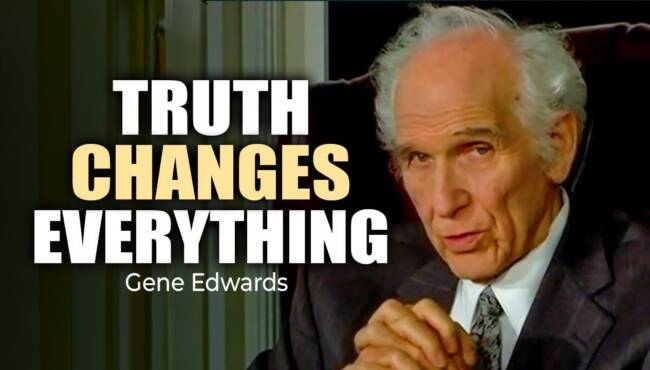
Truth Changes Everything • Jan 01, 2014


The Cost of Following Jesus • Sep 13th 1973
Discover the meaning of radical spiritual transformation, dying to self, and surrendering your life to Jesus Christ. In this challenging Christian teaching, Gene Edwards explores the deeper work of the cross, the surrender of the self-life, and the inward transformation God desires in every believer.
What does it really mean to follow Jesus Christ? Is giving up outward possessions, religious habits, and personal comforts enough? Or is God calling us to something far deeper?
In this continuation of The Secret of Abiding in Christ, Gene Edwards challenges Christians to move beyond outward expressions of sacrifice and confront the hidden areas of the heart where pride, self-interest, criticism, complaining, and the desire for recognition still remain.
True spiritual growth is not simply about changing outward behavior. It involves allowing the Lord Jesus Christ to transform our thoughts, attitudes, words, relationships, and innermost desires.
In this powerful Christian message, discover:
Gene Edwards reminds believers that the Christian life is not merely about becoming more religious or appearing more spiritual. It is about coming before the Lord honestly, allowing Him to expose what remains of our self-life, and surrendering those areas to His transforming work.
This teaching is especially meaningful for Christians seeking deeper spiritual growth, authentic discipleship, a more surrendered life, and a closer relationship with Jesus Christ.
A question for personal reflection:
What area of your life is the Lord asking you to surrender more completely to Him?
(continued from Part 1 – The Secret of Abiding in Christ | The Cross, Self-Life & True Christian Living)
Brothers, I’m clear that all of this would look very serious to a middle-class, upper-middle-class American looking in on us, even Christians. You people are crazy. This is insane, so and so forth. Listen, it’ll be the makings of us. For one thing, it’ll start teaching us something we Americans don’t know: a little strictness in our lives, and an “other” consciousness. It’s a beginning; it’s not much, but it’s a beginning. And the Lord Jesus knew it was an absolute essential to get anywhere. He drew the line there.
When you move from that point to the next point, as great as you may think what we’re discussing is, when you move from there to the next point, you’re probably taking the greatest single step, the most gigantic step, the widest point between two distances anywhere in Christian experience. You go from the loss of all outward things…no ownership…you lose that, and you lead that to the loss of the soul. And when you have come to the loss of the soul, the loss of outward property means nothing. When we speak of the loss of the entire soul, we’re talking about something in regions that we can’t even grasp. We’re speaking of depths of comprehension we can’t plumb. Heights we can’t see. Breadths we cannot distance—the loss of the soul. The loss of the soul.
I see you all so willing to hold the pressure on the outer things. Praise God. I rejoice in that. The Lord rejoices in that. You’re still willing. Your hearts are still there, but it’s nothing compared to the beginning of the loss of the soul. There’s nothing easier to forget than the loss of the soul. You can sit at home with nothing but a floor to sit on and look in an empty living room. Go to the kitchen, a bare cupboard. Down here in the grocery store, eating grapes. One pair of pants, one pair of socks, one pair of shoes, one shirt, and one old coat.
You’re nowhere. All you have done, in fact, is symbolize what God wants to do to you inside: reduce you to nothing. If you think we’ve gotten anywhere in this, you’re dreaming. When you get down into the internal matters, this is different. Where are you in dealing with the Lord? I’m actually here tonight to bring you back on course.
I see a people unlike us. I see a people not like us. I see a people so utterly removed from what we are. I see meeting a brother who, no matter what I talk to him about, never refers to I, my, or me. Well, I realize that there are times when the word I, my, or me may have to come out, but there’s a world of difference. You can feel the difference. You can smell it and sense it. There’s a time when the “I” comes out, and you know it’s capital “I.”
A brother may have to say, “I don’t know.” A brother may say, “I believe so.” You may have to say that to communicate. And yet, if we could get rid of that, that would even help. We have moved to the internal, and that can’t be done by external things. That takes internal involvement. This takes the Lord. In the weeks ahead, we must come to a whole new, deeper experience with the Lord than this group of people has ever known. All I can say to you tonight is that if the Lord gets what he wishes out of these people, there will be some hallmarks. Hallmarks. A hallmark is a company’s symbolic stamp. It’s a hallmark. You recognize that company, that organization, by its symbol. It’s a hallmark.
You will not criticize a brother no matter what he does, and there will be no exceptions to that statement. Furthermore, you’ll not be put out with him, and you will not feel it. Secondly, you’ll not complain. You’ll not complain about anything. “Gene is putting us at an unfair disadvantage.” What about these responsible brothers, who do things to us that are not fair?
I have two things to answer. We have spent four years here, seeking to raise up men who don’t conduct themselves that way. They don’t always make it, but they try. Why don’t we work it out? Brothers and sisters, they may make a lot of mistakes, and sometimes they do, in fact, do things unfairly, but it is not the tendency of their lives. It may become that someday; I hope not. I hope those brothers will always be harder on themselves than they ever will anyone. As far as that goes, I trust that, as a rule, they’ll never correct anybody over anything, no matter what.
We have sought to raise up men in this church who do not behave that way. I trust that you will be raised up as a man who is not like that, too. We are a corporate body, and sometimes it is difficult for everybody to be treated exactly the same; if anybody gets picked on, it’s first the single brothers, then the single sisters, and we don’t care about them. (laughter) It’s good for them. We’ll start treating them nice just as soon as they, especially the single brothers, soon as they’re no longer single. (laughter)
Do not complain over anything. As long as we can complain, there’s still so much left. “But, Gene, if I don’t complain, there’s still so much left.” Yeah, but not as much. When you’re complaining, it’s all still there. When you get to the place where you can keep your mouth shut and feel exactly the same way you would if you had it open, you have come a long, long way. When the mouth can close; when finally the mouth can close, death is not far away. You may feel exactly the same, but if the mouth is closed, progress has been made.
Truth Changes Everything • Jan 01, 2014

Free to Fellowship with Christ • Dec 07, 2013

Sow to the Spirit • Nov 23, 2013