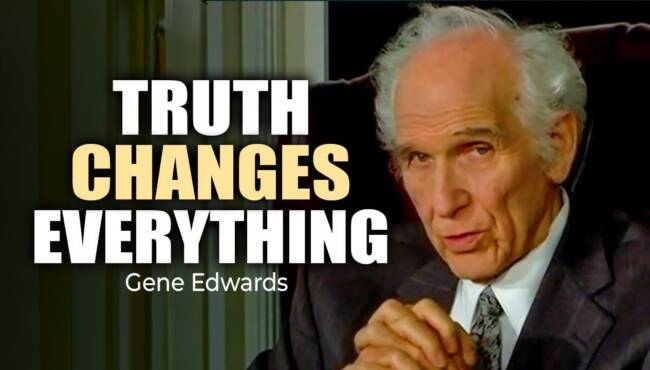
Truth Changes Everything • Jan 01, 2014


Grow Before You Go • Aug 21st 1971
How did Jesus train the twelve disciples—and what can their experience teach us about Christian discipleship, spiritual growth, and the church today?
In this message, Gene Edwards examines Jesus and the twelve disciples from an often-overlooked perspective. Rather than beginning with methods, programs, or ministry techniques, Edwards looks at the way Jesus Himself prepared ordinary men to become His disciples and eventually carry the testimony of Christ into the early church.
For three and a half years, the twelve lived closely with Jesus. They watched Him minister, respond to people, fellowship with the Father, face opposition, and live His daily life. Their education was not primarily a classroom experience. They were learning Christ.
Edwards points to a striking principle: Jesus ministered to the crowds, but He invested His life deeply in twelve men. These disciples were ordinary people whose great distinguishing characteristic was that they had a heart for the Lord.
Living together also exposed their weaknesses. They misunderstood one another, irritated one another, made mistakes, and had to learn patience. Yet Jesus did not abandon them because they were immature. He gave them time to grow.
This becomes an important picture of New Testament church life. Spiritual maturity does not happen instantly. The church grows through knowing Christ, living in fellowship, learning patience and forgiveness, making mistakes, and allowing the life of Jesus Christ to mature within His people.
Gene Edwards challenges believers to reconsider what genuine Christian discipleship looks like. Is our goal simply to learn more biblical information, master ministry techniques, or accomplish more for God? Or is the deeper purpose of discipleship to know Jesus Christ Himself?
If you desire a deeper relationship with Jesus, a better understanding of the twelve disciples, or a more biblical picture of Christian community and the early church, this message offers a challenging perspective on how Jesus prepared His followers.
Well, we’re looking at beginnings. We are going very clearly through the entire New Testament one day at a time, one inch at a time if necessary, to take a look at the church as it really, honestly, truly was without a lot of the hoopla and imagination that is usually associated with it, but the actual practical way the church came about.
Now, we have begun with the life of Jesus Christ because the church is an embryo in Him. Then in the twelve, you see the embryo grow. Then on the day of Pentecost, you see the birth. And for the next thirty years, you see the growth. My impression is that God had not completed what He wished, even when the work in Jerusalem had reached its fullness. But even the Lord Himself needed time to get the church where He wanted it to be.
Now then, this morning I’d like to go back to the word, “Jesus Christ, the author and finisher of our faith.” He thought up the Christian life. So if you want to know how to live it, look at Him. He thought up the church and became its first member. We are the members of the body; He’s the member of the head. The head is a member of the body, and He was the first member of the church, the head of it.
Then, He is also the finisher. Everything you want to know about the church, its principles, anything you want to know about ministry or service to the Lord, you can find in embryo in the Lord Jesus Christ. Now, brothers and sisters, this is a shock, because it flips virtually everything we understand about the Christian faith today.
Very quickly, we have gone over some things. The first thing I want you to realize is the tremendous waste the Lord went through while on this earth. He went through it for a purpose…He went through it for the purpose of preparation. I have read a lot of books in my lifetime. Every one of them gives you the impression that the world’s in a bad situation, God’s in a rush, and one great cataclysmic experience in your life, one big principle that you’ll learn, jump on your horse, and ride off in twelve directions. This is not the Christian experience.
I want to come back and say again: even God had to prepare Himself to be a Christian. It took Jesus Christ thirty years to learn to be a Christian. That may not be good theology, but it is good communication. It took Jesus Christ thirty years to learn to be a Christian. I’ll put it another way. It took God thirty years to learn to be a Christian. The Lord Jesus Christ wasted the first thirty years of His life.
Some of you may be saved from doing a tremendous amount of work for the Lord in your early years. I don’t want anyone to get the impression that we’re saying you cannot serve the Lord in your youth, but it is very dangerous to take on full responsibility while you’re still a young man and go out in twelve directions. Jesus Christ wasted all thirty of His first thirty years, every one of them, and He learned basically two things. He learned to be human. We’re going to see some more of this now this morning when we look at twelve. He also learned to be divine. As a human, He learned to be divine. Or better, He learned to fellowship with the Father; He learned to live in the Father’s presence. He learned to live with the Father. The church of Jesus Christ goes through stages. It takes time for the church to grow up. It took time for God to grow up. These are ridiculous statements. Please understand what I mean. It took time for God in Christ to grow up to full manhood.
I didn’t mention this the other day, but—or maybe I did—in the Old Testament, a priest could not be a priest until he was thirty. Jesus Christ began His ministry at thirty. Ezekiel received a revelation at the age of thirty, though he had been preparing for many, many years. All of this speaks to something. It’s a principle. It’s a tendency of God. Brothers, yesterday I made the comment, “You must not speak beyond your personal experience.” If we speak of the cross, we’ve got to know the cross. If we speak of the deep things of the cross, we’ve got to know the deep things of the cross. If we speak of the deep, deep things of the cross, brother, we are not eighteen years old because it is impossible to know the deep things of the Lord, of the cross, at eighteen. It just can’t be done.
Anyway, let’s forget chronological age and say that your message must always match your experience. As far as that goes, your message should never match your experience. Your experience should always exceed your message. Your experience must be greater than your message. I would even say this to you young brothers: you better know at least ten times as much about anything you say as what you speak, and it is better if you know a hundred times as much on any subject.
I don’t want to get too far into that. There were two things Jesus Christ learned to do. He learned to fellowship with the…He learned to be human, and He learned fellowship with the Father. Would you like to follow the Lord? Then follow Him. Brothers and sisters, learn to be human and know the Father. “What is your task?” Very simple. Get to know Jesus Christ. Really, experientially, know Him daily. You may not know a lot of the Book. You may not know a lot of books. You may not know a lot of facts, but if you know Him, really know Him in experience and in all kinds of experiences, you will have something of the understanding of Jesus Christ, of the Father, that Jesus Christ had of the Father.
I want to say that later, as the story of the church unfolds, you will see more of this. It gets so big and so clear. There are so many beautiful things about the Lord. I am still burdened to deal with this subject a little bit, but I can’t. We’ll just have to pass it. Jesus Christ learned to be human, and He learned to live by the Father. I don’t mean He learned to know something about God; I mean He learned God and lived by Him as His source of life.
Truth Changes Everything • Jan 01, 2014
Free to Fellowship with Christ • Dec 07, 2013

Sow to the Spirit • Nov 23, 2013