
Stop Playing Church • Feb 18, 2026

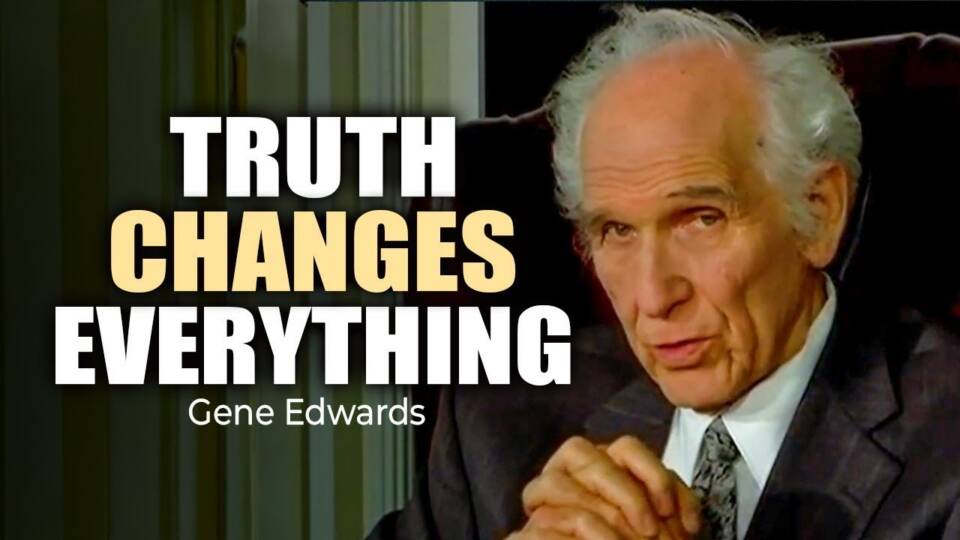
Truth Changes Everything • Jan 01st 2014
For over 1,700 years, Christians have unknowingly read the New Testament in a chaotic, non-chronological order—and the consequences have been enormous. In this eye-opening teaching, Gene Edwards reveals the greatest disaster in church history, a mistake so profound that it reshaped Catholicism, Protestantism, and modern evangelical Christianity as we know it. How the New Testament got in it… This message explains how the New Testament—especially Paul’s letters—was assembled not by spiritual insight, but by a pagan bookbinder who arranged the letters by length instead of history. As a result, believers lost the story, the flow, and the living context of first-century Christianity. In this teaching, you’ll discover:
Why Paul’s letters are not theological treatises
How chronology reveals a living, unfolding story
What happened in the “missing years” of Paul’s life
Why verse-by-verse Christianity misses the bigger picture
How restoring order restores understanding
Why the New Testament was meant to be read as a story, not fragments
This message invites believers into a revolutionary way of reading Scripture—one that restores clarity, beauty, and spiritual coherence to the New Testament.
Now look at the years: how beautifully the years go. Galatians 50; 1 Thessalonians 51; 2 Thessalonians 52. Look at this jump between 52 and 57; that’s five years. The largest stadium in the world is in Rio de Janeiro; it seats 250,000 people. If you took every great scholar who ever lived on this earth for the last 1700 years, and all those that are living today, and put them in that stadium and ask them what happened during those five years, not one of them could answer that question because they don’t know the story.
Paul’s letter to the Romans, which is first in your New Testament, was written in 58… as the sixth book, not the first. Galatians is the first. There it is. Now, hold on to… take a deep breath. Paul’s letters: in their chaos. The order of Paul’s letters by length.
Romans. His sixth letter, written in 58.
Then 1 Corinthians, written in 57. That’s the year before 58.
And then 2 Corinthians, written in the same year as Romans, but that’s not the way we read it. We read it… this… this book was actually written before it. This book was written at the same time. Look at the rest of it and way down here at the very bottom, because it is the shortest book of Paul’s letters, is Philemon. So far out of place, it’s staggering. That’s not where Philemon belongs. Philemon belongs exactly where Colossians and Ephesians belong, as we saw here on this other chart.
Take a look at this. 58, 57, 58, 50, 63, 63, 63, back all the way to 51, 52, then 65, and finally, you have a little order here. 67, and then back to 65. That’s your New Testament and every New Testament that’s been printed for the last 1700 years.
Now, let’s show you. I’m going to ask you to be really honest with yourself, as I will try to be honest as well. I’m going to pick this up and let the camera look at it for a moment. This is to illustrate the mess we’re in. Here’s American history in the order in which it took place. American history. We have to imagine a 13-volume history. In fact, this is pretty much what any American history scholar would know.
Alright. This is the beginning of the story. 1492 – Columbus discovers the New World. Then there are the earliest settlers. We’ve got a date, and the dates just keep growing nice and neatly. Then the colonies. Then the Revolutionary War. The War of 1812. All of this is in perfect order. The Western Movement. The Civil War. The Spanish-American War, World War I, and World War II. The Korean War. The Cold War. And then the Vietnamese War. All of those dates are in perfect sequence. You can pick up that book and read it. It’s a full, complete story.
But let’s rearrange it according to Paul’s letters today. Keep in mind that this column represents the way Paul’s letters are jumbled. You would start off with the sixth book. You’re going to read American history. The first book you read, you’re going to read about the Westward Movement, from the East Coast to the West Coast, because that’s book number 6 over here. It represents Romans as the sixth book of Paul’s letters.
After you have read that, you will be reading the Revolutionary War. And then after that, you’ll be reading the War of 1812. And then you will read about Columbus discovering America, because that’s book number one. That’s the Galatians of American history. That’s the first book that would start America’s history.
Spanish-American War. World War II before World War I. Then the Civil War. Then we’ll be reading the early settlements of the early 1600s. Then you would jump over to the colonies, and then the Korean War. And then the Cold War. And then you would be reading the Vietnamese War. And then you would come, and you would end with World War I.
If you studied American history in the same order that the epistles of Paul are in their sequence, you could study American history for your entire lifetime and never have any, even the most remote idea, of what American history was.
Stop Playing Church • Feb 18, 2026
Escape Religious Cage • Jan 10, 2026
Break the Dead Chains • Jan 10, 2026