Stop Playing Church • Feb 18, 2026

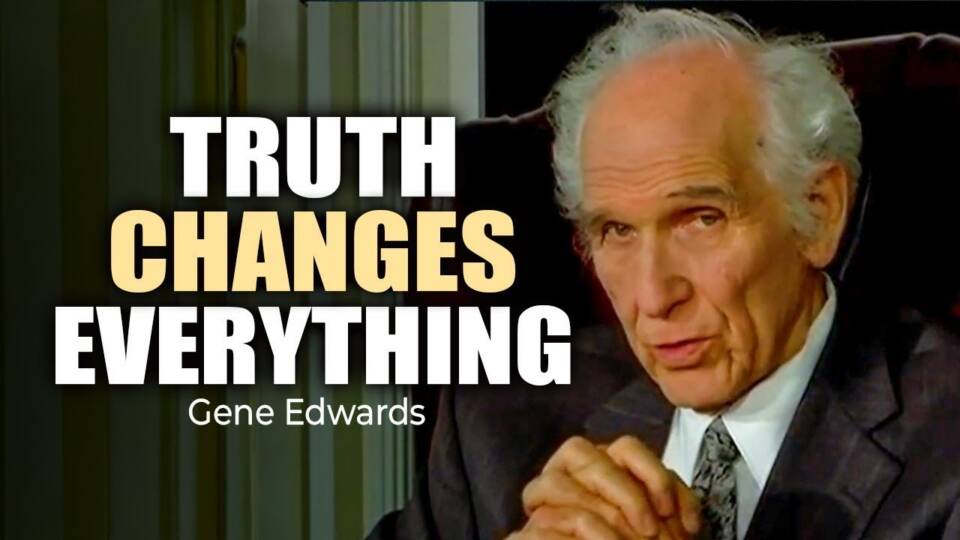
Truth Changes Everything • Jan 01st 2014
For over 1,700 years, Christians have unknowingly read the New Testament in a chaotic, non-chronological order—and the consequences have been enormous. In this eye-opening teaching, Gene Edwards reveals the greatest disaster in church history, a mistake so profound that it reshaped Catholicism, Protestantism, and modern evangelical Christianity as we know it. How the New Testament got in it… This message explains how the New Testament—especially Paul’s letters—was assembled not by spiritual insight, but by a pagan bookbinder who arranged the letters by length instead of history. As a result, believers lost the story, the flow, and the living context of first-century Christianity. In this teaching, you’ll discover:
Why Paul’s letters are not theological treatises
How chronology reveals a living, unfolding story
What happened in the “missing years” of Paul’s life
Why verse-by-verse Christianity misses the bigger picture
How restoring order restores understanding
Why the New Testament was meant to be read as a story, not fragments
This message invites believers into a revolutionary way of reading Scripture—one that restores clarity, beauty, and spiritual coherence to the New Testament.
I’m Gene Edwards, and this is a book entitled Unleashing the Word of God. Somehow it has come into your hands; it’s in your possession, and in the back of it should be a DVD. This is that DVD. It is the story of the biggest disaster in all of church history. Furthermore, it is a disaster that’s never been observed, never been discussed, never been cured. It sits here today. If this disaster had not occurred, there’s a good possibility that Catholicism would not exist, Protestantism would not exist, and no, not even evangelical Christianity as we presently practice, probably would also not exist. So, I’d like to tell you a little story, and that story gives us an idea of the greatness of this disaster.
We’re going to say it’s the year 330. It’s Rome. It’s the emperor himself, and walking beside him is a man named Eusebius, who happens to be from Antioch, Syria. They’re in the palace in Rome, but the emperor is about to leave Italy completely and move to a new city he has built, and it’s going to be called Constantinople, meaning the city of Constantine. He turns to Eusebius. He has been a Christian for about 20 years. He is misreading a great deal of the Christian faith because he has a pagan mind, but feels very definitely sure he is a believer in Christ and a devout follower of Christ. That is still being discussed.
He turns to Eusebius and makes the most interesting statement. Listen to it. He says to Eusebius, Eusebius, what are your mystery writings? Now that’s a pagan mind using pagan language. Eusebius is a Christian. He immediately reinterprets it. He says, Oh, he’s speaking about the letters and the Gospels that were written by the apostles. So, he carries on a discussion with Constantine for a moment, and Constantine says, and you’re going to be amazed at this, because this is the year 330. It is historically accurate; you can find this if you’d like to read it in any good history of the Bible. A New Testament in its totality had never been placed together.
Paul’s letters were circulating. Revelation had just begun to be circulated fairly well. One or two of the Gospels, usually Matthew and Luke or Mark and Luke, and totally separated in other places, the Gospel of John. But because of the incredible cost of making a copy of anything written, it would take literally the coffers of the Roman Empire to put out several copies of the New Testament, and that was exactly what was about to happen at this very moment.
And this is what Constantine said after they had been completely finished discussing this: ” I want complete copies of…” (what we would call the New Testament.) Now these writings, these holy, sacred writings, and using the term still, the mystery writings, which were a term used out of paganism…he said, “I want to have copies of them made.” Well, that would be so astronomically expensive. Even one copy.
You see, for a man to sit down with parchment or vellum and to hire a man to write all that out very slowly and beautifully with ink and quill would take an enormous amount of time when the average person in the Roman Empire was making ten cents a day. Where would you get the money? He commissioned Eusebius to put them together – what we today call the 27 books of the New Covenant or the New Agreement or the New Testament – and then he left for Constantinople; it’s one of the last things he did.
Now, nobody knows if all of those complete New Testaments were ever finished. The general agreement is that not all of them got finished, but some were completed. What happened to them? We don’t know, but everyone feels very certain that one of them survived, and that is a story…that is a tale worth telling.
The oldest Christian monastery in the world was built in the Sinai Desert just before the time of Constantine. Pretty well forgotten. By the time of the 1800s, it was being sponsored by, underwritten by, the Eastern Orthodox Church during the days of the building of St. Peter’s Cathedral under Peter the Great. A man, an Englishman, by the name of, believe it or not, Constantine Tischendorf, was traveling all over the Middle East, trying to collect ancient New Testament scraps. In one of the most unbelievable coincidences in all of human history. He came to the Mount Sinai monastery, and that week, those monks, all illiterate, had some scrolls of absolutely no significance to them whatsoever, and they had just begun to use those scrolls, those strips being taken off of, in order to kindle or to start the morning fire for breakfast, when Tischendorf arrived. He was mortified. He knew exactly what it was. Finally, they had found one of those 50 manuscripts, probably the original one, and there is a reason for believing that. It was in four columns. Everything else that had ever been found as scraps was in three columns or two columns, and usually the words would sort of come like this. There would be some misspellings. This is absolute perfection. Four columns. Clear. Neat. Thirteen, fourteen hundred years old.
Tischendorf played it cool. It didn’t work. They figured out there was something special about those. They would not let him take them away to be examined. He left. He came back ten years later, went to the monastery, and nobody at the monastery knew anything about those scrolls, and he assumed that they were lost.
The story goes, as Tischendorf tells it, that as he rode away, he stopped about ten miles out in a town to eat and was telling the proprietor there all about his woes and his problems and what had happened. The man said, “Sir, it’s a possibility I have those,” and went back into a closet or some storage place and came out with what has come to be known as the Saniyia, or the Sinai, manuscripts. He got them to Cairo. They were examined. Everybody who saw it had a fit. It was purchased by the Russian government and taken to St. Peter’s Museum. And the more they looked, the more they were amazed.
Beautiful story, isn’t it? But I left out one little part of it, and that’s the disaster. A 1700-year-old disaster. I say this emphatically, and I say it historically, and I say it accurately. Out of that accident, that disaster, that catastrophe of the highest order, you and I, or anyone else who’s ever lived on this earth since then, we cannot possibly know. We cannot. We cannot. We cannot understand the New Testament. Put a period at the end of that. I will prove that in just a moment.
Stop Playing Church • Feb 18, 2026
Escape Religious Cage • Jan 10, 2026
Break the Dead Chains • Jan 10, 2026