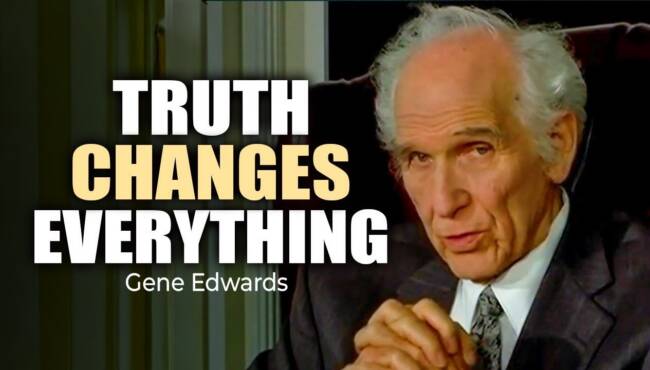
Truth Changes Everything • Jan 01, 2014


How Did Jesus Live? • Jul 01st 1985
How did Jesus live the Christian life? What was the true source of His relationship with God the Father—and what does His life reveal about our Christian life today?
In this profound teaching from Gene Edwards’ Life of Christ series, Gene challenges Christians to look beyond religious methods and return to Jesus Christ Himself as the pattern for Christian living.
Jesus lived in continual fellowship with His Father. He lived in the Father’s presence, beheld the Father, listened to Him, spoke with Him, and drew His life from Him. Gene describes this relationship as something deeper than a religious discipline: it was the fellowship of the Father and the Son.
And that fellowship did not end with Jesus’ earthly ministry.
After His resurrection, Christ gave His life to His followers. The disciples who had spent years watching Jesus fellowship with His Father were now called to experience an inward fellowship with the indwelling Christ. They, in turn, proclaimed what they had experienced so that others could enter into fellowship with the Father and the Son.
Gene traces this remarkable spiritual progression from eternity past, to Galilee, to the first disciples, to the early church, and ultimately to believers today.
This message also raises challenging questions about Bible study, prayer, church life, discipleship, and the way Christian workers are prepared. Gene’s purpose is not to diminish Scripture—he explicitly affirms his belief in its inspiration—but to ask a deeper question: What is the actual source of the Christian life?
His answer continually brings us back to Christ.
The Christian life is not merely something we learn to perform. It originates in God and becomes an inward life of fellowship with the Father and the Son.
If you desire a deeper relationship with Jesus Christ, greater spiritual growth, and a more Christ-centered understanding of Christian living, this teaching offers a challenging invitation: look again at the life Jesus actually lived.
John had a call: “Come fellowship with the Father and with the Son.” Now, I’m not going to stop there. I have two more points. I have made one: I have traced the Christian life for you—the means of the Christian life. Where did it begin? It began in God. That’s where the Christian life began, and I have traced it into the fourth stage. We belong in that stage. We’re those who have received the message from the apostles. We’re the ones who never saw Him alive on earth. That’s us.
I have two more things to say. Well, let’s go on and look at that for a minute. Do you think that the fourth group to hear and see and believe and enter into this means of the Christian life then passed on to others after them the Bible and prayer as we understand it today? The answer is maybe they did. I don’t know. Somebody did somewhere. Starting somewhere. I think it started around the 1500s. Before that, unfortunately, it was no better. It was ritual. And that started about the middle of 350 A.D., perhaps 400. Maybe before that, men still proclaimed the fellowship—the fellowship of our spirits, the fellowship of our inward parts—with an indwelling God, with an indwelling Father and an indwelling Son.
Let me go on. There are two other things I want to point out here: where did the church begin? At Pentecost? I think so. But…I don’t think so. I think the church existed in its embryonic form in Galilee, when those twelve, fifteen, or twenty people ran around with the Lord. But…I think it was before that. I think church life began in the Godhead—in the fellowship of the Father, the Son, and the Holy Spirit. And the church today should be, and is when it genuinely is, a fellowship of the Father and the Son and the believers fellowshipping with the Father and the Son and with one another. But you go back to the wellsprings, you go back to the fountainhead, you go back to foundations. I think those brothers knew church life in Galilee, but they knew it because they were fellowshipping with one of the members of the Trinity. I think the church life in Jerusalem was simply an extension of that.
Let me go on to the third thing. We have the Christian life. We have the church. We’ve only got one thing left, and that’s the worker. Again, I’m driven back to wellsprings. Jesus Christ said that the Father had sent Him, and He, the Son, being sent, chose…He was chosen and sent by the Father; He said that…He turns around and, as the Son, chooses and sends twelve men. So the Father has done it once; the Son has done it once, and then in Acts 13, we find out the Holy Spirit sends men. So the Trinity chooses and sends the workers.
The Father prepared the Son, and I have to ask, how did He prepare Him to be a worker before He sent Him? The answer is in the Trinity. The preparation was in the Godhead. He lived then on this earth, and He lived that life by means of His Father. He chose twelve men. Did He train them differently than the Father had trained Him? He let them live with Him in Galilee for three years. The answer cannot be that they were trained differently. You don’t give up an experience that lasted as long as eternity. It becomes an ingrained habit. I can do something around the house four or five times, and I can’t ever break it.
Here is someone who has spent eternity fellowshipping with God and being prepared by God through that fellowship. He comes to earth, He takes a few people, He gathers them around Him, and their preparation for apostleship is living with Him. Then it falls to them to prepare men, and sitting out in the audience in Jerusalem under the porch is one Barnabas, who sits under them and watches them—now the third motion in this great saga. He goes to Antioch, and he prepares somebody, and that brother sits under him and watches him…and his name is Paul of Tarsus.
Now I come to my main point, perhaps. Not my main point, but listen to me, because this puts the ball game in our court and in this room. I brought it out of time and space, out of eternity and time and space and Galilee and Jerusalem. I’m about to bring it to this room. Well, that’s exciting. I wish there were fifty people in this room. I really wish there were fifty people in this room.
In my judgment, there was something amiss. The gospel was not being clearly established on this earth by those twelve men or those who came after them, because Jewish culture—provincial culture—was pressing in on their gospel. I know that the men who brought the gospel to you and to me were not those men. Interestingly enough, they were not the men who brought the gospel. There comes a time when the Jewish churches are destroyed, and the Jewish people are dispersed. We’re talking about around 70 A.D., and we’re talking again about 100 A.D. They were dispersed into the Gentile churches established by Paul and his followers, and those were the only churches left.
There were a few little sects of John the Baptist, believe it or not, left after the first century—one or two churches outside of Palestine that claimed to be Judaistic churches that there are actual records of, but the great, overwhelming churches, with two or three exceptions, were all the sons of Paul of Tarsus. Those churches were from his hand, or those whom he had raised up.
That brings us to how Paul raised up workers. Alright, brothers, this is so exciting. This is really exciting. Please listen to me. Paul of Tarsus, when he is an old man… and this is the way you ought to be raised up as a worker if the Lord has called you to the work. Paul of Tarsus does what I consider one of the most masterful things ever done: a master stroke of work of genius. Pure and adulterated genius. This is just unreal.
He has raised up a dozen churches. Within those dozen churches…he’s an old man now…there are eight churches where men feel called by God to be workers. He picks those men to come to him. Each of those men comes from a different culture. Each one was present when Paul founded the church in the town where that brother got saved and became a member.
That’s eight different cities in eight different places. They speak different languages. Probably they all speak Greek, but it’s not their native tongue. They have another native tongue. Each of them can come and tell a completely different story about how their church was raised up, and each of them was there when it started, and they saw the whole thing.
Truth Changes Everything • Jan 01, 2014

Free to Fellowship with Christ • Dec 07, 2013

Sow to the Spirit • Nov 23, 2013