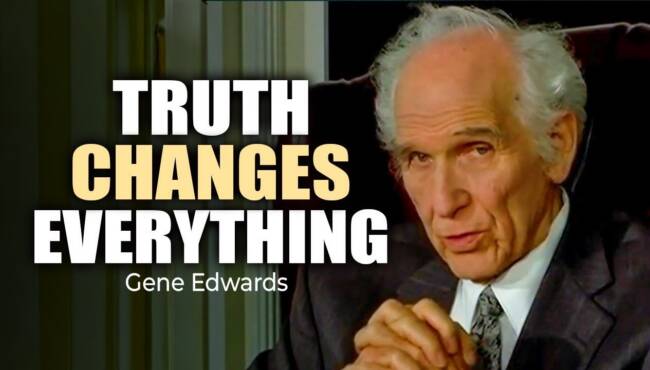
Truth Changes Everything • Jan 01, 2014


The Greatest Love Story • Feb 15th 1973
What is the love of God really like? In this powerful Bible teaching, Gene Edwards explores the love of God as the greatest love story ever told—a story that begins with God’s eternal desire, passes through creation and the fall of man, and unfolds into His pursuit of a bride.
Drawing from Genesis, Deuteronomy, Hosea, and Ezekiel, Gene traces a remarkable theme throughout the Old Testament: God does not merely command His people to love Him. He loves, pursues, restores, and longs for a people who will belong wholly to Him.
From Adam hiding from God in the Garden of Eden to the moving words of Hosea—“How can I give you up?”—Scripture reveals the heart of a God whose love is deeply personal.
Gene presents creation from an unusual perspective: God desired a counterpart, someone who could know Him, love Him, understand Him, and share His life. Man was created in God’s image with a desire for God. But with the fall, that relationship was shattered.
What followed is the greatest love story of all time.
God did not abandon His purpose. He went after the bride He had lost, even though winning her back would come at a terrible price. The biblical story of redemption becomes not merely the rescue of fallen humanity, but the unfolding story of God’s relentless love.
This message invites Christians and seekers alike to see Scripture from a larger perspective and to discover the eternal purpose behind God’s relationship with humanity.
SCRIPTURES DISCUSSED:
Genesis 3
Deuteronomy 6, 7 & 11
Hosea 1, 2, 6, 9, 11 & 14
Ezekiel 16
Chapter 2:19… listen to this: I will betroth you to me forever. Yes, I will betroth you to me in righteousness and in justice, in loving kindness and in compassion. And I will betroth you to me in faithfulness. Then you will know the Lord. And it will come about in that day that I will respond, declares the Lord. I will respond to the heavens, and they will respond to the earth. And the earth will respond to the grain and the new wine and the oil, and they will respond to what God has sown. I will sow her for myself in the land. I will also have compassion on her who had not obtained compassion, and I will say to those who are not my people, you are my people, and she will say “My God.”
Okay, I think there’s one other passage. Oh, let’s read chapter 6, just because it’s fun. Come, let us return to the Lord, for He has torn us, but He will heal us. He has wounded us, but He will bandage us. He will revive us after two days. He will raise us up on the third day, that we may live before Him. So let us know; let us press on to know the Lord.
Hosea 6:6 – For I delight in loyalty rather than sacrifice, and I delight in the knowledge of God rather than burnt offerings. Interesting about the Bible. Whenever a passage of scripture is being read, there will come so much blackness and darkness and hope and so many words of encouragement; you’ll think, goodness alive, the Lord has settled it, and it’s glorious and wonderful. Then the Lord will start all over again, tell them all these terrible things, and they’ll get positive again. I think that’s probably the way it should be to drive the point home again and again and again.
In Chapter 9, he does this. Do not rejoice, O Israel, in exaltation like the Gentiles, for you have played harlot, forsaking your God. You have loved earnings on every threshing floor. The threshing floor and the winepress will not feed them, and the new wine will fail them (that is, it will fail to defeat the Lord’s people). Verse 15, the third sentence. Because of the wickedness of their deeds, I will drive them out of my house. I will love them no more.
In Chapter 11, this could be, I’m sure, was said by the Lord with tears in his eyes. By the way, the word Ephraim is just another name for Israel. Chapter 11, verse 8. How can I give you up, O Ephraim? How can I surrender you, O Israel? How can I make you like Admah? How can I treat you like Zeboiim? My heart is turned over within me. All my compassions are kindled. Then two more lines: For I am God and not man. I am the Holy One in your midst. I will not come in wrath. They will walk after the Lord.
Okay, so it’s chapter 14, then. Just verses 4 through 6. I will hear their apostasy, and I will love them freely, for my anger has turned away from me. I will be like the dew to Israel. He (Israel) will blossom like the lily, and he will take root like the cedars of Lebanon. His shoots will sprout, and his beauty will be like the olive tree, and his fragrance like the cedars of Lebanon. Those who live in the shadow will again raise grain.
I want to go back to verse 4, the second sentence. And I will love them freely.
I’m going to speak on something this evening. Then the next time I speak, I will have to move on. Brothers and sisters, we’re considering something quite new in revelation, and you haven’t heard this before. Has anyone ever heard these things before?
This morning I was going to work with my student teacher. On my way back home, my student teacher and I drive to work together every day. He was telling me some things about the love of God that I didn’t know. I just sat there with my mouth open, just rejoicing. It was really powerful, and he was writing it down. I think some of it is what the Lord showed him up on the mountain this weekend. He was up there for both group meetings. He’s really hoggish about it. I just sat there, and I just sat at his feet. Every brother and sister in this room, the Lord has been showing you some things. Maybe it’s no more than one or two sentences, but something.
Okay. I ask you to be my coworker. We’re going to the whole Old Testament tonight…and that’s just not fair. I’ve seriously thought about reading the entire Old Testament just to trace the line. To trace the line in the Old Testament, you would have to read in three ways. You would have to read from Genesis 1 through Esther. You would have to stop there and know the line is completed. Then you would have to pick up Psalms and read all the way through to Isaiah, and know that, again, the line is complete. Then start with Isaiah and read through it, and know that when you’ve read through all the rest of the Old Testament, the line is complete. In other words, you have your history, you have your poetry, and you have your prophecy: the history, the poetry, and the sermons.
… creating counterparts. Then the animals. And then, finally, man, when He felt ready to create a perfect picture of the counterpart. He did all of that like a skilled sculptor, practicing little by little, always going on to something bigger until finally He made His masterpiece. He would create for Himself a wife worthy of God. I want to repeat that for you. He would create for Himself a wife…worthy. Please hear that. A wife…worthy. Worthy. Worthy of God.
Where would God get this woman? Where would He get her? From out of Himself. Now that’s really heavy. But brothers and sisters, God has a problem. God is a spirit, and in that respect, he is not divisible. He is neither seeable nor divisible. When I get to go to be in a much more personal relationship with the Lord, perhaps the Lord will say, ”Gene, that’s true – and it was also for this reason. There may be another reason. I don’t know. Those are the only two I know. I’m not clear why God had to come into man to have a counterpart, but I know one thing. He did have to come into man to have a counterpart. All I can tell you is that He was an invisible God, and by His nature, He was one. And for him to have a counterpart, He would have to alter His nature and cease being only God.
Truth Changes Everything • Jan 01, 2014
Free to Fellowship with Christ • Dec 07, 2013
Sow to the Spirit • Nov 23, 2013