
Stop Playing Church • Feb 18, 2026

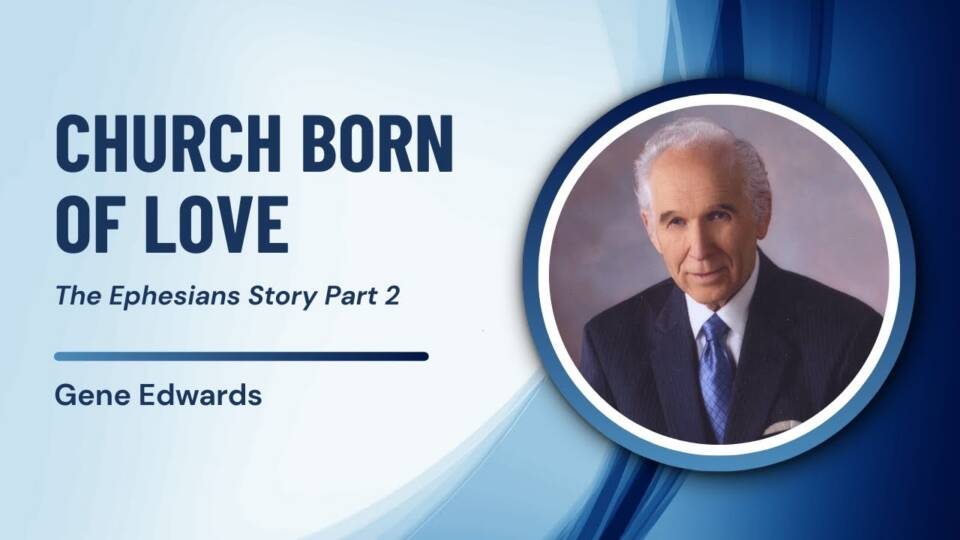
Church Born of Love • Aug 15th 1993
Imagine a faith so revolutionary it transformed a society steeped in misery and caste, without buildings, budgets, or formal leadership. Gene Edwards unveils the raw, unvarnished truth of the first-century Ekklesia – a gathering of people who, despite extreme poverty and hardship, discovered an electrifying, instinctive love for Christ and each other. This wasn’t built on programs or rituals, but on the profound, indwelling presence of Jesus and an organic unity that defied all social norms. This message invites us to look beyond institutional forms to rediscover the powerful, unhindered life of the Church as God intended, centered solely on Christ and a revolutionary love amongst its members. Tune in to be stirred by this ancient, yet ever-present, truth.
The clothes they have on, they have one set of clothes, a tunic, a robe, that’s all on earth they own. And before winter is out, there is a possibility that some of these people, in this city, God help us, let’s hope it’s not the Christians, will have to sell the clothes off of their backs in order to get food to last through the year. That happened quite frequently. Many of these people never had a pair of shoes on. Others have a pair of shoes; it’s a mark that they’re an edge above. They may have to sell those shoes before this year is out in order to have grain to live on during the wintertime. The biggest challenge they will face next year is to buy one more set of clothes and throw away the rags that they are wearing. Some of the clothes that those people are wearing are patched so much that you do not know where the clothes begin and where the patch begins.
Would you look at them again? How many are there? 20? 50? No more than 100. Oh, I really doubt there are 60 people in the church. And I don’t like using the word’ church. ‘ We’ll just call it the ekklesia. Those are your brothers. Those are your sisters. And those are those vaulted first-century Christians we hear so much about. There they are. That’s what it really, really, truly looks like.
They’re not sitting there wondering about the Christian family. They’re not giving a radio broadcast. They’re not hearing everybody say we got to have a everybody is going to go somewhere in this world needs a college education, and you should send your children to a Christian college, and there’s nobody here going off for two years to learn the Bible at a Bible school, there’s no counselor present in this ekklesia. There’s no Sunday school; there are probably three people, maybe four; let’s really hope there are five people in that room who can read and write. Reading is a skill, and writing is a skill; something like being a CPA is today. It was something you paid a man to do for you, to read or to write something for you. People are illiterate. They don’t have Bibles. There’s no such thing as a Bible or a New Testament for these people. Many of them in that room don’t even understand the concept of what a letter in the Greek alphabet is. They do not have the foggiest idea of what writing is. It has never come up in their lives. Half the people in this room are slaves; the other half are really not any more than a beggar might be in our day in India.
All these people are ex-heathen. They were heathens just a year or two or three ago. They drank blood out of their skulls at the temple. Slew ox stood around and watched a religion that was simply the incarnation of superstition. This is what they used to be.
Then one day, a young man by the name of Epaphroditus came and preached the gospel to them, and something happened that is almost beyond our ability to communicate. Those people who were converted got God inside of them, got the Lord inside of them, and something inside of them began to sing, sing to the spheres. They got close to one another and found out that being near one another brought joy. They found out that something mysterious had happened. They’d been changed. They probably smiled. A smile, by the way, is not something that has been around in history forever. I don’t know if you’ve ever seen any of the old Western pictures taken of the Wild West, in the first cameras of pictures of people ever taken, nobody is smiling. A smile is not something well-known to the human race until just recently. These people actually have something called joy. They’ve gone past a smile.
Now they begin to meet together and learn to sing, and they talk to one another in these incredibly informal meetings, there in the home. And they’re the first religion the world ever knew that did not meet in a temple or a special building and had no ritual, but that’s not the point. The point is the way they cared for one another, loved one another, and people began to notice when they greeted one another in the street. They would hug each other, and they would kiss one another, probably on the cheeks. The world looked at this and wondered what was going on because everyone else was walking around like a zombie. The only entertainment was for the wealthy. And here, people seemed to have joy for no other reason than the fact that they knew one another. And they got up early in the mornings, and they met together in the night. And it was rumored that there were well-to-do people present, and they would take care of the people who were poor, who were really in need, like a wife who had lost a baby perhaps that day. And if a man got a job out in the field, and the manager of the field would say, “I need someone else.” Well, he’d strike off running as fast as he could to the home of another brother and say, “You want to work for the afternoon? There’s somebody out here who needs help.” And people began to notice this. And what they were noticing was not some saved Christian. They were noticing something that was going on corporately. And it just didn’t fit anything else.
These were the only people in town who had something besides misery in their lives. And they shouldn’t be that way because these people are worse than poverty-stricken; they’re living on the border of human survival. And then some pagan slips into the room, and people are laughing, singing, sharing, telling stories, and talking about someone named Christos, and these people are mesmerized by what they hear and what they say, and some are saved. They don’t just take off, and you go join a parachurch organization the next day. These people don’t go anywhere to be saved and to be a part of that body of people meeting there in Philemon’s home. That’s all they know of the Christian faith; that’s because there’s not anything else.
And I’d just like to tell you that, and I could almost wish this off on us, the people sitting in that room, with almost no exception, didn’t know what the world looked like 5 miles away. It has often been said that you could take someone during this period of time in antiquity, what we call antiquity, and take them 10 miles from home, and they might never find their way home again because no one would have ever heard of their village or town. They wouldn’t know what roads to take, and there weren’t any roads. They were trails. Now, I realized the Roman roads did lead past some cities, but Colosse is not one of them, and neither is Hierapolis. And when you moved outside a perimeter of 5 or 10 miles, you were as lost as if I were to drop you down somewhere in the jungles of Africa, in the hills of inland China, or on a path somewhere in the Himalayan mountains. And remember, paths were all these people had. There were no roads. And those paths went off in every direction like a maze. And you’d better know which one to take to get to your house if you’re a mile or two from home, because otherwise you might never find home again. So, it was the church in Colossae made up of these people.
Now we’re about to open that letter. I’ve given you a background to two letters, the Colossian letter and the letter we call Ephesians: I’m going to call it Colossians 2. It began in the Trinity in the Godhead in the fellowship of the Father, the Son, and the Spirit. That was the ekklesia. I don’t know how long that went on because that’s immeasurable and non-dimensional, but if we were trying to understand it, we would say millions or trillions or whatever years, but it really wasn’t that at all.
We don’t really comprehend eternal things, but one day, the Son became visible. By the time He was grown, He had become conscious of His entire past eternal history. He remembered it all. He remembered the Father, He remembered the Spirit, and He remembered being there in the bosom of the Father. He was not without total consciousness of His past. He had only one thought, and that was not your salvation nor mine. He had the thought of expanding or maybe even re-expanding, and bringing heaven to earth, or to bring the experience of the Godhead to man, and include them. He did not die for you, nor did He die for me. According to scripture, He died for the church. He loved her and gave Himself for her, but when He stepped upon the scene at Jordan, He did not come to save us from our sins. He came to fulfill His eternal purpose, which necessitated saving us from our sins. It was a small part of the greater whole, and His ultimate and mysterious purpose is almost too sacred to utter, and that’s to include us in that eternal fellowship. The thing that would be called the ekklesia is the first taste of that.
Now, He did something instinctive. I want you to listen to my words. He instinctively did that which is natural to His species. Now, He is a species, not a cat or a dog, not a human, not an angel. He is the divine species. Now, these words might come a little strange to you, but that species has an instinct, and that instinct is to meet together, to be together. And He was going to bring to another and highly damaged species His own species. He’s going to do something that has never been done biologically; He was going to introduce a life form into another life form. If you don’t understand this unique way of presenting that which you already know, raise your hand. He was going to put the life of an eternal God into a human being, and we would have those same instincts.
The habitat of God is the coming together of Father, Son, and Spirit by divine nature. He showed us an embryonic glance of that habitat when He got 12 men together with Him and four or five women. Seems to have expanded to 70. It seemed to have expanded to 120. It may have expanded to 500. And who knows? But this is all before His crucifixion. Let’s just take the group that lived with Him: 12, 15 men, 20, 70, a group of women. Let’s keep it to 12 for a minute. He illustrated to them the Godhead, the instinct, His purpose. He gathered a group of men and women around Him, with whom He was the center. On the day of Pentecost, they knew what ekklesia was because they had experienced a foretaste of it with Him. And I want you to look at just a few elements. One, Jesus Christ is the center, and there is no other center, and it is not the proclamation of Him. It is not the teaching of Him. It is not the understanding of historical matters around Him. These are not facts about Him. It is Him in His presence among illiterate men and women. You can know that the women were illiterate, and those fishermen were certainly illiterate on the day they got arrested by the Sanhedrin. Whether they learned to read and write after that, I don’t know. I know that John probably wrote; I doubt Peter ever did, because I’ll tell you for sure, he sure butchered up the 2nd Peter. Try to read that in the Greek. Somebody didn’t help him enough there. 1st Peter looks really slick. Mark did a good job of getting that all written down really clearly. I don’t want to get into that. I’m sorry. But anyway, they were ignorant men. They were not learned, scholarly, philosophically in tune men, but they understood fellowshipping with Him and with one another.
Stop Playing Church • Feb 18, 2026
Escape Religious Cage • Jan 10, 2026

Break the Dead Chains • Jan 10, 2026