
Return to the Beginning • Apr 13, 2026

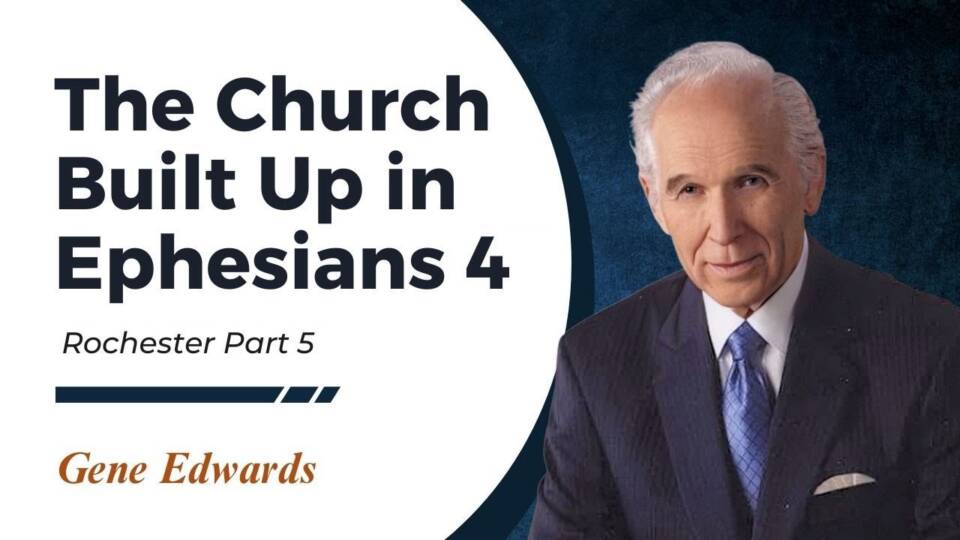
How the Church is Built up in Ephesians 4 • Jul 01st 1996
In this deeply challenging and insightful teaching from Ephesians 4, we are invited to reconsider what the Christian life truly is—and where it actually happens.
Paul’s words call believers to walk in humility, gentleness, patience, and love, preserving the unity of the Spirit in the bond of peace. But this message goes far beyond personal character. It reveals something far more profound: the Christian life cannot be lived in isolation. It only finds its meaning within the living, functioning body of Christ.
This message explores the reality that every believer carries a measure of Christ. No one has the whole—each has a part. And it is only as those parts come together, supplying Christ to one another, that the church is built up into maturity.
Ephesians 4 describes apostles, prophets, evangelists, pastors, and teachers—not as permanent authorities, but as those who equip the saints. Their role is temporary. Their purpose is to prepare God’s people to function, to serve, and to build up the body themselves.
The result? A church where every member participates. A body where each part contributes. A living expression of Christ formed not through teaching alone, but through shared, experiential knowledge of Him.
This teaching also challenges common assumptions about church life. It warns against passive Christianity—where believers only listen, observe, or depend on leaders—and instead calls for active participation. Growth happens when every believer supplies something of Christ to others.
As this process unfolds, something remarkable takes place:
unity emerges, maturity develops, and the fullness of Christ begins to be expressed through His people.
This is not organizational unity. It is not doctrinal agreement. It is something deeper—a shared life in Christ that flows between believers and builds them together into something living.
If you’ve ever wondered what the church is meant to be… or why so many gatherings feel incomplete… this message offers a glimpse into something far richer.
Ephesians 4. I, therefore, the prisoner of the Lord Jesus Christ, entreat you, #94, to walk in a manner worthy of the calling with which you have been called. I don’t have to walk in the Christian life. I can walk in on a girl who walks in the Christian life. With all humility and gentleness, with patience showing forbearance to one another. To one another.
Now, Paul does this in every book he writes. He stops and gets into the…if you want to know what church is like when it’s not so hot, read between the lines here. These are the problems we face in the church. Some of these are very positive, but a few of them are very negative, and that is, each individual of us walks humbly in the greater body, that we are gentle, that we have patience with one another, and that we be patient for a long time, that is, we forbear with one another. Period. In love, being diligent to preserve the unity of the spirit and a bond of peace. And again, that she’s fragile, saints, I have to tell you that. I’d like to tell you she’s not, but one saint can really break the peace. It’s one thing to get down; it’s another thing to complain. It’s another thing for someone to stand up and start really creating major problems throughout the church. You break the spirit, the bond of peace that does live within the church. That’s fairly rare, thank God. There is one body, one spirit, just as also you were called in one hope of your calling. You think we ought to add that, being diligent?
Humility and gentleness and patience and forbearance are definitely addressed to the pieces of the body, the parts, the members of the body; each one of us is doing this, and I think that shows up very strongly with one another. We’re being addressed individually here. And yet, as our brother has pointed out, the being of these things, we really cannot do. It’s a lot easier for these things to be fulfilled in our lives in the house of God. You’ll never make them outside the house of God, and these verses will haunt you to your grave. One Lord, one faith, one baptism, one God and Father over all and through all and in all. I don’t even know what that means. Do we have an “over all”? Mine is over all and through all and in all. The baptism is in us all; faith is in us all; the Lord is in us all; the calling is in us all; the hope is in us all; the Spirit is in us all. It sounds pretty corporate to me, folks. I tell you again that the Christian life and the church are so synonymously woven together that it is almost impossible to think of the Christian life in any other aspect.
But to each one of us, brother, you’re getting another one. To each one of us. And you got another one, too, didn’t you, brother? Grace. What’s the next word? Your grace was given according to the measure of Christ’s gift. I want you to understand that if I have a gift, it’s partial. And if you have a gift, it’s partial. Each of us has a measure of a greater gift. And that relates to everything here. And I’m not going to get into this because I’m going to try to finish this chapter today, but I wish you would take that and meditate on it. For those of you who have heard a great deal about the gifts, there’s one gift to the church. Each one of us has a measure of some part of Christ that we bring to her or in her. Therefore, it is said, when He ascended on high, He led captive a host of captives, and He gave gifts to men. Do you know what that means? I will tell you what I see. And I’m not going to preach it; I’m just going to say what I see. I see Him ascending on high, and He took every redeemed soul with Him. That is, He took His body with Him. All of us, for all ages, were ascending in Him, and with that, He gave some part of Himself to each of us, but that’s all I can say. That’s all I understand. I would like to say to those of you who are into gifts that, as far as I’m concerned, all gifts are dangerous unless they are local in their expression, and I really mean that. I find them to be incredibly dangerous, like that ox tongue I found in the grocery store.
I wonder how many men serving the Lord Jesus Christ today, whose names are famous and whose gifts are great, could survive in the church in Rochester and five years later, could get a good report when they went out to serve now. I wonder how many men could do that. And may God bless men who go out from the church to serve the Lord, and they have a good report. Follow that man.
Now, this expression He ascended, what does it mean, except that He also has descended into the lower portions of the earth. And when you can tell me what that says, friend, write me a long letter. He who descended is Himself also the one who ascended far above all the heavens that He might fill all things. And if you will take that with a verse in 1 Corinthians 14, it’s 14:24. Somebody look that up. I think that’s 14:24, 14:48; I can’t remember. I don’t understand this passage. I confess it. I’m not even going to talk about it, but we have three passages that to me speak more clearly of God’s ultimate…what’s going to happen to us ultimately, practically, is that He will fill us. He will fill the redeemed with all that He is, and that we shall be all the extension of the all of Christ. We shall come into a total oneness. Not only a oneness that we can imagine physically or spiritually, but that oneness will include His filling all the soul and all the spirit of all His people. What about the body, Gene? It doesn’t get anything, but the new body gets everything. That’s the individual body. And then perhaps there is the filling, the coming together of all our individual bodies to literally make up one complete body, a girl. And He fills all in all. And then He turns to the Father and submits Himself to the Father, and the Father becomes all in all. If you do not agree with that, it doesn’t bother me one bit, but I want to ask you to take these three or four verses and try to explain them by any other means. These are the most mysterious verses in all scripture.
Okay, what verse did we leave off on here? And He gave some as apostles, and He gave some as prophets, and some as evangelists, and some as pastors and teachers. And if I stop there, boy, do we get ambitious folks, but if I keep going, you may head for the hills. And I think perhaps the greatest abuse in Christendom is that verse, when it neglects the other two verses, because these people are all listed as temporal. They are all listed at temporal. They have a short-term job to do, and their responsibility is not to forever build and not to forever gift, not to forever practice, but rather they have a short-term goal that turns that girl loose. On her own. And it couldn’t be more patently clear. And the abuse that has come out of this verse, and I don’t know if you know this, but Azusa Street, that what came out of that was not what was in it. What was in it was body life. What was in it was church life. How it was interpreted was tongues. And praise was to me the greater contribution that was made from what flowed out of that. The Pentecostal folks gave us praise, but they stubbed their toe when they said God is now, and this became a gimmick, and that gimmick still lives. However, it more or less died after the Jesus movement; thank God the Pentecostals started looking around for the next thing God would recover, but they had this thing that turned into a gimmick, it was that what God is after is a restoring of the gifts. I bet you never heard that term, did you? God is after the restoring of the gifts.
Well, brother, then if God restores the gifts, He’s going to restore the church because those people have very temporal jobs to do. Listen to the rest. It is a body thing that is being mentioned here. Paul is an apostle. Epaphroditus is called an apostle, and the translators did not have the guts to translate it that way. He is called one sent. These people’s jobs are temporal, and if they continue, they are a damage to her. Let’s read the rest of it. He has given some, not everybody, apostles, and some prophets, and some evangelists, and some pastors, and maybe pastors-teachers for the equipping of the holy ones. You equip the holy ones. You do not preach to them forever. You get down to practical practice. You give them things to do.
For instance, do you want to hear one of my secrets? I’m going to give away one of my secrets. I’m not assigning this; I’m just telling you. Four weeks from now, you will work on, and I will tell them all sorts of things to do with Ephesians chapter 1. You’re going to have a meeting, and you’re all going to be there at 7:00. You, you, you, you, you, you, and you are going to start songs. You’re not going to announce songs. You’re going to start songs. You don’t announce. You announce them, and everybody starts looking in their songbooks. You can kill a song at a meeting. After the song starts, I’m equipping saints. You may not know this, but I’m equipping saints. Somebody hollers out the number. You, you, you, you, you, you, you, and you are going to start a song. By the way, you owe me $1,000 a piece when I get to give you this illustration.
You, you, you, and you are going to pray, Gene. This is terrible. Why don’t you let things be spontaneous? Because the chains are still on you. And this is breaking chains. You go into a meeting, and six months later, the chains are broken. This is the breaking of the chain. You, you, you, you, you, and you are going to testify, but no brothers will speak in this meeting, only sisters. Brothers, you can start songs, and you can even pray short, but you cannot share or speak. Why? Because brothers don’t have off buttons. And brothers don’t know how to be a girl.
“Well, I was listening to Gene when He was speaking last month, and I went over and looked this up in Greek on my computer, and I noticed there were seven ways that the word ‘something or other’ can be interpreted, and there are at least 29 different ways that a man can interpret these seven different translations of this word.” And it goes on and on, or it’s something like that. And brothers, you do this, and I’m not being general. This is who you are. This is what you do. You’re just the frontal lobe right here. This is because you don’t know how to share from the heart. You have no idea how to share from the heart. So, the sisters have to teach you, and so you have the meeting, and the sisters share, and sometimes it’s wonderful, and sometimes it’s a total bust. See, if it’s a total bust, you have to do it again.
Return to the Beginning • Apr 13, 2026

Stop Playing Church • Feb 18, 2026

Escape Religious Cage • Jan 10, 2026