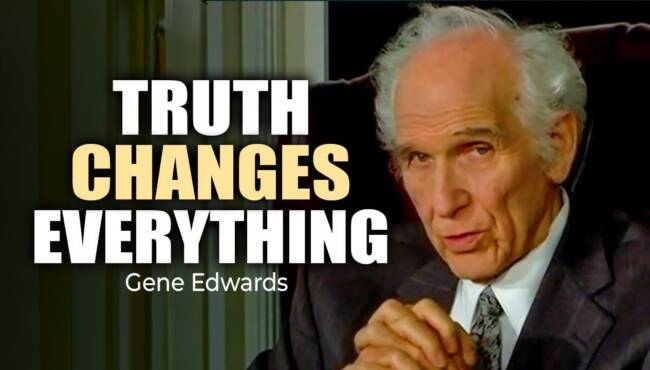
Truth Changes Everything • Jan 01, 2014


CHRISTIANS' ACCESS TO THE HOLY OF HOLIES • Dec 30th 1969
What does it mean to enter the Holy of Holies and truly experience the presence of God? In this Bible teaching, Gene Edwards explores the Old Testament Tabernacle, the mercy seat, the priesthood, and the deeper spiritual reality these pictures reveal about Christ and the Christian life.
Beginning with Exodus and continuing into Hebrews, Gene examines the Ark of the Covenant, the cherubim, the Holy of Holies, and the high priest who entered the innermost place. These Old Testament pictures point beyond outward religious practice toward an inward life with Jesus Christ.
One of the central themes of this message is that genuine Christian expression begins within. The outward life of the believer is meant to flow from an inward supply of Christ. Gene describes this as eating, drinking, breathing, and being filled with Jesus Christ until His life is expressed through His people.
This principle applies not only to individual believers but also to the church. Christian unity cannot ultimately be produced by doctrine, knowledge, commitment, organization, or even a shared vision. True spiritual unity comes from the divine life of Christ working within His people and joining them together.
The message then turns toward prayer and the priesthood of the believer. Through personal stories and the remarkable example of Beta Sheirich, Gene reflects on the power of a believer who gives himself or herself to intercessory prayer before God. One person’s hidden prayer may have consequences far beyond what that person ever sees.
This teaching invites us to consider a deeper question: Are we merely practicing the outward forms of Christianity, or are we learning to live from the inward presence and life of Christ?
Scriptures discussed include Exodus 25 and 30, Genesis 3, Hebrews 4 and 9, along with biblical themes of the Tabernacle, the mercy seat, the priesthood, the Tree of Life, Christian unity, and intercessory prayer.
Exodus 30:17-21. And the Lord spoke unto Moses, saying, You shall also make a laver of brass, and its foot also of brass, and wash withal, and you shall put it between the tabernacle of the congregation and the altar, and you shall put water therein. For Aaron and his sons shall wash their hands and their feet thereat; when they go into the tabernacle of the congregation, they shall wash with water, that they may not die; or when they come near to the altar to minister, to burn offerings made by fire unto the Lord, so they shall wash their hands and their feet, that they die not. And it shall be a statute forever to them, even to him and to his seed throughout all generations.
Now, this is about the outer altar. Now let’s go to Exodus 25: 15 through 20.
Exodus 25:15-20. The staves shall be in the rings of the ark, and they shall not be taken from it. You shall put into the ark the testimony which I shall give thee, and you shall make a mercy seat of pure gold. By the way, may I ask, this word “mercy seat” is also sometimes translated…do you have any other translation for this word? A covering? Any other words? Does anybody have the word propitiation? Alright. Huh? In the margin? Okay.
You shall make a mercy seat of pure gold, two cubits and a half shall be the length thereof, and a cubit and a half the breadth thereof. And you shall make two cherubims of gold, of beaten work shall you make them, in the two ends of the mercy seat, and make one cherub on the one end, and the other cherub on the other end of the mercy seat; and the cherubims shall stretch forth their wings on high, covering the mercy seat with their wings, and their faces shall look one to another; toward the mercy seat shall the faces of the cherubim be.
Where are the cherubim looking? They are looking toward the Mercy Seat. We have an altar, and here we have a depiction of the Ark with the Mercy Seat on it. Alright, let’s go to Hebrews.
Hebrews 4:15-16. For we have not a high priest which cannot be touched with the feeling of our infirmities, but was in all points tempted like as we are, yet without sin. Let us therefore come boldly unto the throne of grace, that we may obtain mercy and find grace to help in time of need.
Hebrews 9:3. And after the second veil, the tabernacle which is called the holiest of all. What is the first veil? As far as I know, it is not mentioned in the New Testament. The first veil is the veil in the Holy of Holies, and it’s opened easily; you just open it, but there is now a veil that covers the Holy of Holies. You’re in the holy place, and you have to go through a veil to get into the Holy of Holies. How many of the priests can get into this place? One. Which one is that? The high priest, that’s right.
Hebrews 9:4-5. Which had the golden censer, the ark of the covenant overlaid round about with gold, wherein was the golden pot that had manna, and Aaron’s rod that budded, and the tables of the covenant, and over it the Cherubims of glory, shadowing the Mercy Seat. What other word do you have besides shadowing? Overshadowing. Do you get the impression that they’re over the mercy seat and protecting it or something like that?
…of which we cannot now speak particularly. Brothers and sisters, we’re going to speak particularly.
Hebrews 9:6-7. Now when those things were thus ordained, the priest went always into the first tabernacle, accomplishing the service of God, but into the second went the high priest alone, once every year, not without blood, which he offered for himself and for the errors of the people.
Hebrews 9:8. The Holy Spirit, this signifying… Do you get the impression of what the word “signifying” means here? What is the word signify? The Holy Spirit is picturing it for us to see. By this, the Holy Spirit gave us an insignia, a signifier, a picture…that’s good enough. You understand? Alright, all of these are pictures for us.
Truth Changes Everything • Jan 01, 2014
Free to Fellowship with Christ • Dec 07, 2013
Sow to the Spirit • Nov 23, 2013