
Stop Playing Church • Feb 18, 2026

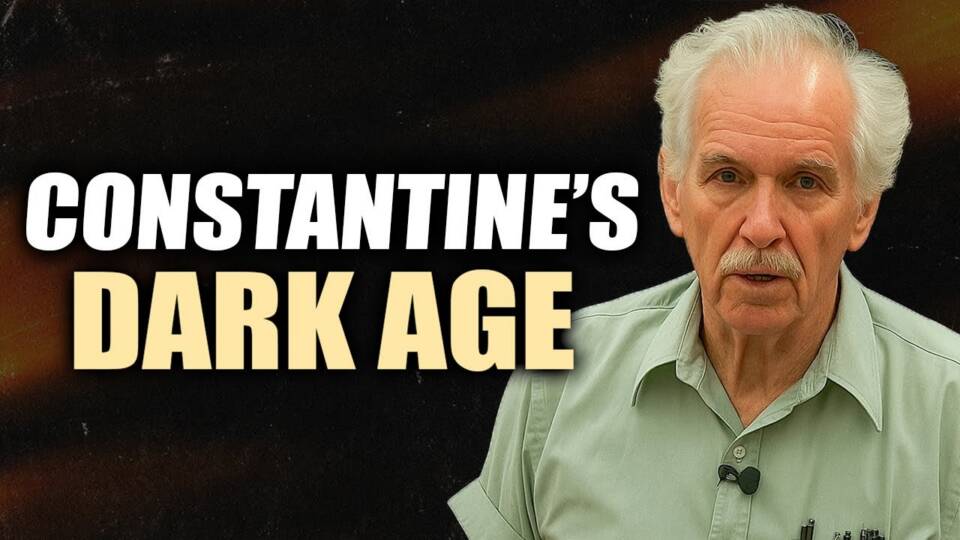
Constantine's Dark Age • Jul 04th 1987
What happened to the simplicity of the early church?
In this full conference session, Gene Edwards explores the dramatic shift that occurred after Constantine legalized Christianity in the fourth century. Drawing from historical and archaeological research, he examines how church buildings, clergy systems, the Sunday morning service, the sermon, and the modern concept of the pastor developed over time.
Was the early church structured the way we know it today? Or did a period of syncretism merge Roman culture with Christian faith, creating something entirely new?
This message challenges long-held assumptions about Christian tradition while calling believers back to the simplicity, vitality, and organic life of the first-century church. Whether you’re a pastor, church leader, or believer seeking historical clarity, this session offers a bold look at the roots of modern Christianity.
Audience: Gene, do you know anything about the origin of the sign of the fish?
It was one of the not early but middle symbols. It was not the earliest; the earliest symbols were Jonah and the anchor; the dove came a little bit later. The lamb was never depicted slain. He was always depicted at the feet of a caring shepherd. I don’t know what was going through these people’s heads, but one thing you get is that they are not carrying a guilt trip around with them. And I don’t know the origin. I’ve heard the classical, you know, I think Hollywood made that up. I have never read any early evidence that that’s true, and someone may have, but I have never read a scholarly statement on the subject of it being a symbol that Christians identified with. I think we’ve gotten into a lot of over-dramatization of what happened during the second and third centuries.
“They went out to the old world, preached the gospel, everybody got saved, the empire fell, and up came this great Christian world empire”; phooey. We were holding on by the skin of our teeth when Constantine came along, and I wish to goodness he hadn’t come along, and now I’m going to commit heresy here. Can I jump up on something radical here? Thank you very much. I appreciate that word of confidence. My own feelings about Constantine are very poor. We Christians should have and should always remain a persecuted minority. I don’t want to be persecuted. I don’t have a persecution complex. I mean, we should always have the short end of the stick. It does not do for Christians to get in control of anything. And we got in control, and we lost it.
Now, here’s my radical statement, and I know you’re not going to understand me. Why I make statements like this, I do not know. But three people in the back row will understand me. The rest of you will have a fit. There are three people who will appreciate this. I wish we had lost at the Council of Nicaea. I wish the Aryans had won and the Trinitarians had lost. I wish we could have left that thing. First of all, I wish it never been held. As one scholar said, “No first-century Christian could have read that creed and understood what it meant.”
Anyway, that’s true because it was written in Aristotelian. I wish we Trinitarians had gone out of there, the persecuted ones. I wish that Constantine had gone with the Aryans. I wish he had denied the deity of my Lord. That would have helped a whole lot. We would have had to go, I don’t know where, but we could have kept our purity, and he wouldn’t have been giving us the taxes that had gone to pagan temples. He would not have built for us a hundred church buildings that turned into cathedrals. He would not have legalized us and then given us the power of the state to kill others who did not agree with us. We should have lost at the Council of Nicaea. That is the Edwardian view. You don’t have to accept it. You got another question.
Audience: Are there other spaces, such as Duro Europa?
Well, I think it’ll keep coming as long as they keep digging. It’s not static. It’s still happening. A lot more recent things have been coming out of Egypt. I think you would enjoy this book. I did a timeline. Have y’all…is it over in the bookstore? Now, treat that with reverence, whether you get it or not. That’s probably the best timeline; I say this in all Texas humility. That is probably the best timeline ever assembled for the early church before Constantine, because it’s the only one that incorporates recent archaeological evidence in the far-right column, and a whole bunch of Christians worked really hard on it. We got that thing copied just before the conference and got it up here. There are 150 copies of it. If you are a history buff, you will enjoy that, and you’ll see all these bishops, bishop this and pope that. Don’t pay attention to that stuff. Just call him a local elder, would you? If you have to get that religious, pay attention to what’s happening in this far-right corner of the recent archaeological information coming up, which is combating all of this other interpretation.
Sister, there are four “house churches” that have been excavated so far. This is interesting. The Roman school of archaeology said that there was an early Christian church under every cathedral in Rome. They listed all the earliest buildings that Constantine built, and they said you’ll find under them church buildings where all of these revered events took place. Recently, because there is a growing evangelical Christian archaeological study of non-Bible lands, non-Rome, they came and challenged that, and went back to those buildings. Listen to this: not one of the ancient Constantinian buildings…not one of them…had a church under it, a pre-Constantinian church. It was either virgin land, a cemetery, or a marketplace. Not one of them had a house under it. No church houses there. Church buildings were invented out of the dark medieval mind of Constantine. They did not exist, per se, previous to him.
Yeah, question, anybody, anything. I’m not against church buildings. I’m just again…Yes, sir.
(Can’t understand the question) Absolutely none whatsoever. That is all, either pre-Christian or pre-second century. Yes. Oh, this book is called Ante Pacem. Do you all understand what a Pacem means? It means “before the peace.” The peace of Constantine: after the Bible and before Constantine came along. It was written by a man named Snyder. It’s from Mercer University and is titled Anti Pacem: Archaeological Evidence of Church Life before Constantine, by Graydon Snyder. Please let me say a word about it tomorrow. I need to because there are a couple of qualifications here. You evangelicals need to be careful when you read this, unless I explain a couple of things.
(Can’t understand the question) You see, you get up here, and you start making radical statements, and somebody starts…I could not be more content with the word of God, the New Testament…you cannot find anybody in this world more committed to the Scripture and or its inspiration than I am. I believe in its dynamic, verbal, veracity, inspiration, and I believe in what’s that word we’re kicking around these days? I believe in inherency. I want you all to know this business of where we got our Bible is ridiculous. I think the only real major debate that ever happened over the first century writings was whether or not to put First and Second Clement in there, and that was all. I’m very content with it. I’ll tell you what I’m so mad about, I could spit fire. I am burning mad at the way the epistles are arranged, and I am so angry with the way Martin Luther arranged the epistles in the New Testament. I get downright neurotic, and I will explain to you why later. Alright, you have another question. Yes, brother.
Audience: What archaeological journals are these things coming out in for us?
Stop Playing Church • Feb 18, 2026

Escape Religious Cage • Jan 10, 2026
Break the Dead Chains • Jan 10, 2026