Christ Made You Holy • Mar 05, 2026

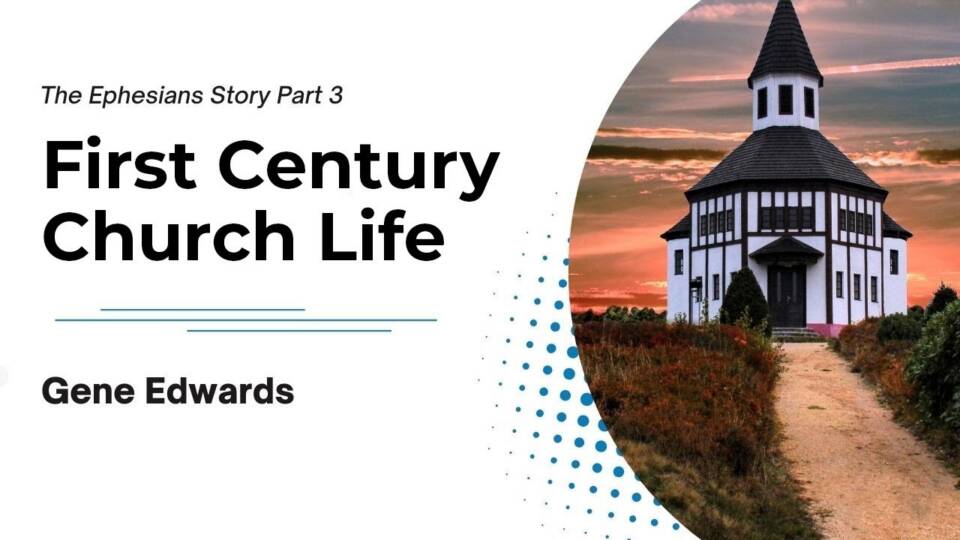
Aug 15th 1993
This profound message of Gene Edwards plunges us into the gritty, desperate reality of first-century life in towns like Colossi, where the “great unwashed” lived short lives marked by filth and malnutrition. We see how the spiritual gifts—from the brother who gives comfort to the unorganized “apostle”—emerged “organically and naturally” within the local fellowship, not through programs or structure. Most critically, we witness the unique peculiarity of the Christian faith: new converts being quickened to immediately fall in love with one another. The sources reveal that the greatest instrument of evangelism the world has ever known is the church herself, magnetic and inseparable from the gospel life. Come discover the authentic, compelling power of the Ecclesia that defied the norms of the ancient world.
He went to all of his churches and said, “Y’all got any volunteers who will move and move to Rome?” And boy, what a church the church in Rome was for about 200 years. Do you understand what happened? They got there and cross-pollinated. Christians, not workers, Christians got there from all over the heathen world and cross-pollinated. They brought their many and varied experiences. It had to be that way because Rome had more different nations and more different tongues and cultures represented than any other place on the planet. And they came there and Paul wrote them a letter, and in so doing, he revealed a little bit of his gospel preached during those four months. But there’s one other thing that is the genius I referred to a minute ago. And that’s when Paul of Tarsus, on his third journey, decided to go to one town, and in this moment, he duplicated the ministry of Jesus Christ in the raising up of church planters. And he turned to each of his churches. By the way, this was before the Roman experience. And he said, “I want you to go with me to Ephesus, Gaius, Secundus, Tychicus, Trophimus, Timothy, Titus, Aristarchus.
He pulled out five young men from among his churches, all of whom indicated a call of God in their lives. Now listen to these men. This brother was there from the beginning. He was saved when he was first in Derbe. This brother was saved when Paul came to Lystra. This brother was present in Corinth from the beginning, and he witnessed the birth of the church. Secundus was there at the beginning of the birth of his church. He went through those four months. He went through those years, and so did Aristarchus and Timothy. And of course, Titus was the richest of all in experience.
He brought eight men with him to Ephesus, and he duplicated the life and ministry of Jesus Christ, forever speaking to the church, and said this, not to Bible schools or seminaries. This is the way workers are raised up: first, they must be in the body of Christ and have experienced its primitive beginnings. They have to be in church life. They have to show forth a calling that can be witnessed by that local assembly of people. And then they are raised up under a man who is as old as the hills, who has spent his whole life raising up churches and has only one shot at it. To do it once, just like the Lord and just like Paul.
And he took them to Ephesus, and they lived with him for two years, watching him raise up that church. Then he left Ephesus and went out into the surrounding country, and he sent those men out in twos to raise up churches. And they did. And they were under his tutorship. That’s how you raise up Christian workers, and that’s how you raise up church planters. One old man at the end of his years, eight people. And you might say, “Then Paul died and went to heaven, and that’s what he left on this earth.” And your lineage does not go back to the twelve apostles. You go back on your lineage far enough, you’ll hit those eight men before you hit anything else in the New Testament. They are the people who took the gospel to the West.
Now, very quickly, Paul got into big trouble after he left Ephesus. Finally ended up in prison in Rome. And there was a ninth worker who was raised up. I don’t know where he came from. All I can tell you is that he was probably one of the Christians in Ephesus who wandered out of Asia Minor across the border and went to a town called Colossae, and raised up Christians there, people who had never known Paul of Tarsus. They wanted to know how Paul was doing in Rome, and they raised enough money to send Epaphroditus, also known as Epaphras, on a ship. Epaphras went to Rome, met Paul, and stayed with him for a while, and came home with five letters: one to Philemon and the other four to churches. One to a Greek church in Philippi. How many does that leave? I’m sorry. There are only four letters. Four letters. One to Philemon, one to a Greek church in Greece. Philippi. Thank you. And two letters to the brothers and sisters in Colossae. Two letters. Colossians 1, Colossians 2. Now, you never heard that, did you? Only he said, when you get through Epaphroditus reading these two letters to Colossae, pass them around to all the churches in Asia Minor, which are nearby. About 300 years later, somebody named it, misnamed it. And what did they misname it, brother? Do you know? You read it all the time. Somebody knows. All the early manuscripts left a blank; to the church in…Ephesus. Two letters were written to Colossae. One letter was written on the headship of Christ, and the other one was written on the body: the head and the body. The two letters are to one church to be passed around to all the churches in Asia, and it is in those two letters that one of our questions gets answered. What was the gospel that could be preached for only four months and leave a people dizzy and exalted, awed and dumbfounded at a Lord so great?
I sat on a porch with a group of 25 Christians in a country called Albania. You know it as Dalmatia, as the farthest point Paul ever preached the gospel before he went to Rome. You probably don’t know Albania is part of the Holy Lands. I sat on that porch with 25 Christians in the oldest city in Albania, and probably the town where Paul went. Those 25 Christians had never known Jesus Christ 30 days previous to my arrival. They didn’t own Bibles. And probably the poorest people on this earth today are Albanians. And that’s barring nobody. I have a friend over there who is a plastic surgeon. He’s one of the highest-paid people in Albania. He makes $12 a month working 80 hours a week. He’s a plastic surgeon. The average family lives on $6 a month, and it’ll buy just about nothing other than some basic grain. And all the bread factories are situated inside military compounds to prevent bread riots; all manufacturing of bread is within army camps. Those people don’t have anything, and they are ignorant, and even now, they are just beginning to learn about the outside world. The only thing they knew about us as Americans was that we were starving to death. We were eating rats over here because things were so bad. You can ask them about anything religious; they don’t know. A brother with me said to someone, “Do you know Jesus Christ? ” And the lady said, “I don’t think he’s in these apartments here.”
And I sat down in Dalmatia, and I watched some Christian missionaries line those people up on pews, benches, and lead them in singing. And when the woman said, “Let us pray,” they had been meeting for three weeks; this was the fourth week they met. When they said, “Let us pray,” about 15 little children got down on their knees and did this, and that’s when I lost my temper. And they were sitting there on those pews, and they said, “Now we have this man coming from America to preach to us this morning.” I asked everybody to put the benches back where they had been, and they had been around the edge of the porch. Then I said to Eddie, who was going to translate for me; he was an Albanian, but he’d been living in Greece. I said, Eddie, anything I do, you do. These things hurt, by the way. And I did this, and he did this. And I did this, and he did this. And I sat down on that concrete porch, and he sat beside me. And for two hours, I presented to 25 people who had not known the Lord for a month the deepest, most profound Gospel that can be proclaimed in tongue, and they understood every word. I preached to them on everything and ended on a subject most of us have never heard addressed: in Christ, and one with God.
They had tears in their eyes. When I finished, they all got up and hugged one another, something they wouldn’t do in 10,000 years in the direction they were being led. They embraced and hugged one another because they had heard of their Lord. We all walked down, or a lot of us did, I’m sorry, not all of us, a little path, a stone-cobbled path, down to the place where the car was parked. By then, it was dark, and we got in a huddle just like you did, put our arms around one another, and they had never touched each other. And we got into this little cluster, and we began to sing, cry, pray, and praise, and it’s organic to the species. And I looked up, and I can’t explain to you what a hell hole that town is, or a hell hole.
We were standing right near a garbage dump. Just room enough for a car to get in there beside a big drop off. And I don’t know where they came from, but I looked up and there were about 50 Albanians who had encircled us and were just standing there, staring at a site they had never seen before. And I want to tell you something, saints. Soul-winning, Bible distribution, radio programs, television programs, and every idea that has ever been perpetrated on the Christian scene do not have the evangelistic power that is innate to the church of Jesus Christ. She is her own greatest instrument of evangelism; she cannot be topped. She will draw men and women unto her to Him. And there were 50 people standing there, watching us and wondering at such a demonstration of affection, joy, and love.
Now, I’m a gambling man; I’m going to answer the second question tomorrow night. I am going to present the Gospel that Paul of Tarsus presented to those heathen towns, those new converts, and those people in Albania 2,000 years ago and about three months ago. And that Gospel is your Lord and mine. And it is upon Him and the revelation of Him and the experience of Him and that alone upon which the church is born, built, falls in love with one another and with Him. Brothers and sisters, that’s pretty much the story of how it was done in the first century, and there is not in that story one paraphernalia of anything that we do today. Nothing.
How do you meet? Who knows? That’s for you to find out, and in so doing, to shame fallen angels and to cause elect angels to glory when they see you in love with Him and in love with one another meet together under His headship when He is head of the meeting, and that brothers and sisters will be organic to your area and your culture. Amen: that’s all there is to that.
28th day of November. It’s about 10:30 in the morning. We’re meeting in a gigantic building; I understand it’s a quarter of a mile long or longer. It’ll hold over 100,000 people, and there are about 20,000 of us in the building right now (laughter). There are actually about 25 of us present here this morning; I suppose maybe more than that. You must have been a Pentecostal at one time, brother. Okay, there are 30 people here. I want to just take a moment to talk to the Lord.
Christ Made You Holy • Mar 05, 2026
Stop Playing Church • Feb 18, 2026
Escape Religious Cage • Jan 10, 2026