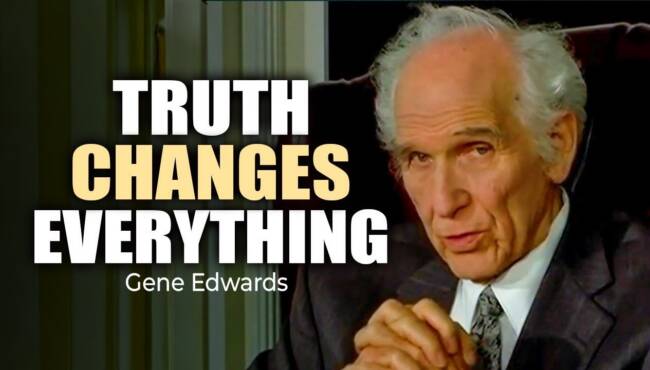
Truth Changes Everything • Jan 01, 2014


Feb 01st 1994
In this message, Gene Edwards opens Genesis 2 and reflects on the deeper meaning of the Garden of Eden, offering a rich and thought-provoking look at humanity’s original design and spiritual habitat. Beginning with Genesis 2:8–10, he traces the biblical story of Eden as the place where heaven and earth meet—where God placed man not merely to exist, but to live in fellowship with Him.
Edwards explores the creation of Adam as a being formed from earth yet filled with the breath of God, a “hybrid” belonging to both realms. He emphasizes that God’s purpose for humanity has not changed: man was created to reflect God’s image and to rule the earth while living in the place of divine fellowship.
Moving beyond Eden, the teaching connects Genesis with Revelation, portraying the New Jerusalem as the fulfillment of God’s eternal intention—a city more glorious than heaven or earth alone because it unites both. Edwards suggests that believers today experience a foretaste of this reality through the ekklesia, the living community of Christ’s body, which he describes as the believer’s true “home.”
The message also contrasts the tree of life with the tree of the knowledge of good and evil, challenging listeners to consider whether much of modern Christianity centers on knowledge rather than life. Edwards warns that an overemphasis on moral knowledge and intellectual understanding can miss the deeper reality of Christ living within His people.
Throughout the teaching, Edwards blends biblical exposition, imaginative reflection, and pastoral exhortation to invite believers into a deeper awareness of their identity and calling. This message is especially meaningful for those seeking insight into Genesis, the nature of the church, and the believer’s relationship to heaven and earth.
If this message speaks to you, consider sharing it with others who are exploring Scripture or longing for a deeper walk with Christ.
In my country? It’s “don’t work on Sunday”. That’s still a big one. Don’t work on Sunday. Yeah, way back. Actually, it did not start until the 1700s, believe it or not. There was no emphasis in this in the Christian family as far as laws were concerned until, at least in the English-speaking world, the 1700s, it came out of John Wesley’s ministry, and a strong teaching that God had changed from Saturday to Sunday, and we’re supposed to obey that. Kitty, what are some really strong American ones?
I know that there are several schools in our country where girls and boys must not physically touch one another. My daughter went to a school one year in which the boys all sat on one side and the girls all sat on the other side in church. Now, that’s unheard of in America, but it’s very common in your world. Well, I think whenever someone gets up and starts preaching against chewing tobacco and cigarettes and alcohol and adultery and cussing and going to movies, he’s run out of anything to say. And he has a very low gospel when you have to get down to talking to God’s people about that. If we love him, we will automatically be worthy of him in our walk. If we don’t, we repent and we get back there fast. To warn us constantly, we are quite, quite, actually, we are, as workers, Christian workers, experts on the knowledge of good and evil.
And if you watch, God’s people come to us and ask questions. What, is this right or is this wrong? Is this good? Is this bad? I asked my pastor one time if it was all right to say, darn. Darn is a substitute word for a cuss word, and in our language, you get a hole in your sock, and you darn it. He said, If you’re talking about darning a sock, fine, but you shouldn’t say darn if you’re angry. It’s a substitute for the word damn and the word damn in our language is a cuss word, and I don’t know about yours. Every language varies. You’ve got cuss words that we would laugh at if we heard them. They’re not cuss words in our language. I can go to my pastor to ask what’s good and what’s evil. He’s an expert on it.
Now, I just would like to remind you, brothers, that our world is life. It is not good anymore.
Whenever you start moving over toward that which is good and that which is evil, be careful. When you start telling God’s people they have to witness, for one thing, you’re on very unscriptural grounds. That kind of an idea did not grow up until the 1800s. And it was a perversion of scripture that taught that. It’s not in the New Testament. And I will be happy to sit down with anybody who teaches that it is and show them the way of their errors. Not everybody is demanded to go out and witness every day or anything like that.
Now, here’s what I want to say to you. That’s no more than half the problem. It goes so much deeper. And now I’m going to get off on history, and I’m actually going to leave the subject. I just want to talk to you. And I’d like for this to be on tape.
I want to trace for you the problems that you and I face right up here, in our own heads, that we’re hardly aware of it. Do you consider yourself, Kalia, and this is an honest question, do you consider yourself from the West or the East? I don’t know. You’re sitting right at the juncture of the east and the west. Are you from the east or the west? No one’s ever asked you that question, have you? I’m east. Do you consider yourself from the East? Yes. Eastern European. Eastern European. Oh, I don’t mean that. What? Oh, that’s hard to say.
See, you are to the right of Greece as you look at a map, and the western world usually is thought of as beginning with Greece the western world is Greece and that direction, yeah I know, but I’m talking about over the over the last 2000, well I know that yeah, well it may be an unfair question. I can tell you this: if you go 300 miles further to the right as you look at a map, you’re definitely outside of the western world. Totally different world. You’re in a world that does not think the way Western man thinks. We can actually measure it in miles. We can put pins on the map and say, that’s where you think Western and that’s where you think Eastern. Now that’s pretty incredible if you stop and think about it.
All right, I’m going to tell you a story that there are probably not 500 people in the world who can tell you this story. In fact, there may not be five people in the world who can tell you this whole story. There are a few people who can tell you most of it, but I’ve got it all together here. See how smart I am? Just how much did you pay for this tape? It wasn’t enough. You should have paid more. What, you borrowed it? It didn’t cost you anything? You should send some money to my grieving widow, my grieving widow is dead now, then send it to my grieving grandson if you can find him. 😊
Let’s go to Greece. You know the word Oriental? I’m not sure if you’re aware of the word Occidental. We are Occidental. Beyond Istanbul is Oriental. Tremendous change in thinking. The way you and I literally think. originated in the Greek world. Not Athens, but the Greek world. And as Greece began to emerge upon the stage of history, a small group of people in that country became very intellectual. We make the mistake of thinking that most of those people in Greece were running around philosophizing. It’s not true. Most of the people in Greece were slaves who could not read or write. Most of the people in Greece were slaves. A large part of them were simply merchants.
But there was a small group of thinkers and those thinkers profoundly influenced everyone in this room and there is nothing we can do about it And if you want to try to save somebody from thinking the way we think and it would be good to be saved from the way we think, you’re going to have to take your baby over to the hills of China somewhere and let your baby grow up there. What? You want them to grow up in the Orient, where they have evil spirits and demons and worship. Idols and all that stuff. Do you think the West is any better off than that?
And so I’m going to pause and get off the subject that’s already off the subject. And I’m going to get off the subject’s subjects to get on to an off on the subject. Our Western medicine had its roots in witchcraft. And a large part of our Christian religion, whether we like it or not, is profoundly affected by mythology, superstition, and intellectualism that had no part in the beginning. And I would like to remind everybody on this tape, and I said this publicly at a conference, and I was almost asked to leave. And I don’t care whether those people threw a fit or not. Truth is truth, is truth, is truth. If you are a Christian, you belong to an Eastern religion, whether you like it or not.
Truth Changes Everything • Jan 01, 2014
Free to Fellowship with Christ • Dec 07, 2013
Sow to the Spirit • Nov 23, 2013