Christ Made You Holy • Mar 05, 2026

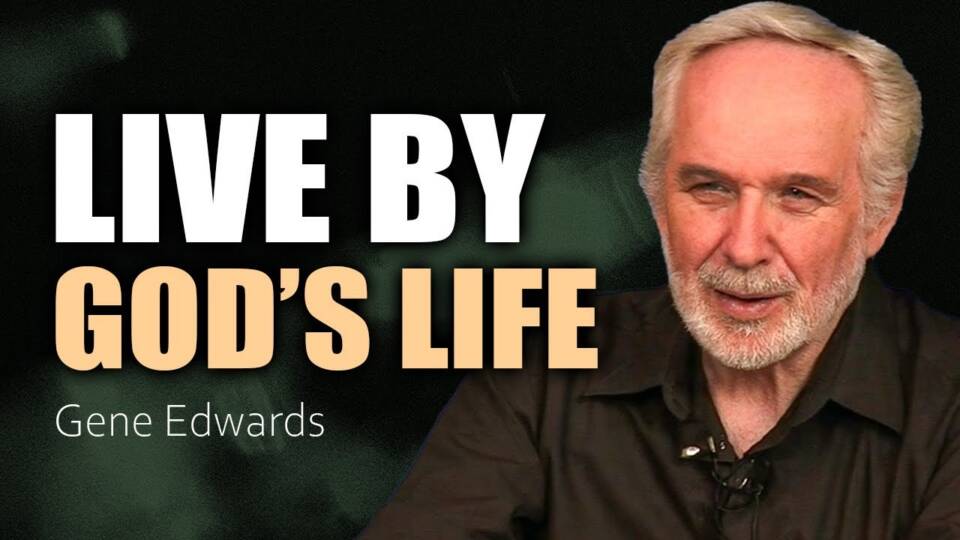
Live by God's Life • Mar 10th 1985
What if the profound brokenness we experience is not merely psychological, but a radical wound inflicted deep within the human soul by the Fall? In this compelling message, Gene Edwards unpacks the devastating, yet often unconceived, damage that has made our natural abilities—even our thinking and logic—fundamentally untrustworthy. However, he immediately pivots to the glorious reality: the believer is now a “new species,” having received the very life of God into a quickened spirit. The path to Christian reality is not found in intellectual “reckoning,” but in the absolute submission of the damaged self-nature to this indwelling divine life, following the example of Christ’s perfect fellowship with the Father. Gene Edwards invites us to look beyond mere doctrine and discover our true capacity to walk and live within the spirit—a new, accessible internal realm of communion.
DCLC 1985 #4 History of the Spirit Part 1
…placed in Adam, and because he had something from other realms, he could see the other realms. There was something corresponding between Adam and the realm from which that spirit came.
There are a lot of mysteries to me. I assume that when the Lord took that bone from Adam, that bone must have been glowing, but there can be no question in my mind that she really wasn’t a “separate” person. Hold on for a minute. She was an extension of Adam. She was Adam. She was Adam because out of that bone the Lord fashioned…He did not create a woman, and she, too, had a living spirit. I hope you understand what I mean. She was bone of his bone, and the New Testament tells us we are spirit of His Spirit. She was once inside of Adam. We were once inside of God; some portion of us. We’ll get to that in just a moment.
Well, the fall is shrouded in mystery. We don’t really understand when the rebellion took place in heaven or even if that’s what it was. I know we’ve heard that so often, but you know, that’s still a conjecture of an interpretation out of the book of Ezekiel. We don’t really know the whole story of the fall or how it originated. I can’t tell you that I’m clear about the origin of sin. I can’t even tell you what sin is; oh, I could give you a theological definition without any problem, but some element got brought into creation, and it began in the heavens, it seems, and then, it seems, that Lucifer paid a visit to the earth, and after his coming here or maybe it was present all along, I don’t know but there appears a tree of the knowledge of good and evil and Adam did not eat of the Tree of Life and he did not take God’s life in him, but instead he ate of the tree of the knowledge of good and evil.
Now, this is a very complex thing, the tree of the knowledge of good and evil. God knew good, and He knew evil by wisdom. Unfortunately, Adam learned it by experience. What happened to Adam at that moment? I cannot fully say, but it seems absolutely certain that this man, who was created by God with three elements: spirit, body, and soul; the body being from the earth, the spirit being something from other realms, and the soul being what came from this union.
Adam ate. He obviously sinned first in his soul by his disobedience, but sin entered into him through his body, and the scripture makes it clear over and over again that the Christian view of sin is that it comes to our members, into our body. I was once very, very ill. I was really, really ill. I was in bed for a year and convalesced for three years after that. I probably sinned less during that year than at any other time in my whole life, because my body was so weak. Was this wonderful, how little I sinned? Now, I know that you may think it’s because you weren’t moving around; no, I can sin sitting perfectly still, without moving a hair on my head or a muscle, but I was just really doing great that year as far as sin was concerned. It was a terrible price to pay because my body was so physically weak.
Here is the soul. This marvelous creature, Adam, is sinless and innocent, full of great wisdom, and capable of exercising dominion over this entire planet. Sin enters his body and comes into his body, and it’s almost as though the spirit refuses to share space with sin; that the spirit would rather die than share space with sin or anything that had to do with the results of the activity of a fallen angel. The spirit dies. Now that creates a real problem because it seems in the Old Testament that the spirit isn’t totally dead, and theologians have conjectured, and I will only pass on to you what they have said, and that is, and I suppose I agree with that, the spirit died to its own environment. Man could no longer see the unseen. He could no longer see an invisible God. He could no longer hear things that pertain to the invisible realm. I think it’s so beautifully portrayed in the story in the garden that the door closed, and cherubim were put in front of the door with a sword, and the door between the two realms closed, and there will be no more intercourse, no more commerce. Man will not be able to make that trip. This place that interfaced the heavens and the earth, this place called the Garden of Eden, where two realms met, where angels played, and men walked with God, was closed off from man, and the door was slammed, and man was left with a spirit that had no activity toward other realms. It was dead to God, and as far as I’m personally concerned, the spirit died utterly. Sin is now indwelling the body just as that spirit had once indwelled that man’s soul. There is a foreign object that has been put inside of us. It is not ours, and it does not belong to us, and it is stronger than we are.
Now, do you know why it’s stronger than we are? Well, I’m going to guess. Because it seems that it has come from a higher form of life than we have. Sin seems to be something given to us right out of the very activity and nature of a fallen angel, and that’s a higher form of life. In the New Testament, the term “indwelled by sin,” the word ‘indwell’ is the same word that is used to speak of Christ indwelling us. There seem to be two forms of life indwelling the Christian. I’m getting ahead of myself. One confined to the flesh, the other confined to the spirit. Where does that leave the battleground? The soul.
The body was a body at the time of the fall, but it became flesh. I think the best definition for the flesh, and there are three ways the Old Testament and New Testament use it, but concerning this particular use of the word flesh, I think the best definition of the flesh is the body indwelt by sin. Now we have ceased to have a body, and we have now got flesh. The body is indwelt and corrupted by sin. Something is living in our bodies. You can almost sometimes feel this. That which I would, I do not, and that which I would not, I do, yet it is not I, but sin that dwells not in my spirit, not in my soul, but in my members. It is not I, but this living, breathing entity, this living thing in my flesh.
Okay, now this is the saddest of all the sad stories that man will ever hear. The spirit is dead. The body is indwelt, rapidly deteriorating, and becoming flesh. Evidence of that being that if we are to believe the scripture, that man lived for a very, very long time, but with every passing generation, people lived less and less until, finally, there was a standoff between sin and man. We got to where we could live all the way up to being 70. Methuselah lived hundreds of years; I don’t remember how many.
Now, if you think the death of the spirit is sad, if you think the indwelling of sin in our mortal bodies is sad, you have heard nothing until you hear that the soul becomes damaged by this fall. And I, still, at the age of 52 and 33 or 34 years in the ministry, I have not yet plumbed, understood, nor conceived of the depths of the fall of man in his soul. The psychology of man, the soul of man, became so fallen. I’m fascinated when I read the ancient Christians, the old devout ones, those the Roman Catholics burned at the stake and then sainted later, or threw them in dungeons or whatever they did, canonized them after they had done all these ugly things to them. You go back and read what they have to say, and you are so thankful to know they saw it too. And that is how fallen man is, how untrustworthy he is. It’s in all of their writings. And it’s not, they’re not reading this out of a textbook and writing it down. You can see them driven by their knowledge of what they have seen in their lifetime of the fall of man.
And there’s that dichotomous thing where we also see how wonderful we are in Christ. And these are irreconcilable. I hate to dwell on the fallenness of man because always out in the audience, there is one dear sister or two or three who only hears how wretched she is. That’s what she has heard all her life, and she gets hold of this and just holds on to it. But Gene, but Joe, but George, but Pete, whoever the poor guy’s name was that was speaking, you told me how wretched I was, and that’s where I’ve lived with that knowledge. Then they tell you all about the wreckage and ruin of their lives because of this, and you want to grab them by the nape of the neck and say, “Where in the world were you the next night when we talked about our place in Christ?” They never hear it. That’s psychological damage. This person has a very low regard for himself and a very low self-image.
Christ Made You Holy • Mar 05, 2026
Stop Playing Church • Feb 18, 2026
Escape Religious Cage • Jan 10, 2026