Christ Made You Holy • Mar 05, 2026

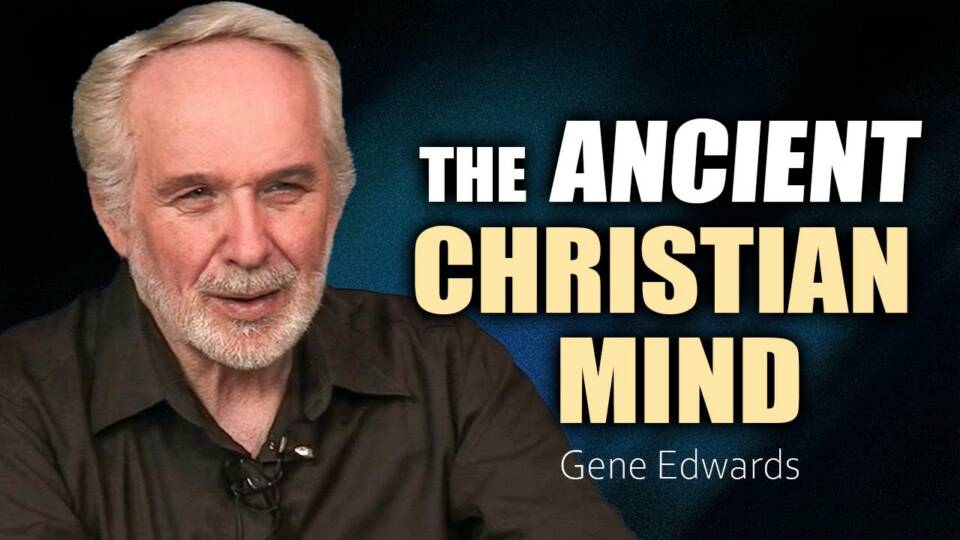
The Ancient Christian Mind • Jul 04th 1987
In this powerful Church History Conference message, Gene Edwards explores a radical and deeply spiritual truth: the Christian mind did not begin with man—it began in God before creation itself.
Drawing from Colossians 2:9–10 and 1 John 1:1–3, this teaching challenges believers to rethink the foundation of the Christian life. Our problem, he argues, is not lack of knowledge, theology, or information. The problem is our mindset—specifically, the Western, Aristotelian mindset that has shaped Christianity for centuries.
Edwards contrasts the Western analytical mind with what he calls the Christian mind—a mind that originates in the eternal fellowship of the Father and the Son. The mind of Christ is not native to this planet. It is not native to human intellect. It is spiritual, ancient, and rooted in the eternal fellowship of the Godhead.
According to this message:
The Christian life cannot be lived by human effort.
The Christian mind cannot be grasped through reasoning or debate.
Restoration of the church begins not with structures or methods—but with fellowship.
Jesus Himself lived by this eternal fellowship. “Without My Father I can do nothing.” And to us He says, “Without Me you can do nothing.” The Christian mind is passed on through indwelling life—Christ in you.
This message also addresses:
Why Protestantism struggles with restoration
The difference between intellectual theology and experiential faith
The loss of the early church’s language of “in Christ” and “in God”
The danger of rationalizing spiritual realities
The call to young men and women to carry the torch of testimony
Edwards ultimately brings the focus back to simplicity: a living, experiential encounter with Christ. The restoration of the church begins with recovering fellowship—first with the Lord, then corporately with one another.
This is not a message about religious reform. It is a message about spiritual recovery.
The Christian mind is older than creation—and it is found only in Christ.
You’re getting a little tired, aren’t you? Yes, you are. A little sleepy. You know, up in New England, where Helen and I lived, back in the days of the Puritans, churches used to have long, long services. One particular church came up with a very unique cure for sleeping Congregationalists. The pastor preaches for an hour or two every Sunday. So, they had two men walk up and down the aisle, watching to see whether people nodded off. Now they had a long pole with a sharp stick. If they saw someone nodding off, they took this long pole with a sharp stick, and they walked over… and gouged the preacher. With that in mind, I’ll try my best to keep you awake today.
Today’s message will probably be somewhat different from what you’re used to hearing. I often approach the Gospel of the Lord with a vocabulary quite different from what you may be used to. Whatever I get into today, I want you to know that none of it, on the experiential basis, none of it is theory. You may find some of that difficult to believe. Nonetheless, it is true. I’m going to talk a great deal today about an experiential faith. Where are all the saints from Memphis? Will you stand up? The Memphis saints, will you stand up? Okay. Now, if anything I say today you don’t believe, you go to these people right here, get a good eye on them, and ask them if what I said was true. Okay. Thank you. Sit down.
I have two passages of Scripture I like to read very much. Colossians 2:9 and 10. “For in Him all the fullness of deity dwells in bodily form, and in Him you have been made complete.” Now, I’m going to do something that I do a great deal. I’m going to make that part of the Gospels. I’m going to put this in first person and let the Lord speak for Himself here. I’m going to reread it, but listen. This is the Lord speaking. “For in Me all the fullness of deity dwells in bodily form, and in Me you have been made complete.”
Now, would you turn with me to the first John, the very opening words? We’re going to read the first three verses. This is John the Apostle speaking, speaking specifically of his fellowship with the Lord Jesus Christ. He is writing this as a very old man, and he is writing it to what are probably fairly new Christians, or at least new in that they were not converted when he was, and most of them, if not all, had never met Jesus Christ. “What was from the beginning, what we have heard, what we have seen with our eyes, what we beheld, and our hands handled concerning the Word of Life. And the Life was manifested, and we have seen and bear witness, not bore, but bear witness, and proclaimed to you, the eternal life which was with the Father and was manifested to us. What we have seen and heard, we proclaim to you also that you may have fellowship with us. And indeed, our fellowship is with the Father and with His Son, Jesus Christ.”
I’m going to reread that. I’m going to fill in the blanks. The brothers who wrote these books were using a great deal of economy in their words. I’m going to expand it a little bit. So, it will live just a little bit more. Paraphrase it if I may. “Our Lord, who was from the beginning, the One we heard, I and the other apostles, what I and what they saw with our eyes, what they and what I handled with our very own hands, I’m speaking to you about the Word of Life. That Life was revealed. And those other men with me, and I have seen Him and bear witness and to proclaim to you, Him who is eternal life. And He was with the Father, and He was revealed to me and to us. This One, this Jesus whom we lit with for nearly four years, whom we saw and heard, He is the One we proclaim to you. And this is why we do it: that you may have fellowship with me. And indeed, my fellowship is – is – with the Father and with His Son Jesus Christ.
Alright, let’s see if we can bring together a few things from the last three days. Whatever I am about to say to you, the heart of the matter in these introductory words is this: we shall not get to the business of going on with restoration with our minds, or with things that we will discover with our intellect. It hasn’t been that way in the past. It won’t be that way in the future either. I want to encourage the process with today’s message. My wife asked me, “To whom are you speaking when you stand up there?” I sat back in the chair and reflected on that for a moment, and I said, “I’ll tell you who I’m speaking to. I’m speaking to a young man out in Nebraska or Kansas who has been called to the Lord who has or is about to leave the religious system and who’s going to hear these messages and he’s going to take, about 20 years from now when the Lord has put him through an earthly hell, has taught him the cross, he’s going to lift his hand and he’s going to take the torch of the testimony from the hands of men, who today, are doing their part as God enables them to hold that part. And that’s to whom my heart delivers these messages.
Here’s the crux of what I want to say in the beginning. Our problem is not knowledge. Our problem is not information. Our problem is not theology. Brothers and sisters, our problem is not a lack of clarity in understanding Scripture. Our problem, as we move forward, is our mindset, not our mentality. I’m not going to try to explain this any more clearly, but every generation is caught in a certain pattern of thinking. In the last few days, I have shown you that we have a right to exist on the basis of these controversial second- and third-century texts. It looks like we look like Christians outside the religious system.
Yesterday, I was trying to tell you, but you may not have caught this. The Protestant mind cannot possibly move forward in restoring or uncovering or rediscovering or re-experiencing when we can stand in a pulpit with a choir with a church building, having come out of a seminary and serve as pastors preaching sermons being that which is doted on by a community and with that mind justify that seminary, that Bible school, that church building, that choir from verses in the Bible. We have a mindset that is closed to restoration. Do you understand? There’s no way the Protestant mindset will press forward.
There is a need in every generation for you and me to be delivered out of where we are into something of being in Him and in the eternals. And for just a moment, I’m going to trace for you the history of three mindsets very quickly. One is the Western mind and what it has undergone over the last 2000 years. The second one is the so-called Christian mind, and where it has gone for the last 2000 years. And then quickly the mind set or the mind and the heart of brothers and sisters who have stood outside the religious system, and where their mind, their ability to comprehend and grasp the Lord’s ways, has been. Now, if you want a definition of a mindset, I’ll give you a scientific one, really quickly. The engrams that imprint on neurons are located in the gray matter of the frontal lobe. Now that’s why I’m using that term. You understand? It’s an old term. It’s been around a long time. It’s used mostly in science.
The Western mind that you have sitting in this room…are you clear? You are a Westerner and a product…Shirley, don’t nod your head like that. You don’t have a Western mind. (laughter) You got an eastern mind. By the way, we’ve heard so much criticism of Eastern religions and oriental religions. If in the next 10 seconds you had to decide whether or not you would join, you had to pick one of the two, and you had to do it in the next 10 seconds, to join and become part of a Western religion or one of these Eastern religions, which one would you choose? Now, quickly, how many of you would choose a Western religion? Okay, Lord. Fine. Okay. And how many of you would choose an Eastern religion? Would you raise your hands? Brother Lance, I want you to turn around. Look at this. Hold your hand up really quickly.
Those of you who would choose a Western religion have three choices. Judaism, witchcraft, paganism, or what grew out of paganism, humanism. The rest of us belong to an oriental Eastern religion. It’s on the other side of Istanbul. Our faith comes from the east. True, it was near east, but it’s east, and it’s oriental. He was an Easterner, brothers and sisters. Are you clear? And it came to the West, met the Western mind, and was greatly altered. Are you clear? And if we are to restore, we’ve got to break from the Western mind. We can’t get anywhere otherwise. Where will we go, Gene, to break from that mind? That is what I’m going to talk to you about today—the Western mind.
Christ Made You Holy • Mar 05, 2026
Stop Playing Church • Feb 18, 2026
Escape Religious Cage • Jan 10, 2026