Stop Playing Church • Feb 18, 2026

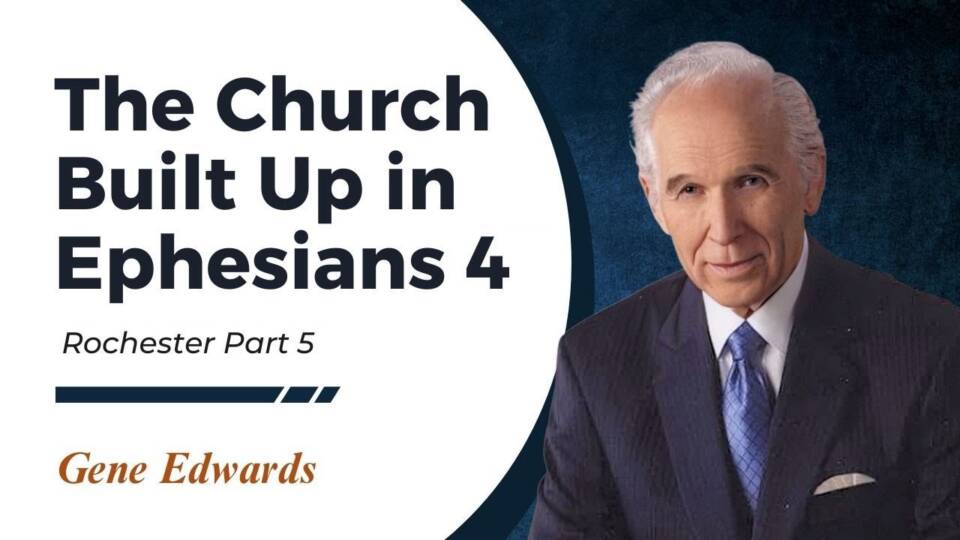
How the Church is Built up in Ephesians 4 • Jul 01st 1996
In this deeply challenging and insightful teaching from Ephesians 4, we are invited to reconsider what the Christian life truly is—and where it actually happens.
Paul’s words call believers to walk in humility, gentleness, patience, and love, preserving the unity of the Spirit in the bond of peace. But this message goes far beyond personal character. It reveals something far more profound: the Christian life cannot be lived in isolation. It only finds its meaning within the living, functioning body of Christ.
This message explores the reality that every believer carries a measure of Christ. No one has the whole—each has a part. And it is only as those parts come together, supplying Christ to one another, that the church is built up into maturity.
Ephesians 4 describes apostles, prophets, evangelists, pastors, and teachers—not as permanent authorities, but as those who equip the saints. Their role is temporary. Their purpose is to prepare God’s people to function, to serve, and to build up the body themselves.
The result? A church where every member participates. A body where each part contributes. A living expression of Christ formed not through teaching alone, but through shared, experiential knowledge of Him.
This teaching also challenges common assumptions about church life. It warns against passive Christianity—where believers only listen, observe, or depend on leaders—and instead calls for active participation. Growth happens when every believer supplies something of Christ to others.
As this process unfolds, something remarkable takes place:
unity emerges, maturity develops, and the fullness of Christ begins to be expressed through His people.
This is not organizational unity. It is not doctrinal agreement. It is something deeper—a shared life in Christ that flows between believers and builds them together into something living.
If you’ve ever wondered what the church is meant to be… or why so many gatherings feel incomplete… this message offers a glimpse into something far richer.
What the scripture says is “Wives, submit to your husbands.” Well, Gene, what’s the difference? The difference is the church of the Lord Jesus Christ. The difference is the community of believers. Here’s some more of those plurals. Don’t count them yet, brother. Someday we’ll get back to finishing this, but it is within the functioning body of a community of believers that we ever dare say, wives, be unto your husbands as unto Christ. It is only in the body that we say husbands love your wives, because you’re so toe-headed and so dumb that you don’t know how to love your wife. But you will learn what love is, and you will learn to love her, your wife, in a body of believers. Because if you do not learn to love your wife within a body of believers, you are going to hear, not from your wife, but from the wives. And that isn’t theory. I mean, it’s not a theory.
Are they trying to have a woman’s liberation? Do you want to meet liberated women? You come into a sister’s meeting after about two years, and those gals have been built up into a sisterhood. And they are protective of one another. And they become a troop, and they become a force to be reckoned with. And men have always feared women; that’s why they take this passage and jump on it. You’re supposed to submit to me because he’s afraid of you. You can out-think him, you can out everything him. You can out everything him, except he can lift more wood than you can; that’s all he can do. And when a sisterhood grows up in the church, brothers run for cover. The sisters will protect. And yes, I tell you, sisters will be a little bit submissive to their individual husbands in the church; you can actually see it happen. A little bit. And you might even watch some brothers come into a real loving, close relationship with the sisters because they’re in the church, the church is a girl, and they begin to learn a little bit about these things. And I’m not talking theory to you, and I’ve got brothers and sisters in this room who will stand up and tell you this is the absolute truth. And it is organic. It’s not something I do. It’s not something I teach. This is the third time I’ve ever said this in public in my life. I said it last year for the first time, and you know how I figured it out? By watching the church.
Do you remember in the brothers’ meeting last year? I’ll never forget this. I said to the brothers in Orlando, there were a whole bunch of men in the room, and I turned to them, and I said – I was trying to prove a point about myself – I said, “Are you afraid of me? I got the biggest horse laugh you ever heard in the, I mean, it was a guffaw. “Afraid of you? We never see you. We hardly know you.” And then one little voice said, “No, Gene, we’re not afraid of you, but we sure are afraid of the sisters.”
I’m leaving this meeting. I’m shooting one last flare into the air. Brothers and sisters, we don’t know the New Testament because we have preached it totally outside of the community, the community of Christ. If there is freedom in that place, the brothers will lead, and the sisters will cheer them on. When the brothers don’t do what they ought to do, the sisters will stop them cold. Not a sister – the sisters. They don’t care if the brothers lead the church, just as long as they have total veto power over anything that’s done. And they get it. They get it among themselves. I know we’re late for dinner. You are supposed to leave a very liberal tip. Those kids out there have been serving you. They’re making $3 an hour, not just while they are serving you, but in all the time they’re working here; they’re $3 an hour; I’d call that child something or other. Will you please leave a very liberal gift for them?
Stop Playing Church • Feb 18, 2026

Escape Religious Cage • Jan 10, 2026

Break the Dead Chains • Jan 10, 2026