When the World Calls You Evil for Loving Christ • Nov 22, 2025

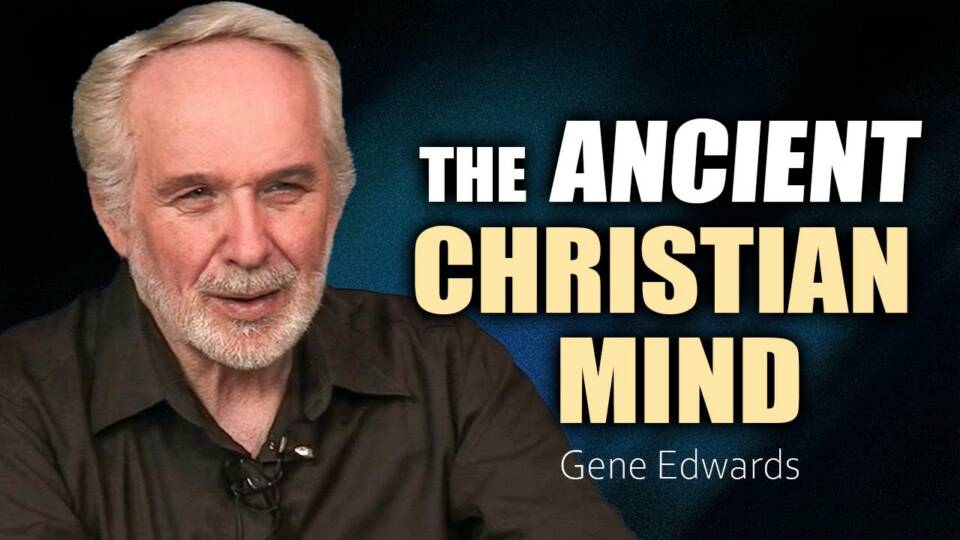
The Ancient Christian Mind • Jul 04th 1987
In this powerful Church History Conference message, Gene Edwards explores a radical and deeply spiritual truth: the Christian mind did not begin with man—it began in God before creation itself.
Drawing from Colossians 2:9–10 and 1 John 1:1–3, this teaching challenges believers to rethink the foundation of the Christian life. Our problem, he argues, is not lack of knowledge, theology, or information. The problem is our mindset—specifically, the Western, Aristotelian mindset that has shaped Christianity for centuries.
Edwards contrasts the Western analytical mind with what he calls the Christian mind—a mind that originates in the eternal fellowship of the Father and the Son. The mind of Christ is not native to this planet. It is not native to human intellect. It is spiritual, ancient, and rooted in the eternal fellowship of the Godhead.
According to this message:
The Christian life cannot be lived by human effort.
The Christian mind cannot be grasped through reasoning or debate.
Restoration of the church begins not with structures or methods—but with fellowship.
Jesus Himself lived by this eternal fellowship. “Without My Father I can do nothing.” And to us He says, “Without Me you can do nothing.” The Christian mind is passed on through indwelling life—Christ in you.
This message also addresses:
Why Protestantism struggles with restoration
The difference between intellectual theology and experiential faith
The loss of the early church’s language of “in Christ” and “in God”
The danger of rationalizing spiritual realities
The call to young men and women to carry the torch of testimony
Edwards ultimately brings the focus back to simplicity: a living, experiential encounter with Christ. The restoration of the church begins with recovering fellowship—first with the Lord, then corporately with one another.
This is not a message about religious reform. It is a message about spiritual recovery.
The Christian mind is older than creation—and it is found only in Christ.
Now, I’m going to close with this point. I asked you where the Christian mind began. I asked you who the first Christian was. Now I’m going to ask you, where did the church begin? I will tell you where the church really began. It began in the fellowship of the Father, the Son, and the Holy Spirit in times past. He brought that fellowship into a carpenter shop, and then He lived with 12, maybe 20, maybe 50, maybe 70 men and women, and they watched Him fellowship. Then they got Him inside of them, and they fellowshipped with Him and with one another, and lo and behold, the fellowship, the Godhead had come to earth to human beings. The church of the Lord Jesus Christ in her embryonic form was here, out of the fellowship of men and women intimately with God and with one another in spirit. Yes, this is where it all begins. We will lose something we need to lose so desperately: our being enamored of our frontal lobes, and we will gain in fellowship with Him something out of the sense of Him, His way, His mind. You shall not read this and come up with a Protestant church. Something new and glorious will begin on the earth again. I want to say it one more time. These are spiritual matters, and they begin in spiritual places, with the Lord Jesus Christ, and in a deep personal encounter with Him that moves to a deep personal encounter with many until it becomes a corporate body of people fellowshipping in the face of God.
Now, I’m going to tell this story to illustrate everything I said. I made this up. I’m going to pass it on to you. It’s the day after Pentecost, and it’s 4:00 in the morning, and nobody has arrived at Solomon’s porch yet, but it’s going to be the first day in church history or the second day in church history. And Peter has told all of the other 10 apostles to be with Him on the wall behind Solomon’s porch. They get together at 4:00 a.m. for a prayer meeting, and they’re all scared. They have 3,000 people coming in, and they don’t know what to do. Peter sits there, his back against the battlements, and he says, “James, what are we going to do?” James says, “Don’t look at me.” “John, what will we do?” I don’t know. Anybody got any suggestions? Don’t have any suggestions. And they wait. And a little while, they start hearing a rumble of footsteps.
Thomas looks over the wall, and looks around, and there they’re coming. Then the hundreds, and then, more than hundreds, into the thousands. And they’re getting in there, and now they have sat down, and they’re waiting. And Thomas sits down, and he goes, “Ooooh.” John looks up, looks over that crowd with a living within him, a Lord with whom he has set up communication and fellowship, the Father and the Son and the Spirit in Him, and He somehow has learned how to go into that place in Him, in God, in Christ, in Spirit. That place has become a living reality.
He sits back down, and he says, “Peter, I got an idea. The One we handled, the One we held, the One who came from God and was revealed before our very eyes bodily. The One upon whom I rested my head. The One whom I heard speak. The One whom I watched every day, fellowship with an indwelling Father. The One with whom you and I have fellowship even now. Let us declare that one unto them, that they might have fellowship with us, for our fellowship is with the Father and with the Son Jesus Christ.”
That’s what those men did during the first century, and that’s where we will always begin in restoration. We will begin in the face of God, in the spirituals, laying hold of Him. May the Lord make this practical, experiential, and simple in the lives of all the gatherings that are represented here. And to the young man called of God in this room, brother, don’t turn it loose until it becomes your very breath of living. Don’t let go until you make it yours.
Lord Jesus. Oh Lord Jesus. Oh Lord Jesus, once more shake us with the sight of Your face. With Your full fellowship, laid hold of by us here now. I trust You, Lord, to deepen Your way in all of us. Amen. Now listen to me before we go. The best meeting of the church hasn’t been held yet. We haven’t done it in my lifetime. The richest, most wonderful praying, or let us call it something higher and better, fellowship, intimate fellowship with the Lord, has not yet been known. The highest witness of His purpose has not yet been seen. The greatest manifestation of His unity by people drowned and saturated by the oneness of His Spirit has not yet been laid hold of. That’s not going to be my privilege; it’s going to be yours. Brother, there’s much land yet to be possessed, inside of Him, in His bosom, in His being: take it, take it from us and take it higher and richer and deeper. Will you stand up?
Men or women under 30 who have been called to preach, or whatever you call it in your group, and you’re under 30, will you raise your hands? I’d like to see. In fact, stand up. Let me see because I might miss somebody. There may not be many of you. You’re under 30. You’ve been called to preach, or whatever you call it. You know what it is. One, two, three, four, five, six, seven. Okay. How about from 30 to 35? Where are you? Are there any? Did I miss any? How about 30 to 35? Anybody? Stand up. So, oh, we got one, two…oh, you’re all in the back row back there. Let’s see. Yeah, I think at 35 we tend to hide. Would you brothers do me a favor? Would you come down here? There are a few loose chairs around here. Would you like to come down here? All of you who have just stood, would you come on down here? I want to be able to look you in the eye when I talk today.
When Stephen finished today, I wanted so much to sing the first stanza of “Faith of Our Fathers,” but I couldn’t remember it. I have it here in front of me, and it’s one of those you need a doctorate in music to understand how to read. The words fizzle out, and you’re supposed to know where to go next. We’ve got: Faith of our fathers, living still, in spite of dungeons, fire, and sword. Oh, how our hearts beat high with joy whenever we hear that glorious word, Faith of our fathers, and it ends. What comes next? Does anybody know? I’ll tell you what, if you know the rest of it, that stanza, write it down, and somebody bring it up here to me. I can’t hear your words clearly enough to write them down. At the end of this message, we’re going to sing that song, and I’ll tell you what the words are.
Well, Helen and I will be leaving tomorrow morning. We’re going back to Portland. We start a conference. Just as you do here, we have a conference up near Portland, Maine, each year. We’re going back early in the morning. I have to be there on Sunday to speak. Our conference there will last a week. I really don’t even know why I’m bothering to go back. I think I just held that conference. Let me explain why. Last year, we had something under 200, but boy, it was a wonderful conference, and excitement was running high. We’ve had the telephone jingling all fall, and people asking for extra bundles of folders, and you can pretty well judge what’s going to happen. We were expecting about 300 people. Recently, we began getting cancellations, people calling up and saying, “Hey, I hear you are going to be in Richmond. That’s only 200 miles away.” That New England’s too far away anyway. Since I’ve been here, it’s been, “Hi Gene, we were going to go to New England to your conference up there, but we found out you were here and we just decided to come here.” I understand the conference this year has, out of nowhere, had this increase in numbers. You’ll be interested to know that 78 people are coming to our conference in Portland. Somewhat of a shocker.
For those of you who were going to go and didn’t, I have two things I need to tell you. I really do. One of them is that, if you want to hear about next year’s, I realize that, after being here, we will probably never see you again. It’s so much closer to come here, but if you are interested in next year’s, we may be meeting in another place. We may have found a cheaper place to meet. You may want to write in because Christian Books Publishing House is going to completely purge its mailing list and start over. So, you might want to write them in case you want to be notified about next year’s.
Now, I think I’ve got it here. Faith of our fathers. Faith of our fathers’ holy faith. We will be true to you till death. Does that sound right? Alright. Good. Did you all get down here, brothers? Good. I want to thank you for putting up with me. I want to thank Stephen and the brothers from Richmond, Mike, all of you brothers, Kenny, and John. I’m going to have to do it all. Mac, Richard, and don’t prompt me. What’s the other brother’s name? All of you for inviting me here. When I was a young man, I was invited to speak at the First Baptist Church in Houston, Texas. At that time, it was one of the largest churches in the state, in the nation. And I said, “Well, I don’t know how well I’ll do, but I’ll always, even if I leave town running, I’ll always be able to say that I spoke there.” And now I will be able to say I had the privilege of sharing in ministry with Lance Lambert and brother Steven Kong, and no one’s ever going to take that privilege away from me, and it is an honor.
I want to read a passage from Acts 20:4: a most revealing verse. On first appearance, the verse seems almost insignificant, if not an afterthought. It is, in fact, one of the most revolutionary things written in all scripture and perhaps one of the highest geniuses expressed in the early Christian faith. Acts 20:4 – And Paul was accompanied by Sopater of Berea, the Son of Pyrrhus, Aristarchus and Secundus from Thessalonica, Gaius of Derbe, Timothy from Lystra, and Tychicus and Trophimus of Asia. They probably came from the surrounding area of Ephesus and there is another brother who is with them, but his name is never mentioned, and scholar, he’s there, believe me, he’s there, and he’s there in lots of places where his name is never mentioned in Acts, and the only thing that scholars have ever been able to conclude was he must have been the brother of Luke, and Luke just kept leaving him out. Probably his younger brother. That would have been, of course, Titus, almost certainly from the city of Antioch, Syria.
When the World Calls You Evil for Loving Christ • Nov 22, 2025
This Is How You Must Honor The Son • Nov 22, 2025
Truth Changes Everything • Jan 01, 2014