Stop Playing Church • Feb 18, 2026

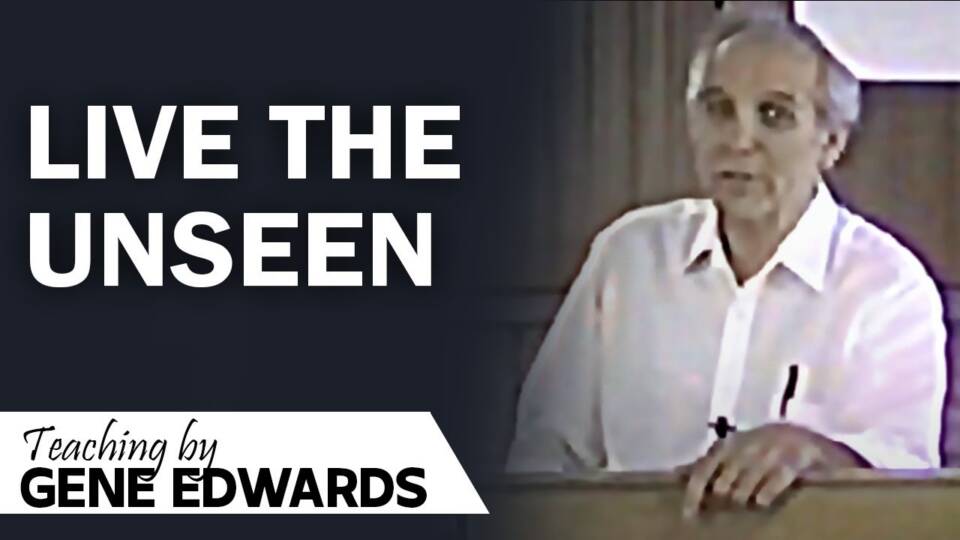
Live the Unseen • Jul 01st 1987
What if the life we call ‘Christian’ isn’t meant to be lived by human effort at all? Gene Edwards challenges us to look beyond our earthly perspective, revealing the profound truth that the Christian life is the very life of God Himself, originating in the eternal fellowship of the Godhead. This message unearths your own ancient, spiritual origins in Christ, before time began, demonstrating that you are a unique ‘hybrid’ being designed for an existence where the spiritual and physical seamlessly converge, like the Garden. Sadly, historical developments often obscured this glorious reality, reducing faith to performance or doctrine. Join us as Edwards invites you to reclaim the first-century experience, rooted in the deep, personal intimacy of Christ’s own fellowship with the Father.
Brothers and sisters, that’s about where we are right now. We’ve got to get back to that first century, but no, we’ve got to get back further back than that: into the Godhead. We’ve got to go back where the fellowship of divine life began and begin looking at this. I want to proceed by saying our answer lies – I’ll tell you where our answer lies. You might say our answer lies hidden somewhere in the epistles. I just read something out of the epistles. All the riches of heavenly places have been given to you. They are now yours in Christ Jesus. Oh, that’s wonderful. Doesn’t mean a blooming thing. I mean, I can sit there and I can preach it. I can tell you how rich you are. But something inside me wants just a little modest reality.
One of the things that we’ve gotten in recent years in the deeper Christian life is positional truth. We are in Christ. We have been crucified. We have risen from the dead. We have been glorified and sanctified. We have been all these things. That’s a wonderful positional truth to grasp intellectually. Would you give me just two minutes of the reality of my position? Just two minutes. Let me have the reality of my position; I don’t want positional truth. Take positional truth out and hang positional truth. I want reality to be truth; I want truth that’s got reality to it. Now, then, the apostles were writing those books, and they were not writing theory. They were not writing Christian doctrine; they were writing that which was their own experience and an experience which was the experience of those dear brothers and sisters.
Now, let me just clarify here before I oversell. You’re not going to leave here today or this week perfectly. You’re not going to leave here sinless. You’re not going to leave here transformed, transfigured, glorified, sanctified, or petrified. You are going to leave here just about the way you got here, with a little equipment to touch the Lord in reality, in other realms in Him. That’s about all you’re going to get, but that’s a little bit more than most of you have got right now, and it will help you. And if you will pursue it, it’ll help you a great deal, and if you don’t pursue what little is given to you this week, very practical, very workable, if you don’t pursue it, it will stop working. Ain’t that amazing? It really will fall on you, your responsibility.
All right. Now then, the epistles, though, brothers and sisters, are really not the place to look because they are a statement of the reality that those men received. But they were, you might call a second motion, a stage two. The place we really need to look, and we have never looked, and why we’ve never looked, I don’t know. The place we need to look is in the Gospels, and find out how Jesus Christ lived the Christian life, how He fellowshipped with the Father on this earth.
The Christian life for us began in Judea. For Him, it began in the Godhead. But instead of looking at His life of those parables and those things, you know, and then you have to walk the second mile, and you have to be more perfect than the Pharisees. Rather than looking at the me part of this, I got to do this, and I got to do that, and God is expecting me to do more. Let’s look a little deeper. Do you know the song ‘Break Thou the Bread of Life’? It has a term in it that says, “Beyond the sacred page, I seek Thee, Lord. Beyond the sacred page, I seek the Lord.” To find Him, to find His way of fellowship, to get involved in His fellowship with the Father; this is what those disciples of old did and came back with this vocabulary expressing their experience. Well, we’re going to go back and we’re going to clip out those 200 or 300 years and we’re going to look at them. And this was the message I meant to bring to you last night.
Stop Playing Church • Feb 18, 2026
Escape Religious Cage • Jan 10, 2026
Break the Dead Chains • Jan 10, 2026