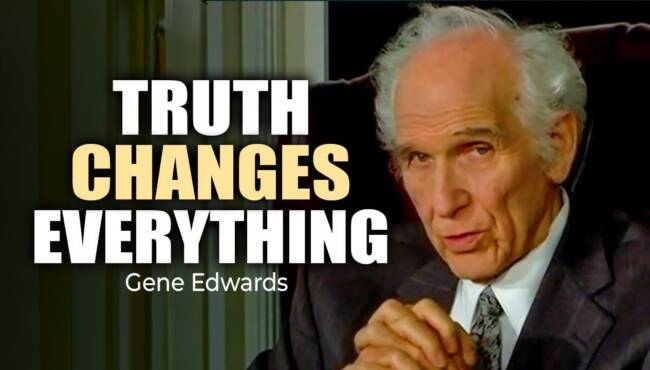
Truth Changes Everything • Jan 01, 2014


COULD YOU FOLLOW JESUS? • Jul 01st 1985
What do the Beatitudes really mean—and what do they reveal about what it means to follow Jesus?
In this message, Gene Edwards takes us back into the historical setting surrounding Jesus, His disciples, and the Sermon on the Mount to explore the Beatitudes from a striking perspective. Rather than treating “Blessed are the poor,” “Blessed are those who mourn,” and “Blessed are those who are persecuted” as isolated religious sayings, Edwards asks us to imagine the actual men and women standing before Jesus when these words were spoken.
These were people who had chosen to follow Christ from town to town. Some had left homes, occupations, possessions, and ordinary comforts behind. Some were hungry. Some were poor. Some had wept. Some had wealth. Some longed for righteousness. And all of them were beginning to discover the cost of following Jesus.
Against that background, the Beatitudes become deeply personal.
Jesus speaks of spiritual poverty, mourning, meekness, hunger and thirst for righteousness, mercy, purity of heart, peacemaking, and persecution. But He does more than teach these things—He embodies them. He knew hunger. He wept. He experienced rejection and persecution. He lived in complete dependence upon His Father.
Gene Edwards challenges Christians to move beyond a merely religious familiarity with the Sermon on the Mount and consider a much more personal question:
If Jesus were physically walking from town to town today, would you follow Him?
This message is especially valuable for Christians seeking a deeper understanding of the Beatitudes, the Sermon on the Mount, Christian discipleship, spiritual growth, and what it truly means to follow Jesus.
In following Him those three years, they really did get hungry, and they really did cry, and they really did have their spiritual poverty. And somewhere or other, those 80 people figured out a way to follow Him for the next three years. In so doing, they probably never broke the habit of being what they were during those three years.
My own feeling is, and I’m sitting here not in any way trying to put you under a pile, but my feeling is, having observed the passing parade for nearly thirty-five years now, Roman Catholic priests are about the only ones that have any idea what it’s like to be a worker in the kingdom of God…and I sometimes wonder about them. They take a vow of poverty, and that’s how they live. Those men didn’t take a vow of poverty, but just by their willingness to follow Him around, it was very uncomfortable how they had to live.
I want you to stop thinking about it. I want you to stop considering it. I just don’t want you to get too comfortable. Sister, I don’t want you to get too comfortable. I don’t want to get too comfortable. I’d like for you, and I’d like for me, to sense what was going on with them: the compassionate heart of reassurance He gave them. The practical and almost frightening declarations He threw at them. And the rebuke He threw at some of them; He spoke to the wickedness in the hearts of many of them.
In it all, there is an atmosphere of what it takes to be a follower. No, a worker. One of the twelve called. When they got through, they had an atmosphere of what it was like, what it was going to be like, and what it was like to be one who followed Him.
Maybe the most encouraging thing, and I’m sure it’s been in all of your minds, the most encouraging thing about it all is that everything He said- not, of course, including the false prophet part and things like that – He exemplified everything He said to them. He had wept, and He had laughed; He had been hungry, but He had eaten. His strength was broken and bridled. He hungered and thirsted after maintaining His righteousness. He had seen the face of God.
Reward beyond reward was being laid up for Him in heavenly places. The kingdom of God was His. He had a sense of this far deeper than any of them could have, but not far deeper, not beyond your understanding of what this all is, because you’re on the other side of the Sermon on the Mount, and you have a sense of their reward, and you know a little bit about other realms. You know that they were hungry, but they also ate, and then drank. I like for us, I like for you, as I have had to face this, look at it, and review it as somebody who wants to serve the Lord.
Truth Changes Everything • Jan 01, 2014

Free to Fellowship with Christ • Dec 07, 2013

Sow to the Spirit • Nov 23, 2013