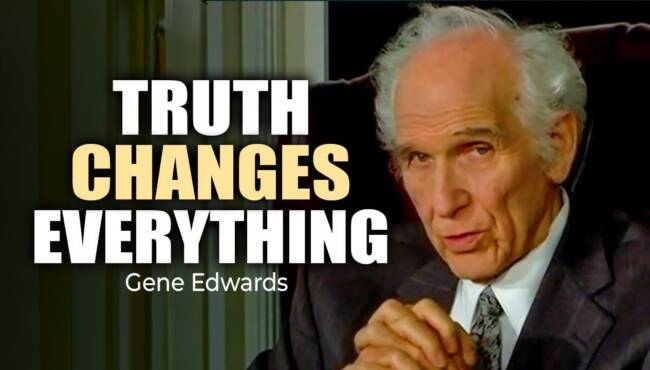
Truth Changes Everything • Jan 01, 2014

LIVING 1 PETER 2:9…Every Day • Dec 28th 1969
What does it mean for Christians to be a royal priesthood? In this Bible teaching, Gene Edwards explores God’s purpose for His people—from the kingdom of priests in Exodus 19 to the royal priesthood of 1 Peter 2:9 and the kings and priests described in Revelation.
God’s desire has never been limited to a small group of specially trained religious leaders. His purpose is a people—a spiritual house and holy priesthood—who live in His presence and offer spiritual sacrifices to Him through Jesus Christ.
Gene traces this theme through Scripture, examining Adam, Abel, Noah, Abraham, Moses, Israel, the Levitical priesthood, and ultimately Jesus Christ and His church. The message raises a fundamental question for every believer: What does it actually mean to be a priest to God?
A priest, Gene explains, is not simply someone who preaches, attends seminary, performs religious duties, or works for God. A priest is someone who comes before the Lord, opens himself to Him, receives from Him, and allows the life and nature of God to flow through him.
This changes the focus of the Christian life.
Rather than beginning with what we can accomplish for God, we begin with living in the presence of God. We come before Christ, open ourselves to Him, receive His life, and allow Him to work His nature into us.
God is seeking more than isolated individuals. He desires a people who together become a holy and royal priesthood—a spiritual house through whom the life, character, and authority of Jesus Christ can be expressed.
In this message you’ll explore:
• Why God originally called Israel to be a kingdom of priests
• What 1 Peter means by a “royal priesthood”
• Why priesthood belongs to every believer
• What it means to offer spiritual sacrifices to God
• The difference between working for God and living before God
• Why the presence of God is central to the Christian life
• How God forms His nature within His people
• The connection between priesthood, spiritual authority, and God’s eternal purpose
Gene Edwards ultimately brings the teaching to a deeply personal question:
Will you be a priest to God?
Will you come to Him, live in His presence, open yourself to Him, and allow Christ to fill you until His life flows through you?
The next person was Noah. We can say Noah learned God’s design by walking in the Lord’s presence. God had an ark that was a picture. It was a picture of God’s plan. You may not realize it, but the ark contains many pictures of His city. It does, and he got a pattern from God by being in the Lord’s presence.
Now we come down into things much meatier than this; we come to brother Abraham. You and I have already looked, and we remember that Abraham was truly a priest to God. He lived in a tent, and he walked with the Lord, and the Lord walked and spoke to him face to face.
Brothers and sisters, I want to ask you now, what is a priest? A priest is one who offers up spiritual sacrifices to the Lord. In the simplest words, a priest is someone who lives in God’s presence, opens himself to God, lets God pour into him, and pours himself out to God. Better, I would say, he is someone who stands before God in His presence, as Moses did on Mount Sinai; Moses stood there before God, and in God’s presence, God spoke to him face to face until the very reflection and image of God was on his face. You recall that the temple has three sections to it, right? The outer court, the holy place, and the holy of holies. Moses stood as high priest that day: he wasn’t in the outer court or the holy place; he was in the holy of holies. Probably he was in the outer court that day he slew that Egyptian; he was going to deliver his people by killing the Egyptians off one at a time. Then he was in the holy place as he lived out in the wilderness and just learned for 40 years. But now he was in the holy of holies when he stood on Mount Sinai, and the light and the life of God were on his face.
Now then, we turn to the real honest-to-goodness priests. God said to Moses, “I want all the nation to be priests for me, a whole kingdom of priests.” Brothers, He made a group of people who live in His presence, open themselves to Him, and let Him pour Himself into them until He was gushing out like a river. He wanted a group of people who would…it’s the same thing exactly…offer up spiritual sacrifices to the Father continually.
To accomplish His eternal purpose, God needs a corporate body. For Jesus Christ to truly be the royal priest, He must have a group of priests. For God’s eternal purpose to be worked out, God must have a building and a group of priests; those priests come together as a house and, as a priesthood, become a royal priesthood through which God works all His purpose: that He might have a group of people who will offer sacrifices up to Him. The more they offered sacrifice to Him, the more they opened themselves to Him; the more He flooded Himself into them, and the more He flooded out of them. Then He would have a change of line. May I say that? A change of lineage. He has not only a priesthood, but a kingly priesthood that not only lived before Him, but now has His authority and reigns on the earth.
Now this is what the Jews were to be. A body, a corporate body built from people who open themselves to come into His presence, day and night. Did He get His nation of priests? Did he? No. What happened? What happened? Well, don’t you know what happened? Audience: They broke the covenant.
They broke the covenant. Alright, brother; they broke the covenant. There came an hour when they broke the covenant. I had not planned to get on this, but I just felt like we’re just going to have to look at this. I’m going to get off the subject completely.
Hebrews 6:1-2. Therefore, leaving the principles of the doctrine of Christ, the teachings of Christ, let us go unto perfection, maturity. Does anyone have the word maturity? Not laying again the foundations of repentance… if you have a pencil, where it says “those foundations of repentance,” mark number 1…the foundation of repentance from dead works. You know what that means? Foundation of repentance from dead works. You repent from trying to save yourself. Have you ever thought about that? You don’t just repent of what you have done wrong; you repent of doing good.
Good came from the tree of knowledge of good and evil; it did not come from the tree of life; you got to repent of good. Number two, mark it down: of faith toward God; that’s the other coin. Number three: the doctrine of baptism. It just occurred to me that we have never yet looked at all the baptisms. This afternoon, we spent about an hour looking at one of them. And of laying on of hands. What number is that? Four. And of the resurrection of the dead and of eternal judgment. What does this passage talk about? Six things that are called what? The principles, the elementary teaching. Let’s read that again. Repentance from dead works, faith toward God, baptism, laying on of hands, resurrection of the dead, eternal judgment.
Does that sound like kindergarten to you? How many times have you heard anyone talk about all the baptisms? Oh, but brother, I have unfortunately done that myself. I have heard baptism and baptism and baptism, but only one kind…not many. Have you ever heard of the doctrine of the laying on of hands? How many of you have heard it expounded? Really? I’ve never heard a word about it.
Now, let’s go right back where we were. Then the covenant was broken, and they chose a tribe to represent them. Now, not all the people of Israel would be holy priests; one tribe would be. What’s the tribe? The tribe. The Levites. They got the Levites, and who was the number-one Levite? Aaron. They narrowed it down not only to the tribe of Levites, but even to Aaron’s family. We won’t take time for that. They picked out the other 11 tribes, the heads of the other 11 tribes. They were saying, “We’re still priests, but you do it all. We’re still priests. You do it all.” Now, we’re going to take just a moment. Do you know that another situation like that arose? We are still suffering from this. To this day, we’re still suffering from this. All the tribes gave up the priesthood and put it on Levi; Levi would be the priest.
Another situation came up, and it still exists today. Can you tell me, in the New Testament, whether there is any scriptural ground for the elder, the presbyter, to minister? There isn’t, is there? There ought not to be.
Truth Changes Everything • Jan 01, 2014

Free to Fellowship with Christ • Dec 07, 2013

Sow to the Spirit • Nov 23, 2013