
When the World Calls You Evil for Loving Christ • Nov 22, 2025


Why You Still Feel Alone • Jun 01st 1992
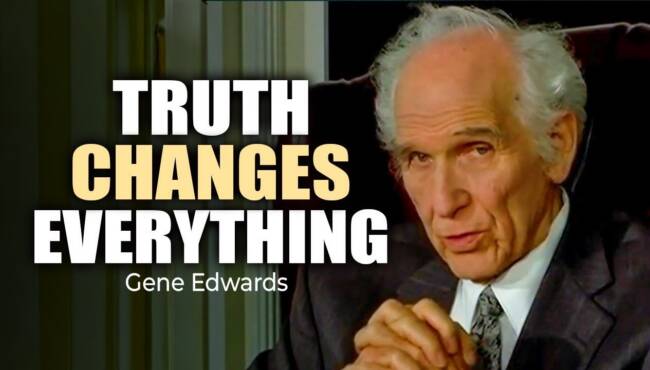
In this powerful and deeply reflective teaching, Gene Edwards explores a question that challenges modern Christian assumptions: What if your worship is pushing you away from God? Drawing from Acts 2 and the early Christian experience, Edwards introduces the concept of the spiritual community of the believer, calling listeners back to the simplicity, depth, and organic nature of true fellowship in Christ.
Rather than focusing on church systems, movements, or religious practices, Edwards explains that the early believers were bound together by something deeper—a shared life centered entirely on knowing Jesus Christ personally. He contrasts modern religious culture with the first-century ekklesia, emphasizing that true Christian community is not built on doctrine, programs, or shared goals but on a living encounter with Christ Himself.
Throughout the message, Edwards challenges familiar assumptions about church life, including worship practices, Bible study, prayer routines, and organizational models. He argues that these elements do not draw believers closer to Christ; rather, Christ Himself draws believers into worship, fellowship, and shared life together. His emphasis is clear: authentic spiritual community grows naturally when Christ is truly at the center.
Edwards also reflects on church history, showing how genuine Christian fellowship has endured through every generation. He describes it as an organic, deeply relational experience—a community of believers drawn together not by obligation but by a shared hunger to know the Lord.
This teaching speaks especially to those who feel disillusioned with institutional religion or long for a deeper, more authentic Christian life. It offers a compelling vision of what the church can be: a daily, relational, Spirit-centered experience of knowing Christ together.
If you are seeking clarity about Christian fellowship, longing to know Jesus more deeply, or wondering whether your spiritual practices are helping or hindering your walk with Him, this message offers both challenge and hope.
Christian Community – DCLC June 1988 Grand Prairie TX Message #1
Now, the reason I’m telling you is that it was my uncle. Uncle Steve was a bank robber, and Daddy and Steve were the two best people in our family. My mama’s side was even worse. I really don’t want to tell you all that. I grew up in a family out of deep poverty and incredible ignorance. My granddaddy didn’t want anybody to know he couldn’t read, so he’d pick up the Bible, and he’d hold that thing sometimes for an hour or two upside down. Ignorant poor people. I grew up in the oil fields. I’m in East Texas, a roughneck. Everybody I knew smoked, cussed, drank, spat tobacco, and usually had two or three fingers missing. Everybody had a strange name. Mope, Runt, Blackie, Tars, Mama. Guy was about 68 and about that wide. Little brother. These were the names. Nobody had a real name; everybody had a nickname. The only female in my whole life was my dear mother. That’s the only one.
Listen, I got saved out of desperation. I didn’t get saved because I was spiritually inclined. I want you to know that whatever I may know of the Lord Jesus Christ tonight or today is because I was driven there out of desperation. I did not get there by inclination. I am not spiritually inclined. Now, what I want to tell you is I owe everything to the body of Christ. What I have learned, what I know, what I have experienced has been within her walls, within this spiritual community of the believer. Not as an individual miser sitting at home reading Christian deep, spiritual, profound books. No, but from the body, from that spiritual community that has been in existence for 2,000 years. Say, “Praise the Lord.” She is your hope of knowing Him here and now in a real way.
I’ll tell you again. If you won’t confess this, I’m going to confess it for you. The first book I ever wrote was entitled Here’s How to Win Souls. It was written by a 25-year-old kid. Very zealous. I reasoned that I was as zealous as I was told to be zealous. Little verses of scripture picked it all up and pulled it together, and I was told to go out and take the whole world for Christ. The church was a building, and I couldn’t stand it. I don’t mind telling you that. I don’t like to go to church. Hey, listen. Look at me. Listen to me. Confess my St. Augustine-like sins. I can’t stand going to church on Sunday morning. It’s the most boring thing in the world. I’d rather go home, turn on my dryer, fold my clothes in there, get a chair, and sit down to watch my clothes spin—hot dog. There’s my sock. I wondered where that handkerchief was. Now that’s exciting compared to going to church.
I was in Thailand during the fall of Vietnam, and I was invited to speak at a church. I think it was a CMA church. I don’t know what it was. Those people had been in a hypnotic trance from the day they had been saved, and Sunday morning was this. They gave me this, and I stepped down out of the pulpit, down on the floor, and I began talking to those people. The translator had to follow me around, and I talked to those folks, and they had to stay out of their hypnotic trance. Those people were offended, literally offended, because they didn’t get their nap that morning. There is a hypnotic trance that we get into on Sunday morning. You know what I’m talking about. I know you’ve been there. That is what the world thinks the church of the living God is. The church of the living God is a 24-hour day experience with brothers and sisters. It is a place of caring and love. It is a place of profound spiritual experience. It is a place where JESUS CHRIST IS DAILY KNOWN by people who are utterly enamored with one another because they have known, encountered, felt, and experienced the love of God. It’s poured out of their hearts to one another. That is the church.
I don’t like to go to church. I’ve been to church twice in the last 25 years. What do you think about that? Haven’t been to Sunday school yet. Well, I’m going to tell you something else. I don’t like to read the Bible. Well, that’s not true, but I’m going to say it. You like to read the Bible. Then why are you not reading it? I don’t like to pray. You know why I don’t like to pray? Because it’s boring, that’s why. I’ll tell you something else. It makes me feel guilty, because when I come to pray, I don’t have anything to say or do.
Now then, brothers and sisters, I’m not taking everything away from you. I want to replace it with something more profound. I don’t know what prayer means in the New Testament. I don’t know what it means to you today. I know that I see nothing today that I would call something I’d like to get involved in for the rest of my life. I want you to know that there’s something better than what we understand prayer to be, and that is fellowshipping with Him, and fellowshipping with Him with others. It’s there, and it’s real.
Now, let me come back to the Bible. I’m going to take the New Testament away from you right now. I’m going to take the books in order. I’m going to try to chip away at the individuality in your concepts. You know the oldest book in the New Testament. What’s the oldest book in the New Testament? You haven’t the foggiest idea. Oh, I tell you, lady, the fact you don’t know is one of the greatest problems we have in the church. The New Testament is in its present arrangement not because God and the Archangel Gabriel came down and put it in that arrangement, but because Martin Luther taught doctrine at the University of Wittenberg and arranged the New Testament according to his syllabus; it is an absolute chaotic mess. I mean Matthew, Mark, Luke, and John, that’s fine, but after that, it is doctrinally arranged, and you never get the story of the spiritual community of the believers because they are messed up.
The oldest Christian writing ever penned is probably the book of Galatians. James probably came along about the same time, before Matthew, Mark, Luke, or John were ever conceived. Now, have you ever been blessed by the book of Galatians? Well, you should not have been blessed by the book of Galatians. The book of Galatians was not written for you, and the sentences in it are not written for you. We call them verses now, but the book of Galatians was written to four churches. Churches. Churches. It is not for you. It is for a body of believers who were knit together, who loved one another and cared for one another daily. They lived in one another’s pockets. They understood and knew what ekklesia meant. They were a spiritual body committed to one another in harmony and unity, and a loving relationship in Christ, in Him the center. Take away the book of Galatians. It isn’t yours. It belongs to the spiritual community of the believers. Praise the Lord. Well, good. Let’s go to the second- and third-oldest books in the New Testament.
We come to First and Second Thessalonians. Oh, there was a verse of scripture in First Thessalonians that just changed my life. Well, it shouldn’t have, and there’s not a promise in it. There’s not a verse in it. There’s not a word in it that was written for you. Reread the opening passages of both of them to the ekklesia in Thessalonica, to the holy ones of God. It was written to a body of believers who were knowing and encountering the Lord. Doesn’t belong to you. Belongs to the eternal church. Okay, let me think real fast. Oh yeah, First and Second Corinthians. You Pentecostals love that book. Oh, you know that’s so funny what you do with some of those verses, and you make them individual. Even in your church, you make them individual. Brothers and sisters, I’m sorry, whatever blessing you got out of First and Second Corinthians…and I know I’m being extreme here…I know somebody’s going to go home and say, “Gene said I shouldn’t have anything to do with all those books in the Bible because they were written to churches and I don’t have a Bible anymore.”
Well, I’m really simply trying to make a point. First and Second Corinthians were written to the church in Corinth, but you don’t approach it from that viewpoint, do you? You get down and read that thing and start looking for little goodies that’ll help you get a nice, great big automobile, or out of the present mess you are in. Or as one sister who just got married… my wife was having breakfast with her one morning when they started to pray. The woman bowed her head and said, “God, make John stop being mean to me.” It’s that kind of “search in the scripture.” God, make people stop being mean to me. Alright, what’s the next book? The next book’s probably Romans. I’m sorry. For I am persuaded that neither depth, nor life, nor things past, nor things to come, nor anything created can separate you and me from the love of God, which is in Christ Jesus…that was not written to you. Go read chapter 16 of Romans and see who it was written to. Their names are inscribed there. They were the saints who gathered in the city of Rome. It was written to a community of believers. Ephesians was written to a bunch of churches in Asia Minor. Colossians was written to a brand-new church in Colosse. You can’t have either one of those. They don’t belong to you. They belong to the church. You can’t have Philippians because Philippians was written to the church in Philippi.
Okay, we’re down to Titus and Timothy. 1st Timothy, praise the Lord. Maybe here’s a book for you. Let me ask you a question. Is your name Timothy? Now, let me tell you to whom the book of Timothy was written. It was written to a man who plants churches, and if you ever read it again, remember that; it was written to a man who plants churches. 2nd Timothy was written to a man who plants churches from a man who plants churches, and the book of Titus was written to a man who plants churches from a man who plants churches.
Now we have almost come to the end of Paul’s writings, and praise the Lord, there is one book that Paul wrote, it’s nine verses long. I think it’s the book of Philemon, it’s written to an individual. The problem is that it’s about slavery. I don’t know how much it’ll help you, but it’s yours if you want. 1st and 2nd Peter were written to the churches that were dispersed into the Gentile world. You can have first, second, and third John if you wish, but they were written to individuals within the church.
When the World Calls You Evil for Loving Christ • Nov 22, 2025

This Is How You Must Honor The Son • Nov 22, 2025
Truth Changes Everything • Jan 01, 2014