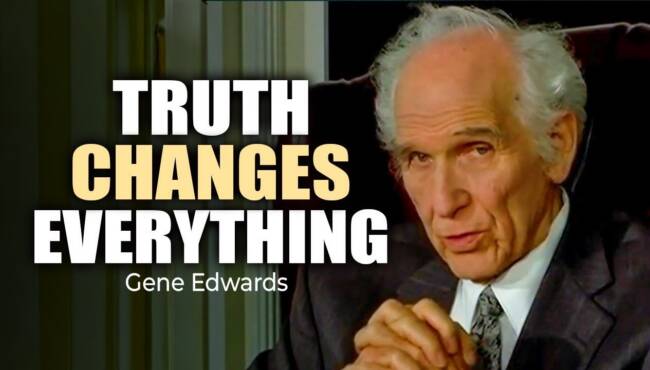
Truth Changes Everything • Jan 01, 2014


Jun 01st 1988
In this powerful 1988 Winona Conference message, Gene Edwards explores the meaning of true Christian spiritual community and the believer’s shared pursuit of Jesus Christ. Rather than focusing on religious systems, denominational structures, or outward programs, Edwards calls believers back to a Christ-centered fellowship rooted in authentic spiritual life together.
Drawing from church history, personal experience, and New Testament principles, Gene Edwards describes what he calls “the spiritual community of the redeemed” — a rare but recurring expression of believers who hunger deeply to know Jesus Christ and live in genuine fellowship with one another. He explains how true Christian community is not sustained by movements, programs, doctrines, or personalities, but by an ongoing encounter with Christ Himself.
Throughout the message, Edwards challenges modern individualistic Christianity and emphasizes that believers were designed to experience Christ corporately within the body of Christ. He discusses the organic nature of spiritual fellowship, the importance of knowing Christ experientially rather than merely intellectually, and the beauty — and difficulty — of authentic Christian community life.
This teaching also includes reflections on:
This message remains deeply relevant for believers seeking deeper fellowship, authentic discipleship, house church life, and a more experiential knowledge of Jesus Christ.
Whether you are exploring simple church life, New Testament fellowship, or longing for deeper intimacy with Christ, this teaching offers timeless encouragement and insight into the spiritual community God desires for His people.
Listen, you can’t fool me. I’m a preacher, and I act natural. Doggone it, I’m going to keep on acting natural. And it costs me. If I were just to put on a little piety, oh, how much more reverently I would be treated. And sometimes I really wish I could be treated a little nicer than I’m treated. I am not kidding you, but it all goes in community saints; it goes, it just plain goes.
One of the things that bothers me about being in a Baptist church is that I sit there, usually in the balcony if I’m forced to it, and I’m sitting up there, and I’m looking over that crowd. Let’s say I’m looking down at a thousand people —any thousand people. Now, some of you are going to be shocked at what I have to say, but it only shows how much you need the community of Christ. Look down over the balcony and there, instead of a thousand Baptists and Methodists or heathen, it doesn’t matter, and I will tell you what you’re going to see. There are a thousand people there. One fourth, statistically, one fourth of the people in that room who are adults have deep, profound drives of sexual perversion. Five kleptomaniacs. 75 compulsive liars. Compulsive liars. Probably 100 alcoholics. 10, 15, or 20 drug addicts. We’re talking about Baptists here, folks. We’re talking about good old believers. You know this, Alex. I am not telling you anything you do not know.
Now here’s what I want you to get clear on: I have just told you about the well-adjusted ones. Oh, you ain’t heard nothing yet. The blamer. I don’t know how he does it. I’ve been watching this guy for years, and he can make you feel guilty within five seconds of meeting him. Do you know who I’m talking about? The blamer. The dictator. The dictator. Let’s see, I got me blamer, I got me dictator on, I’ve got the follower, and then and then there’s the, uh, you know, this this this leader, he’s got dot every i, cross every t, and then there’s this sweet little person who says, “Let’s just love one another. Why do we have to have problems? You’re always having problems around here. I’m going to leave because there are problems.” And then there’s the person: I love him most of all. Oh, he is the bane of my life. This is the devout Christian. If you’re here, please don’t ever get into my life circle. Oh. Oh, Gene, I want to know the Lord. He arrives one day with his suitcases. Oh, I want to know the Lord. Oh, so? He’s so…you just fall in love with the guy. He’s got a heart for the Lord. And he follows the Lord. And everything, he’s just got a heart for the Lord. Everything is just right, and he’s just exactly what you hope for. And then when he’s been there about ten years, one day something happens to his life that he doesn’t enjoy, and he stands up on his feet and says, “I’ve never had a mind of my own. Everything I’ve ever done, I’ve been following you. The only problem I’ve got in my life is your fault, not mine.” He has wanted to shirk — I didn’t know this; he looked perfectly normal to me — he’s wanted to shirk responsibility. And then when something didn’t go right in his life, everybody on earth but him is responsible. You’ve got 200 of those guys sitting in that audience now.
See, you don’t know that. You don’t know that, sitting out there in your nice, little, clean, sanitary world. You know what? You know, I’ll tell you what you know. You have a Christian friend two houses down. You’ve got another one four blocks down the street, and you’ve got another one over here, three blocks down the street. And you have another friend about ten blocks down the street, and you all get together for fellowship because you just can’t handle denominational Sunday morning services anymore, and you really love one another, but you have made one simple discovery in life, and that is you have the four most unlucky friends who ever lived. Is that not true? Mary is having a nervous breakdown. And Joseph is going into bankruptcy. George is really strange, and Agnes is thinking about divorcing him. John is materialistic. And Anne breaks down and cries at sunrises, etc. The only people who are normal in the whole group are you and your husband, and you fight all the time.
This is putting it right where it is, my friend. And you know, the four of you, four families of you, tolerate one another, help one another, and so on and so forth, but you really feel like this is the scrubs of God. It ain’t so, friend. You probably have three of the most well-adjusted family unit friends in the whole world. You ought to meet most of us. Boy. And you discover this in community. That’s what you discover in community. And they discover you. Peevish. Feelings get hurt. Oh, I love the person who always starts every sentence off with, I’m confused. This week I sat down in Texas with a brother who I was warned— I was warned that he does this to everybody who comes. He asks the same question. And I sat down with him, and his first words out of his mouth were, I’m confused. And he told me all this thing that was going on. Now, he had spiritual men answer his question over and over and over. And I tried— shoot, I’m not spiritual, but I tried, by the way. You know, I gave it the old college try. You know, I have to tell you, before it was over, I was poking fun at him. I figured it was the best thing I could do. He would answer me. I said, “I know, you’re confused.” And he didn’t like that. Brothers and sisters, that’s a crutch. That’s just a crutch.
You’ve got the signs and wonders people. They are born that way. Did you all hear about that cloud over Russia? Do you know what that thing up there, Mikhail Govichok, stands for? I’ll tell all of you signs-and-wonders people something: I’ve been all over America, and in every town I’ve been in, somebody has walked up to me and said, “God gave us a word the other day in prophecy that there’s going to be a revival starting in our town, and that revival is going to spread all over the world.” Now listen, there are over 450,000 communities in America, and not every one of them can get that honor. It’s impossible. And I’m going to tell you something else. There ain’t that many miracles. Then there’s a brother who’s “mindy.” Gene, I have a question. And here he comes. Who knows what that question is going to be? There is no way to know what that question is going to be. This brother? Oh, I tell you, there is no end to what that brother will come up with. He has books and books and books and books. Now, honestly, his brain’s going to split wide open. And he wants us all to get together and study the Bible every week for four or five hours together.
And then there is someone else who just wants us to be related. Related. Let’s just be related to one another. Let’s pray for the sick, the dying, and maybe even the dead. You all come into the church, you do, and there you are. Everyone has a different problem, and every one of you has a different wish. And I don’t mind telling you—we’re having problems in Portland. Hello Portland. We’re having problems. And I’ve learned a lesson in Portland. We have 62 people who’ve moved there from every part of the United States of America, and every one of them came with their list. Every one of them came with an agenda. Gene, this is what I want. Give it to me. And this is what I want. Give it to me.
Have you ever read Life Together by Dietrich Bonhoeffer? He said the first crisis that comes to a body of believers is the dream wish. Everybody comes in with a dream wish. I rejoiced when I read that to know that someone else had had this problem. Everybody has got a dream wish. And by the way, I can tell you you’re just about almost going to have to have some kind of a split somewhere in the beginning. I’m sorry for that, or some kind of falling away or something, or a lot of people moving, because everybody comes in with a dream and a vision, and they look at the guy or guys who are leading, and they say, I want you to give me what I myself cannot produce. Do you understand what I’m saying? I want it. I have never been able to produce it, but I’ve come to this place to see that we have it.
Now I’ve got a good word to say on top of all this mess that I’ve just described, and that is, when your false face drops. When your religiosity is exposed. When it is really found out that you are pathological. That you are a royal mess. And that you live in a world of royal messes and you’re all together in the same boat and it sprung a leak. That, my brothers and sisters, is the spiritual community. And now here’s what my word is: Would to God all of us could understand that’s what we are, that the self-righteousness would fall away; that we would discover that God’s people are infinitely different than one another, and none of us can demand the church be anything, that there is in the center of her a cross, and it’s not for 90% of us; we’ve all got to go there.
Then, the wonderful discovery. You can never know Jesus Christ by yourself as deeply and as real as you can with other Christians. You’re never going to know it the way you ought to know it, except within that community. You can’t do it. I know Jeanne Guyon did. I know Fenelon did. I know that Francis of Assisi and Saint Therese of Spain, all of these people, Saint John of the Cross, all these folks had these deep, profound personal relationships with the Lord. But you’re not Jean Guyon. And you sure are not St. John of the Cross. And you’re not St. Francis of Assisi. You and I are swinging on a cobweb, friend. We are just barely here. And when our false faces fall, we even discover we don’t like to pray. And we don’t like to witness. And we don’t even like to read our Bible sometimes. And for sure, we don’t like to go to church on Sunday mornings. That I can bet money on. You know, we don’t like Sunday school. And for sure, we sure enough don’t like to tithe. And that’s the — that’s spiritual, that’s the spirituality. That’s the list of spiritual things: go to church, read your Bible, pray, witness, and that’s just about it. Tithe. We don’t like doing those. And then we learn that we’re undisciplined, but that, within that spiritual community, there’s hope and there’s help, even for one such as me and even for one such as you. And that we, the least common denominator in the kingdom of God, you and me, you and me, of all people, can get to know the Lord a little, in a way, within that house that belongs to Him, where God is housed. We can get to know Him with one another where we never could on our own. And that’s your hope.
I’m telling you, that’s your hope. And maybe that’s point one of this conference: Your hope is not your individual experience. Your hope is that the community becomes spiritual, that all those eccentricities and problems you have will never find their solution in books—they will be found in the body. That your longing to know Him will never be found alone. And you can’t imagine how individualistic the questions that are asked of me are. They are all like spiritual misers wanting to know Christ. Listen, friend, it doesn’t work that way. The Christian life was for that spiritual community of the redeemed. It is not for you, the individual. You have no birthright to Christ in the depths as an individual. Now, I’m going to do this really quickly, and then we’re going to quit, but hear me. The individualism of the Christian today…it passes understanding. Everything we see, think, and do, even in our church meetings and in church buildings where preachers preach, an individual gospel is preached to us.
The whole concept of the community as the place where we, weaklings spiritually, discover Him together and find our strength in Him together is lost. I want you to understand something. The New Testament isn’t yours, and all those precious Bible verses aren’t yours. I’m going to take the epistles and the order they’re written. The book of Galatians doesn’t belong to you, and you can’t claim a verse in it. I’m being radical. It was written to four churches in Galatia, not to an individual. And everything in it was aimed corporately. The second two books ever written on this earth that were Christian were 1 and 2 Thessalonians, written to a church. The next books ever written on this earth—long before Matthew, Mark, Luke, and John were written—1 and 2 Corinthians were written to a church, not to you, an individual. You can’t say, “And God promised me in Corinthians…” He didn’t do it. It was to a church. It was to the body in a city, a community of believers. And all you love Romans 8, well, it wasn’t for you, and you can’t have it, and I’m taking it away from you. (laughter) Romans 8 was written to the church in Rome, and if you’d like to know who they are, read first Romans 16, then read Romans 1, and meet them. Those are the people who are knit together, living together, one with one another, there, committed forever to one another. That’s to whom it was written.
Truth Changes Everything • Jan 01, 2014

Free to Fellowship with Christ • Dec 07, 2013

Sow to the Spirit • Nov 23, 2013