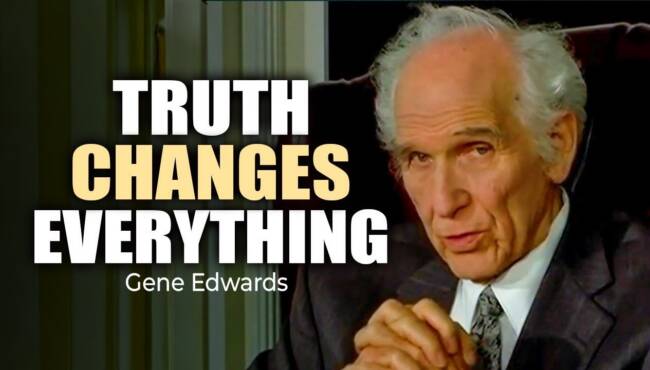
Truth Changes Everything • Jan 01, 2014


Free from the Law • Nov 11th 1987
Romans 7 contains one of the most important and misunderstood passages in the New Testament. In this message, Gene Edwards explores the believer’s relationship to the law, the struggle described by the Apostle Paul, and the freedom found in Jesus Christ.
Many Christians know the frustration Paul describes: “What I want to do, I do not do, and what I hate, I do.” Why do sincere believers struggle to live up to spiritual standards? Why does the Christian life often feel like an impossible burden? And how does Romans 8 answer the despair of Romans 7?
Through vivid illustrations and practical insight, Gene explains that the problem is not God’s law, nor is it the Christian standard itself. The problem is the weakness of human effort. Romans 7 reveals the futility of trying to please God through self-effort, while Romans 8 reveals the freedom of living by the life of Christ.
This teaching challenges legalism, religious performance, and the constant pressure many believers feel to become better Christians through willpower. Instead, it points to the believer’s union with Christ and the reality that the Christian life is ultimately lived by His life, not ours.
If you have ever struggled with guilt, condemnation, spiritual failure, or the feeling that you can never measure up, this message offers hope and freedom. Romans 7 exposes the problem; Romans 8 reveals the solution.
Key themes include:
This message is part of the Romans teaching series and provides a deeper understanding of grace, spiritual freedom, and the believer’s relationship with Jesus Christ.
We’re in Romans 7. Romans 7 is very dear to my heart because this is the chapter that, when I saw this, my life can be divided into two places. About 1963, everything that came before and everything that came after. And it’s Romans seven that stands as that spot in my life, so this is a – Every time I speak on this—and I know some of you in this room have heard me speak on this subject—but most of you have not, and this is really important to you. I made an incredible discovery in Romans 7. It was all mine. I’m gonna pass it on to you.
Romans 7 is every man’s testimony who has ever been a Christian, if he has ever followed the Lord. There is a dual message here: one is to the Jew, and the other is to the Christian. We’re gonna look at the Jewish message. And then we’re gonna do a radical shift, and we’re gonna take a look at the message to Christians that’s hidden in this chapter.
Now, to our visitors over here. I’m trying—I’m not trying—I’m doing this. I’m succeeding brilliantly. Ah, we’re casting the entire book of Romans into somewhat of a drama. What we started off with was a trial of the entire human race, divided as Jews and Gentiles. And the trial was Romans 1, 2, and 3. Abraham came and spoke to us and then gave an invitation to another way to be justified: justification by faith. And some responded. And we all went into an anti-room, those of us who got converted, because we really didn’t want to – what… Ah, you don’t remember? We did not want to come to the day of distress, and what? Wrath, and be faced there with a law we could not obey and with good deeds which we did not perform. So, we found the righteousness that is by a gift, not by works.
So, there were some questions asked in this little counseling room we’re in—maybe it’s a big one—and questions have been asked. Now a question has been asked about the law. It’s come up several times by some of the Jewish believers in the room. They’re having a real hard time juggling all of this. We have just found out in Romans six that a question was asked: Shall we sin more so that there might be more grace? Because we are received by the Lord on the basis of the fact that we were so utterly sinful, that He had no alternative but to take us, to accept us, to approve us on the basis of righteousness given to us because our state of sin was so great.
Well, if grace would be so abundant in such a high-water mark of sinfulness, why not more sin? Therefore, there’d be more grace. Paul answered that. But now he is going to continue, and he is going to talk about the law to the Jews here in this room. And he’s going to free these Jews from their law. Now, here’s what I simply want you to know: two or three things we start off with. Listen very carefully.
First, there’s nothing wrong with the law. The problem is not the law. The law failed not because there’s anything wrong with the law. The law failed because the guy who was reading it, the person who was seeking to obey the law, therein was the problem.
Here is the law. It is spiritual. It is wonderful. It is good. Wonderful thing. Ten commandments, all the other commandments—great, mighty things. But the one who walks up to it, reads it, and turns around and seeks to carry it out in his own life—he is the problem. Let me put it in one simple sentence: The law is of itself intrinsically good and intrinsically perfect. Maybe the word perfect is too strong, but yes, it’s perfect. You are intrinsically too weak to carry it out. It’s that simple.
Now here’s what the law did to you. The law exposed you to the knowledge of sin. You didn’t even know sin was sin. You didn’t even know it was bad. The law exposed you to the true knowledge of sin. Sin awoke when you discovered the law. Until then, sin was sleeping. You just plain flat weren’t bothered. You walk down the hall—there are fifty doors on the long corridor you’re walking down. You’re not paying any attention to the doors. You have no interest in any of them. You don’t care about any of those doors, until you come to a door that says: PRIVATE – DO NOT ENTER. You stop and look at that door. And something inside of you says, “Says You? What do you mean, I can’t go in there? Private? Do not enter?” You are totally uninterested in all the other doors. But when the law was put on you -“private, you may not enter” – that was the door you wanted to go through. Sin was not a monster until you tried to do the goodness of the law.
So, you were exposed to sin and its sinfulness by the law. Secondly, the law showed you to be utterly weak. In fulfilling the law, you learned you were incredibly weak. All right, that’s your second problem, it’s the enormous discovery of your weakness. The third thing was that this monster seized the wonderful, wonderful law to bring you to death and slavery.
Now the question is asked toward the end of the chapter. The question is asked in our little anti-room here: Does that make the law sinful? Does it make it bad? Does it make it wrong? No. There is nothing wrong with the law. The law did not cause you to sin. Sin took your knowledge of the law and worked in you lust and craving to go through the door that said, “Private. Do not enter.”
You were walking down the street—long, beautiful Broadway. Big beautiful store, full of furs and mannequins dressed in jewels and so on and so forth. You didn’t care about any of that. You weren’t wanting any of it, but as you walked down this long, long sidewalk by this lavish store with its beautiful windows, you cared nothing about anything, you lusted for nothing, you were not sinning, until one of the big windows had only this sign: “DON’T THROW A BRICK THROUGH THIS GLASS WINDOW.” And there, lo and behold, were a pile of bricks. And sin awakened through the law. There was nothing wrong with that sign. The law is not intrinsically evil. But you, weaker than sin and stirred by the law, sin used the law to attack your flesh. Not your soul, not your spirit, but came to where sin lives: in your body.
Truth Changes Everything • Jan 01, 2014

Free to Fellowship with Christ • Dec 07, 2013

Sow to the Spirit • Nov 23, 2013