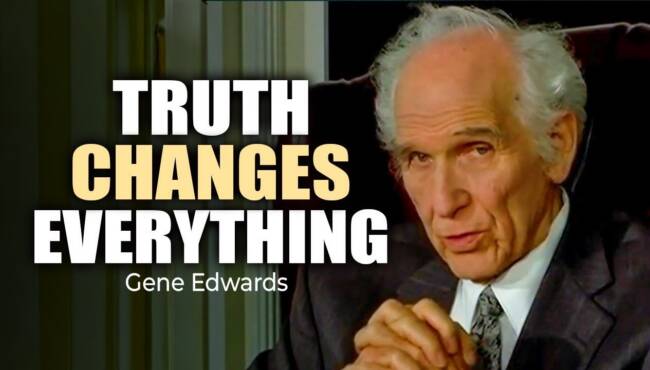
Truth Changes Everything • Jan 01, 2014


Runniing for Grace • Feb 09th 1996
This message explores one of the most liberating truths in the Christian life: the difference between living by the law and living by the Spirit. Drawing from Galatians 3, this teaching reveals how believers—and even entire churches—begin in the Spirit but can subtly drift back into legalism through human effort.
At the heart of this message is a powerful question: Did you receive the Spirit by works of the law, or by hearing with faith? The answer reshapes everything about how we understand our relationship with God. The Christian life does not begin with effort, rules, or religious performance—it begins with faith. And it continues the same way.
This teaching goes beyond the individual experience and brings a profound emphasis on the corporate nature of the church. The body of Christ is not merely a collection of individuals, but a living, spiritual organism that receives, walks in, and expresses the life of the Holy Spirit together.
A key insight in this message is the distinction between the indwelling of the Holy Spirit and the baptism of the Holy Spirit. While individuals experience the indwelling presence of God, the baptism of the Spirit is revealed as something belonging to the entire church—a shared, corporate reality rooted in Pentecost.
The message also challenges legalistic Christianity—the tendency to impose standards, expectations, or performance-based righteousness. Through real-life examples and biblical teaching, it exposes how easily believers can be brought back under the law, even after experiencing freedom in Christ.
Instead, the call is to live in what cannot be seen—to embrace the “invisible” realities of faith:
This teaching invites believers to step into a deeper freedom—one that removes fear, releases love, and restores the joy of knowing God without condemnation.
It also encourages practical expression within the church: speaking, sharing, and participating in the life of the body so that spiritual truth becomes lived experience rather than mere teaching.
If you’ve ever struggled with legalism, performance-based faith, or feeling like you must earn God’s approval, this message offers clarity, freedom, and a return to the simplicity of faith in Christ.
We don’t have anyone illiterate here, do we? Then we are miles ahead of the saints in the first century. They couldn’t read it. They had to memorize it and then speak it. They did a lot of memorizing in the first century… not just Christians… everybody had to memorize a lot because they couldn’t write or read. Now, if there is anyone who over functions after I’ve said all this, I want you to know that he will intimidate the “underfunctioners”. Someday I will return, and I will ask everybody in the church to write two names on the sheet of paper. Number one, who functions too much? And number two, who functions too little. And I will do this. That’s not a threat. That’s a prediction. I will come into the meeting and read those names publicly. So, start looking at that guy or that gal who talks too much, and we’ll be gentle with the one who doesn’t function, but we’ll be really ugly to the one who overfunctions. You’re stealing bread out of the mouth of another child of God.
Okay, that has nothing in the world to do with the message this morning, does it?
There is no way to go into a meeting and not function. Well, Gene, I wasn’t feeling good and had a headache. Saints, I have stood up to speak when, honestly, I would have traded having to get up to speak for a good horse-whipping. And yes, some of those are among the best messages I’ve ever brought in my life.
Well, my point was that you can always read something. You always have Scripture and a songbook with you. Do you bring your Bibles? Would you bring your Bibles? You might need it. There’s always a chance I might read something out of it. I think that’s good enough. You can always read something. That was my point. Okay, and I’m going to do that today. I’m going to read something. It’s going to be one of your last chances to ask questions. Do you want to get anything clarified here? Do you want to say anything? Talk about anything. You want to gripe? You want to praise the Lord?
You feel free to interrupt me. Any of you feel free to interrupt me. I know where my point is. Usually, I can come back to it. The New Testament literally gives not only license but encouragement for saints to interrupt one another. Do you know this? This is in the First Corinthians. And if one is speaking and another has a revelation, let the first be silent. Now that’s incredible, isn’t it? And yet that should happen in the church all the time. Oh my goodness, that just reminded me of…I just saw something. Then it’s time for that person or for me to shut up, because this is bigger than that. You just come right in there and talk to us. The only exception to that is if you start saying, “Oh, I just saw something wonderful…” Then I’m going to go ahead and talk, as soon as you get your emotions under control.
Another verse says, “the spirit is subject to the prophet.” So, if you’ve had a revelation, we’ll wait until you’re emotionally mature enough to share it with us without losing your equilibrium. And don’t feel bad about that, because it happens to me, too. I sometimes can’t say what I want to. You probably never noticed this, but I cry a lot.
We are going to get into chapter 3. Some of this is murky. It’s really murky. Paul repeats himself. He says things are vague. And there are only a few people in the world who can interpret him and make it understandable. And of course, I’m one of those people. But today, I’m going to just skip all sorts of passages. Here we’re in Galatians 3. I’m not going to try to unravel some of these things about flesh and his illustrations. I’m just going to look for things…two things. I’m going to look for plurality, and I’m going to look for things that are invisible. Although we might talk a little bit about turning negatives into positives, so that we can find, because Jesus Christ is so positive about us, and you have to remember this is a crisis letter. But then all the letters to the churches were crisis letters, and there is no exception to that, by the way. Every one of those churches had a crisis. Thank God it provoked a letter. Otherwise, we’d know very, very little about our faith.
I hope you all someday get used to the fact that I have to do this, and it won’t even seem weird in 10 or 15 years. What verse did I leave off? Five? It’s really amazing how this goes from day to day. I can’t see squat now. Does he then, who provides you with the spirit and works miracles among you, do this by the works of the law or by the hearing of faith? And we have covered that verse. So we will go to number six.
Abraham believed, and God said, “Abraham, you’re righteous.” God looked at Abraham and saw him right. Now, brothers, sisters, this is an invisible passage…that a man would believe and God would say, “All the wrong things are gone, and everything you’ve ever done is right and pleasing in my sight. You are just. You’re acceptable in my sight. You’re just, and the edges of the margin are even on both sides. And all of that out of believing.” Brothers and sisters, that passage right there, that simple verse so easy to read past, is really the whole Christian life.
It is one thing for me to believe. It is another thing that this amazing miracle takes place: that God says, “You believe now? You’re right with me.” And boy, the third step is the hardest of all, and that’s to accept that it’s true. Do you follow me? Are you and I…do we not live in hangovers? I got a Christian hangover; I feel really guilty today. Well, you see, the brothers and sisters in St. Cloud, Florida, are going to resolve this issue. They are going to be and live in step three. They are going to see that which cannot be seen. They’re going to see themselves as God sees them. They’re going into the invisibles and see justification and righteousness, but not anything physical. Remember that the physical things are made out of the spiritual things, and the invisible things can be laid hold of and made visible by faith. And this is one of them: that you are righteous by no more than having “faithed” Jesus Christ, and then hanging on to that and ignoring the visible, and standing in the invisible. Are you with me?
It is those who are of faith who are sons of Abraham. He welcomed us. He was one of those who welcomed us. Now, if he can do that and be an Old Testament believer, can I not turn around to him and say, “Hello, Dad.” Can I not bring him into the present? Or can I go to him in the past? Or can we not meet somewhere where there’s neither? And say to him, “Abraham, I’m one of your sons. I have come out of, and am a result of, being what you are—one who got right with God by ‘faithing’ Jesus Christ. And we are kinfolks. We are the same house, the same lineage. You walked in the right standing of God…and so do I. Thank you for welcoming me. I want you to know that as I come into your house, I don’t come as a prodigal. I stand as you do – right with God by having ‘faithed’ Christ.
Okay, you’re a son of Abraham. You ought to be able to do something with this. Maybe have a play. Decide whether you’re going to personally…I’m not talking to the church now…decide whether or not you’re going to invite him here, or you’re going to go to him there, or that you’re going to get in the great cloud of witnesses and sit down and talk together. He’s not that far away. “Hi, Dad. Thanks for showing me how to be right with God by nothing more than just ‘faithing’ Jesus Christ, believing in my Lord.” Therefore, be sure that it is those who are of faith who are sons of Abraham, as the Scripture says…please do something with that verse. That’s not a verse. That’s a sentence…and the Scripture foreseeing.
Truth Changes Everything • Jan 01, 2014

Free to Fellowship with Christ • Dec 07, 2013

Sow to the Spirit • Nov 23, 2013