When the World Calls You Evil for Loving Christ • Nov 22, 2025

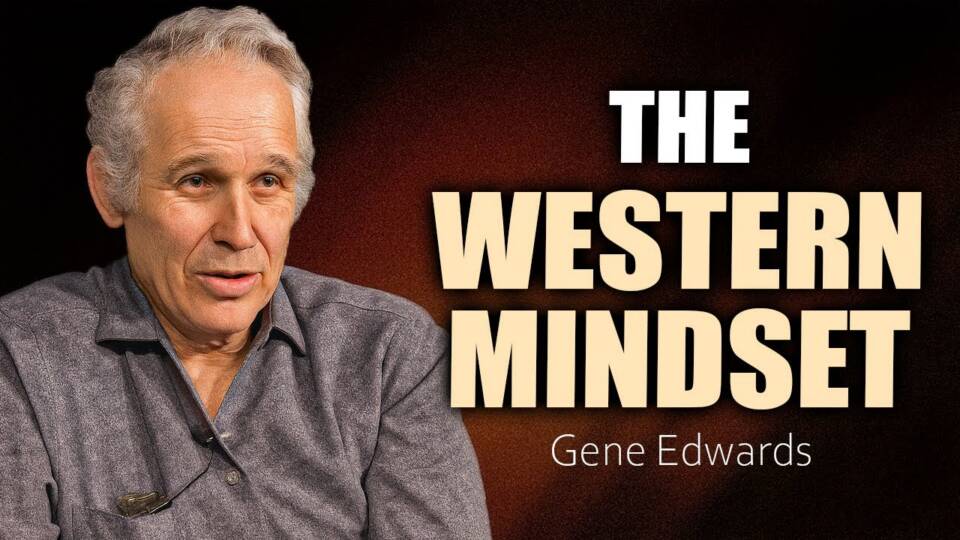
The Western Mindset • Jul 18th 1999
This message explores a rarely discussed question: how did the Christian faith become what it is today—and what role did Western thinking play in shaping it?
In this teaching, Gene Edwards traces the roots of modern Christianity back to ancient Greece, examining how philosophical systems—especially those influenced by Aristotle—reshaped the way believers understand Scripture, theology, and even church life.
Rather than approaching faith as a living relationship with Christ, the Western mindset tends to analyze, define, and systematize everything. Over time, this way of thinking introduced structured sermons, theological frameworks, and intellectualized interpretations that may have unintentionally distanced believers from the simplicity of knowing the Lord.
This video challenges long-held assumptions about:
It also raises an important question: what happens when faith becomes something to study instead of Someone to know?
By walking through key moments in church history—from early philosophers to the development of institutional practices—this message invites viewers to reconsider what authentic Christianity looks like. It is not merely a critique, but a call to rediscover the deeper, experiential reality of Christ.
If you’ve ever felt that something is missing in modern church life… or wondered why faith can feel more analytical than relational… this message speaks directly to that tension.
Thank you, brother. We’ve got Aristotle. We’ve got the son of Aristotle, Augustine, and the grandson of Aristotle, Thomas Aquinas. You don’t know who he is. I’m sure I don’t have time to talk to you about Thomas Aquinas, but he’s the guy who baptized Aristotle and made him a Christian. He is the father—I’m sorry—he is the official designated theologian of the Catholic Church. Luther was an Augustinian monk who studied Thomas Aquinas, Augustine, and Aristotle. He comes forth, and he makes a statement—oh gosh, I have to go back.
There were three kinds of Roman Catholics. The poor peasant down at the bottom who just did what he was supposed to do. He was about half pagan in his thinking. Then there were the strict thinkers, the theologians, and there’s a little footnote of Catholics who are called mystics. They had a teaching—I wish I had time to go through that. That teaching was: to know the Lord, you had to contemplate and meditate. Meditate and contemplate. Now, that came out of heathenism. That came straight out of Plato, that there were seven ascents to union with God. That’s where you get St. Therese, John of the Cross, and two Catherines. I’m trying to think—somebody else? Who? Thomas Merton. Michael Molinos almost fit into that category. The person who broke away from those seven ascents was Jeanne Guyon. They threw her in the Bastille. She said there’s a simple way to know the Lord. That was the name of her old book, A Short and Simple Way of Knowing the Lord, and she skipped the seven ascents.
Now, Catholic doctrine holds that to really touch the Lord takes an entire lifetime. It takes great suffering, and only a few people ever attain it. Now, that’s doctrine. That’s written in stone. And it was platonic in everything about its teaching, yet it is in this room right now. Luther came along and said in Protestantism and Lutheranism, there will be no mystics. He took the statement of Thomas Aquinas and said, “The residence of divinity”. He should have said “the residence of the spirit”. Aristotle said man is body and soul. So, all the Roman Catholics and the Protestants were mixed up on the soul. They never understood us to be three parts: body, soul, spirit, or spirit, soul, and body, or that all of those were one. He said that the spiritual, the place, the residence of things spiritual, are in the intellect, and that the Lord is apprehended by intellectualism. Straight out of Aquinas. Straight out of Augustine. Straight out of Aristotle. There will be no mysticism. He shot dead a deeper walk with the Lord Jesus Christ before Protestantism even got off the runway. It will be intellectualism.
Now, I went to what is considered to be the best Protestant seminary in the world. It always wins that award. Fuller, Trinity, and Grace; they were also rans. I went to a seminary that has the largest theological library in the world. It’s the biggest seminary in history, and you can include the Jews and the Shinto or anybody else. It’s number one in everything. And in our orientation at Southwestern Seminary, they said, quote: “You are here so that you can give an intellectual, rational reason for your faith.” And everything we were taught was taught from that view. Everybody who’s ever come out of Southwestern Seminary, which is the most evangelistic seminary in the world and has produced more missionaries than probably all the rest of the Baptist denomination put together, and the most evangelists—of whom I was one—they churn out 2,000 ministers a year, maybe 3,000 by now, and every one of us come out of there as intellects. There was never a day when we were given anything of the deeper Christian life. Not one day, and there’s not another seminary on earth that does either. They are all built on an intellectual comprehension of the Bible.
Okay, now that’s Protestantism. Now let’s talk about evangelicals. That’s us. This is not a pretty story. Now then, you’re going to see me get angry. You have no idea who is called the father of the evangelical mind, do you? Have you ever heard of that term? The father of the evangelical mind. Oh, much earlier than that. No, evangelical, not Protestant. He’s the grandson. George Whitefield. Okay. Now that’s his term. That’s what they grace him with. The father of the evangelical mind. Evangelicalism. These are people who believe you must be an adult to be saved, that you have to be born again, but this is not a Calvin or Lutheran teaching. I want to introduce you to George Whitfield. George, forgive me, and while I’m at it, what’s his name? Forgive me, too. No, not Wesley. I’m thinking about someone. George Mueller, one of the heroes of evangelical Christians. George, forgive me for what I’m about to do to you.
George Whitfield is a perfect expression of the evangelical. George was interested in the church, and George needed money…and George, in order to get money, started orphanages. He would have all these thousands of people giving money to an orphanage, and he’s established an orphanage. I have nothing against it. It’s wonderful. It was a tearjerker, but he skimmed some of that money off so he could travel, preach, and get people saved. No one has done that since then. (laughter) Come to Pentecostalism. I’m jumping ahead. Come to Pentecostal Deliverance Ministries. How often a Pentecostal will start some organization so that he can raise money, skim some of it off, so he can go preach the gospel. Okay.
John Wesley comes along, and he preaches, but he establishes what do they call those things? Something societies. Anybody remember? Societies. Societies that later grew up to be Methodist churches, and they called them Methodists because there was a method. They all used the same syllabus all over. He’s the father of the home Bible class, and all of that stuff. That’s fine. He preached; he established societies which became churches. Now, I don’t have anything critical to say about John Wesley, but you should know something. When he died, he was one of the ten wealthiest men in the English-speaking world. You didn’t know that. He raised an enormous amount of money for the different projects that the Methodists got into. That’s fine. I hold nothing against this man.
Let’s come back to the evangelical mind. Now, he gave us “born again.” He gave us salvation. He and George Whitfield. Those two brothers, we owe that to them, that you had to be an adult, not a baby, to be sprinkled. Then came Finney, who was an evangelist. I want to try to explain something to all of you and shock you to death. There has grown up a mind, and part of it’s underground. That mind says, the church of Jesus Christ is dead and hopeless, but it’s got money…and we’ve got to get the money. We can’t fight the church because it’ll sink us. So, we’re going to be sweet to it and give it lip service. We’re going to take its money, and we’re going to evangelize the world. This is the part that’s above ground.
Can you turn that off? You can’t? No, I got a better idea. You see. I want the tape off. I used to be an evangelist, and I knew. So, you’re not supposed to know this, but right now you’re giving to one of those interdenominational organizations. Okay. Enter Dwight L. Moody. He took one look at the church and said, Good night. No. But Dwight L… Yes, sir. Well, he’s (Charles Finney) sort of the guy who didn’t believe in the church either and went around preaching everywhere and kind of gave us the first really…okay, George Whitfield and Charles Finney saw the church as hopeless but used it as an instrument of raising money to get things done to save the world. Now, out of this, a mentality began to develop. Saints, I’m telling you all this to get to this point. There grew up an interpretation of the New Testament, and here again, Aristotle is gathering our verses.
(Continued in Part 2)
When the World Calls You Evil for Loving Christ • Nov 22, 2025
This Is How You Must Honor The Son • Nov 22, 2025
Truth Changes Everything • Jan 01, 2014